Practice
From Understanding to Action
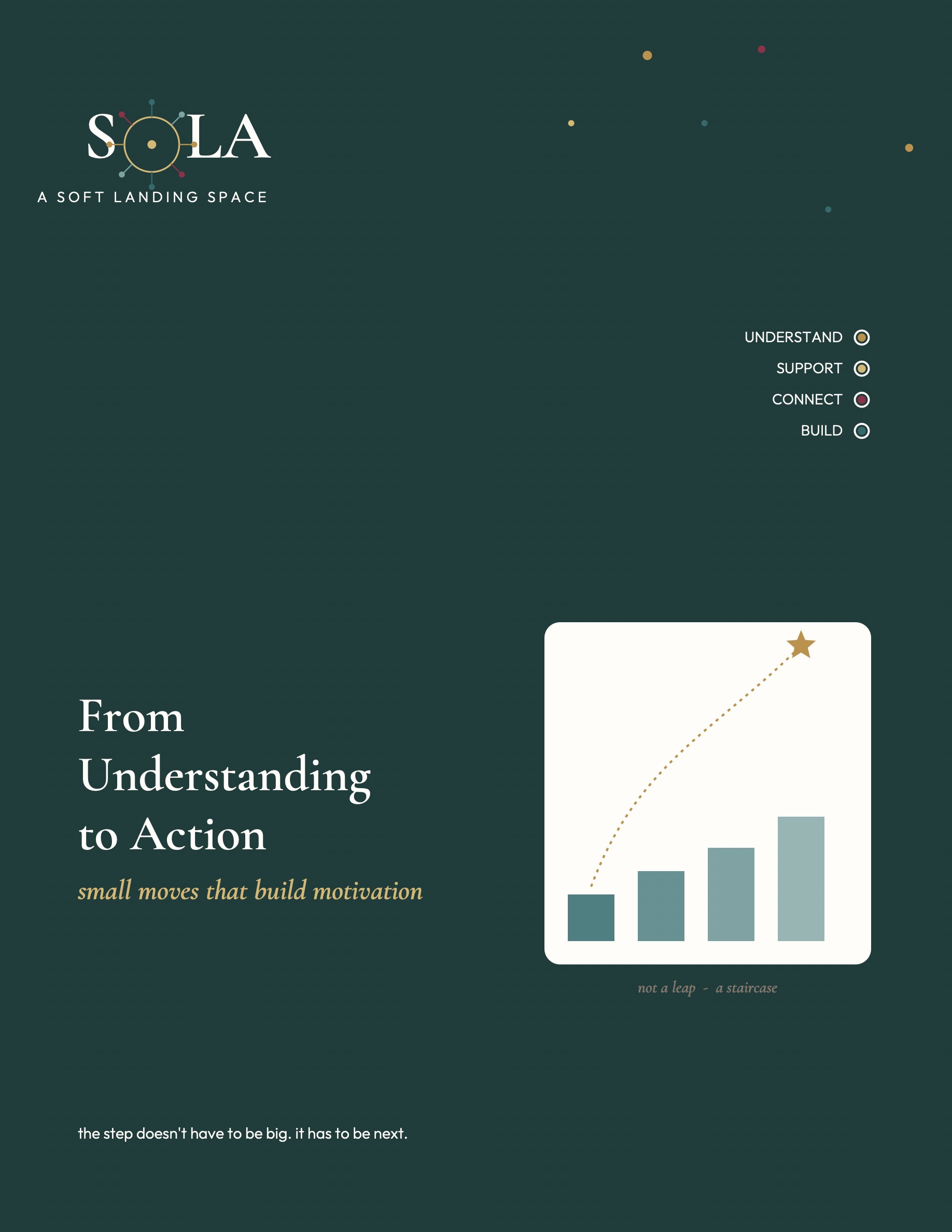
small moves that build motivation — the step doesn't have to be big. it has to be next.
Most of us are waiting for a feeling before we start: a rush of motivation, a moment of clarity, the sense that we're finally 'ready.' So we wait. And the waiting itself starts to feel like progress, when really it's just delay with a better outfit on.
Behavioral activation flips the order. It says: act first, in a small enough way that it doesn't require motivation to attempt. The feeling of wanting to continue usually shows up after the first small action, not before it.
The workbook, as designed. The same content is written out below.
See the other 11 pages
Motivation follows action, not the other way around.
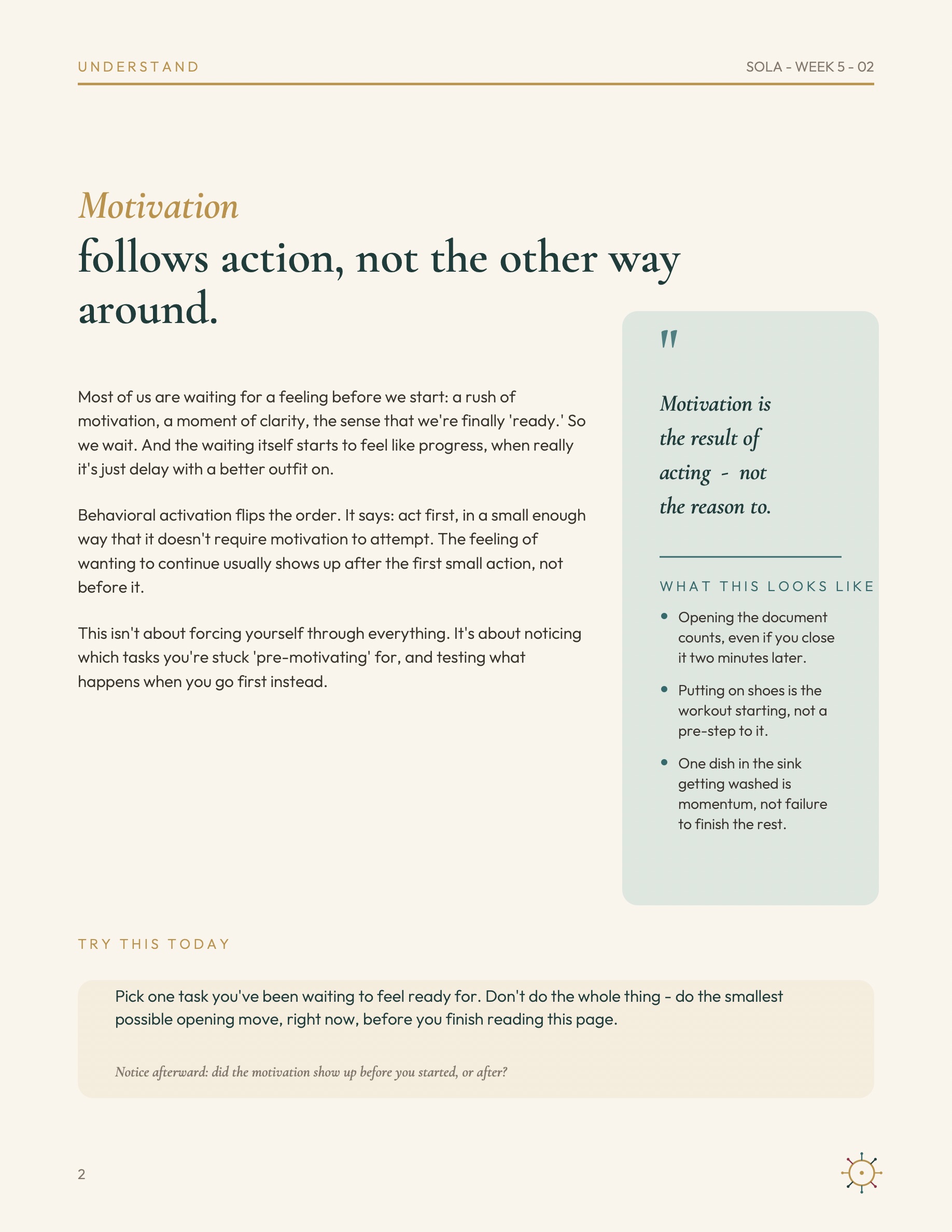
Most of us are waiting for a feeling before we start: a rush of motivation, a moment of clarity, the sense that we're finally 'ready.' So we wait. And the waiting itself starts to feel like progress, when really it's just delay with a better outfit on.
Behavioral activation flips the order. It says: act first, in a small enough way that it doesn't require motivation to attempt. The feeling of wanting to continue usually shows up after the first small action, not before it.
This isn't about forcing yourself through everything. It's about noticing which tasks you're stuck 'pre-motivating' for, and testing what happens when you go first instead.
"Motivation is the result of acting - not the reason to."
What this looks like
- Opening the document counts, even if you close it two minutes later.
- Putting on shoes is the workout starting, not a pre-step to it.
- One dish in the sink getting washed is momentum, not failure to finish the rest.
Try this today
Pick one task you've been waiting to feel ready for. Don't do the whole thing - do the smallest possible opening move, right now, before you finish reading this page.
Notice afterward: did the motivation show up before you started, or after?
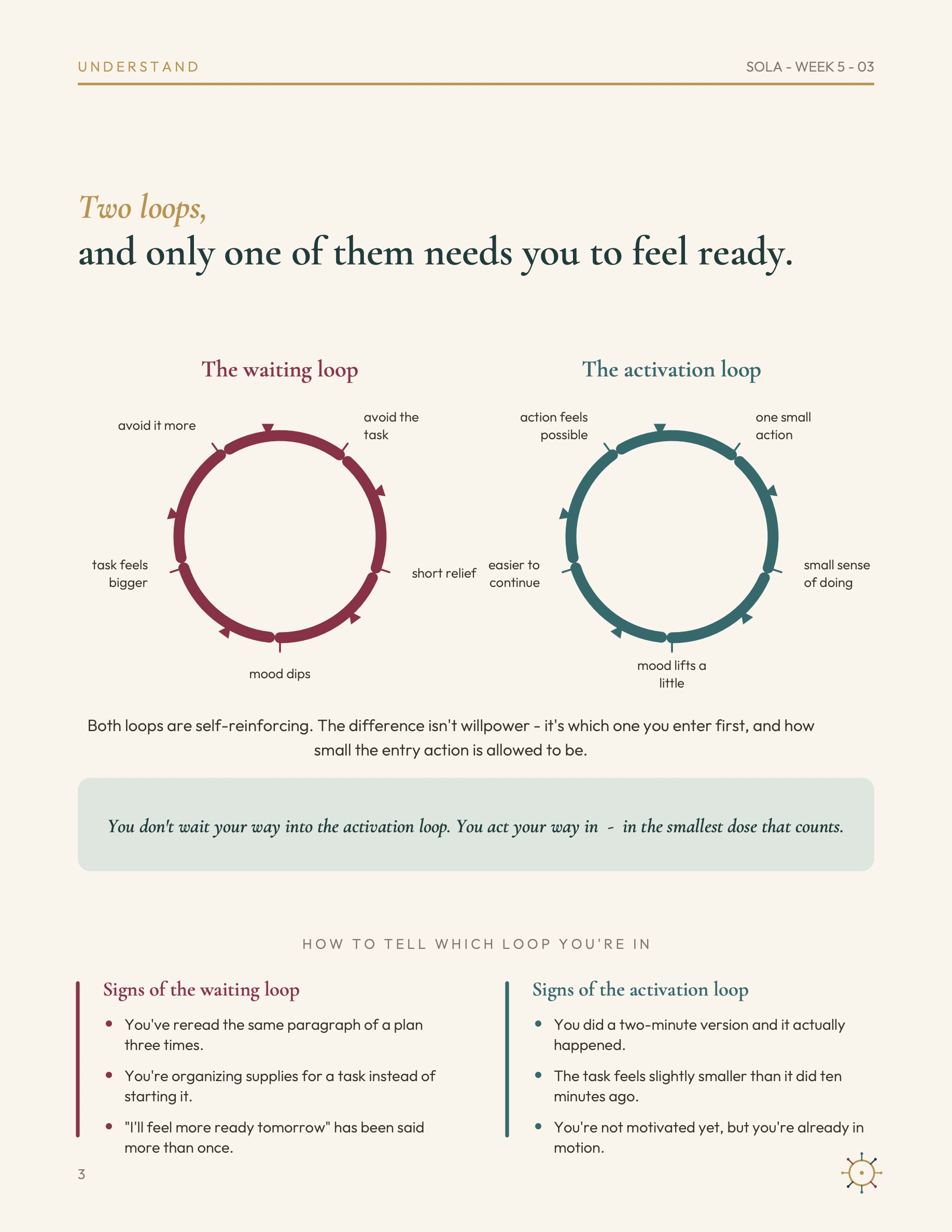
Two loops, and only one of them needs you to feel ready.
The waiting loop (a circle): avoid the task → short relief → mood dips → task feels bigger → avoid it more → …
The activation loop (a circle): one small action → small sense of doing → mood lifts a little → easier to continue → action feels possible → …
Both loops are self-reinforcing. The difference isn't willpower - it's which one you enter first, and how small the entry action is allowed to be.
You don't wait your way into the activation loop. You act your way in - in the smallest dose that counts.
How to tell which loop you're in
Signs of the waiting loop
- You've reread the same paragraph of a plan three times.
- You're organizing supplies for a task instead of starting it.
- "I'll feel more ready tomorrow" has been said more than once.
Signs of the activation loop
- You did a two-minute version and it actually happened.
- The task feels slightly smaller than it did ten minutes ago.
- You're not motivated yet, but you're already in motion.
What makes a first step easy to take.
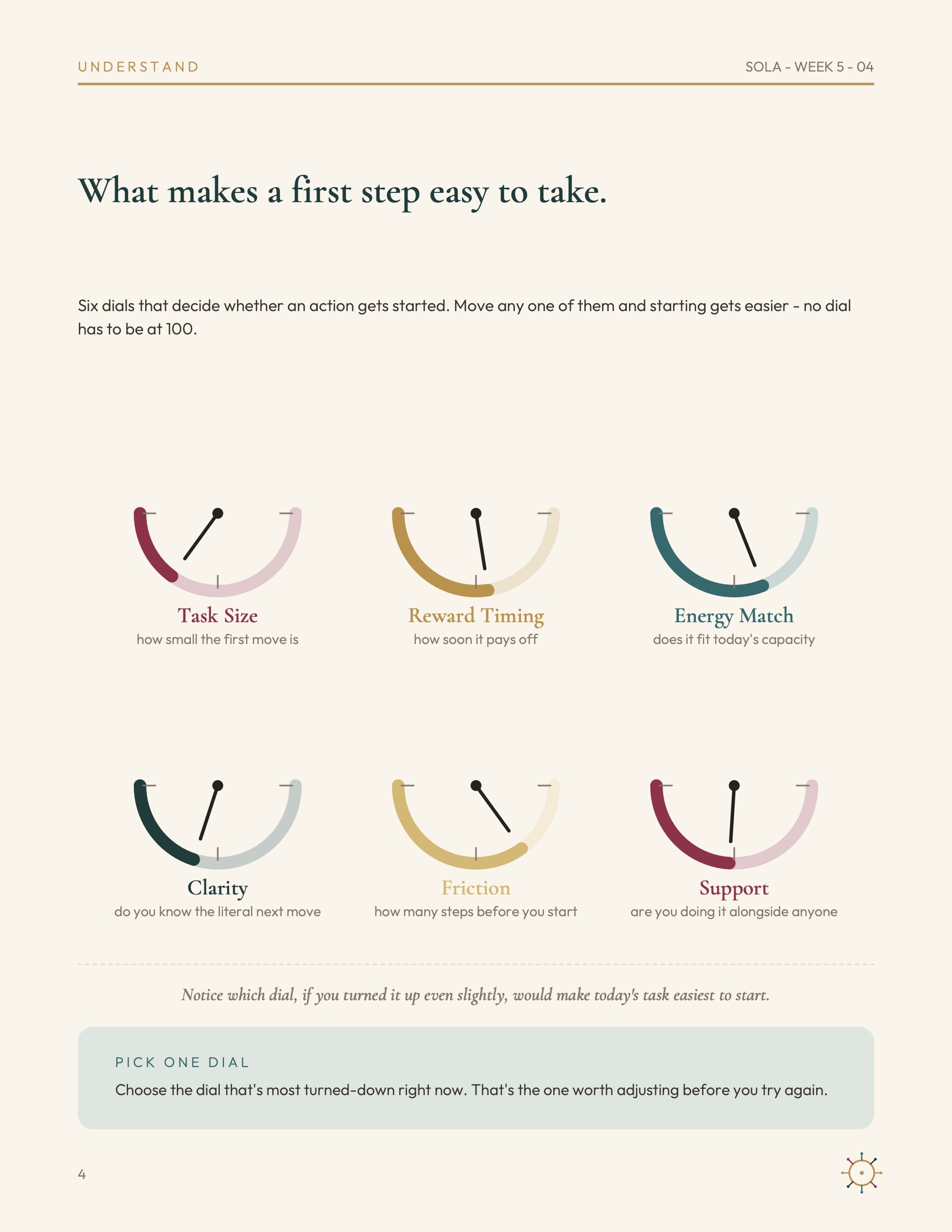
Six dials that decide whether an action gets started. Move any one of them and starting gets easier - no dial has to be at 100.
Six dials:
- Task Size — how small the first move is
- Reward Timing — how soon it pays off
- Energy Match — does it fit today's capacity
- Clarity — do you know the literal next move
- Friction — how many steps before you start
- Support — are you doing it alongside anyone
Notice which dial, if you turned it up even slightly, would make today's task easiest to start.
Pick one dial Pick one
Choose the dial that's most turned-down right now. That's the one worth adjusting before you try again.- Task Size
- Reward Timing
- Energy Match
- Clarity
- Friction
- Support
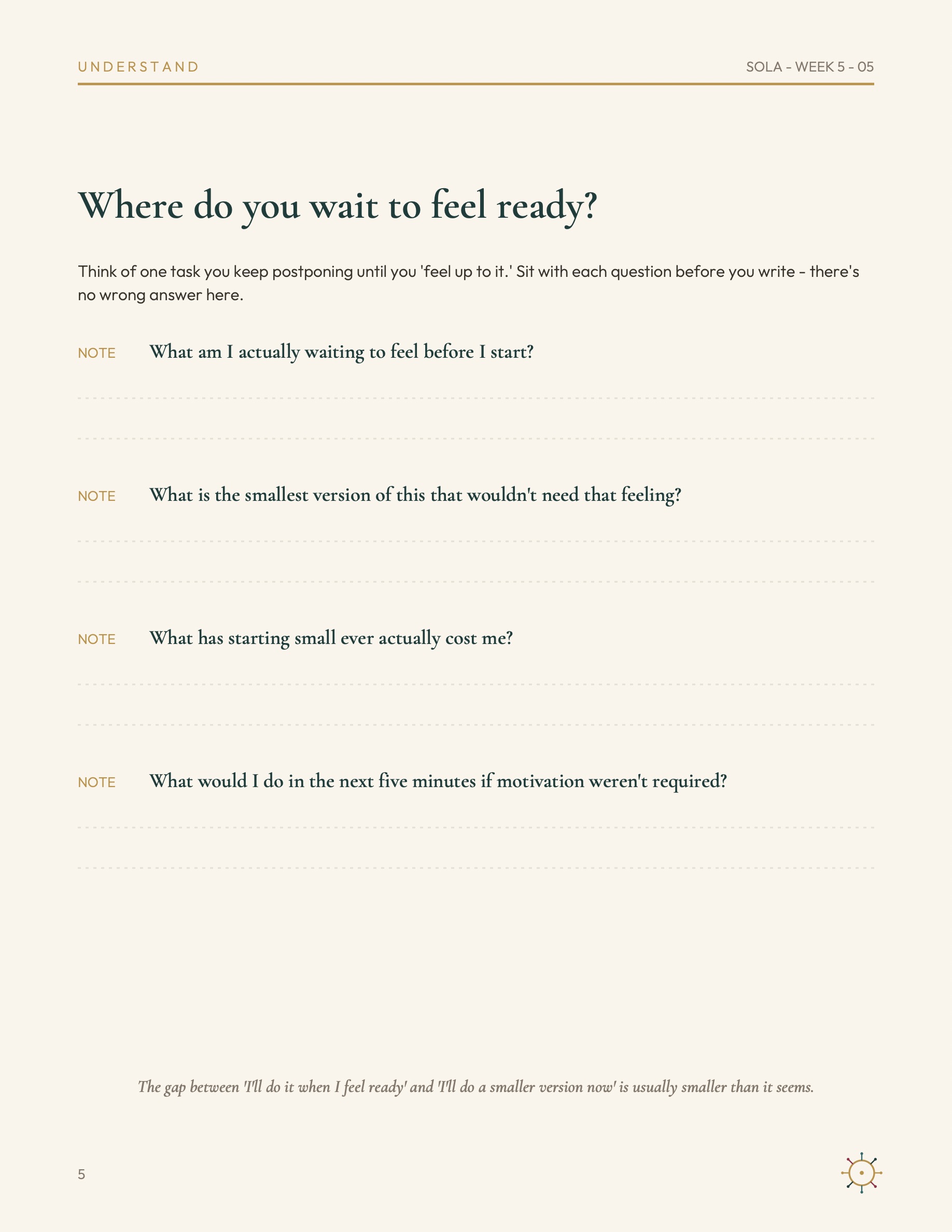
Where do you wait to feel ready?
Think of one task you keep postponing until you 'feel up to it.' Sit with each question before you write - there's no wrong answer here.
The gap between 'I'll do it when I feel ready' and 'I'll do a smaller version now' is usually smaller than it seems.
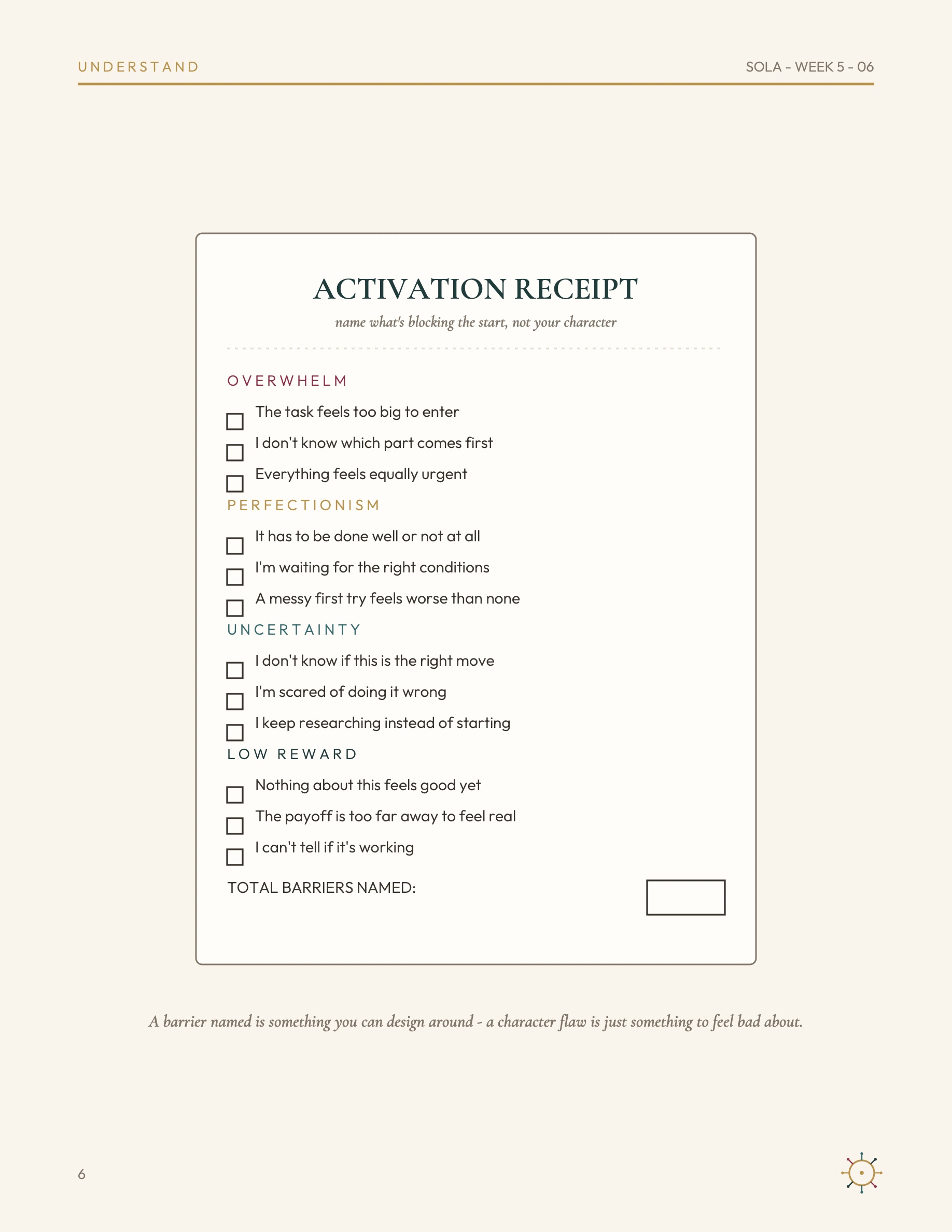
Activation Receipt
name what's blocking the start, not your character
Overwhelm Tick all that apply
- The task feels too big to enter
- I don't know which part comes first
- Everything feels equally urgent
Perfectionism Tick all that apply
- It has to be done well or not at all
- I'm waiting for the right conditions
- A messy first try feels worse than none
Uncertainty Tick all that apply
- I don't know if this is the right move
- I'm scared of doing it wrong
- I keep researching instead of starting
Low reward Tick all that apply
- Nothing about this feels good yet
- The payoff is too far away to feel real
- I can't tell if it's working
A barrier named is something you can design around - a character flaw is just something to feel bad about.
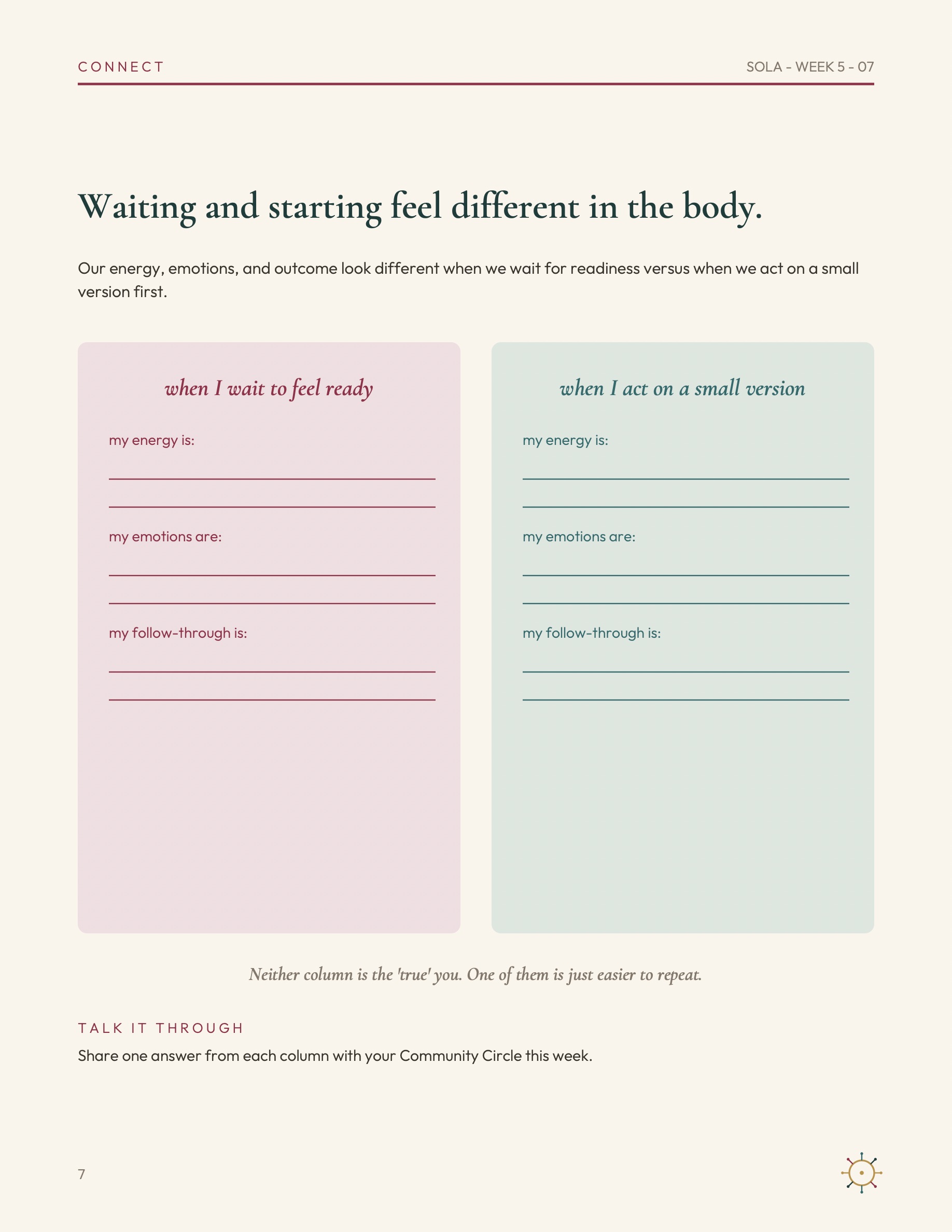
Waiting and starting feel different in the body.
Our energy, emotions, and outcome look different when we wait for readiness versus when we act on a small version first.
| when I wait to feel ready | when I act on a small version | |
|---|---|---|
| my energy is: | ||
| my emotions are: | ||
| my follow-through is: |
Neither column is the 'true' you. One of them is just easier to repeat.
Talk it through
Share one answer from each column with your Community Circle this week.
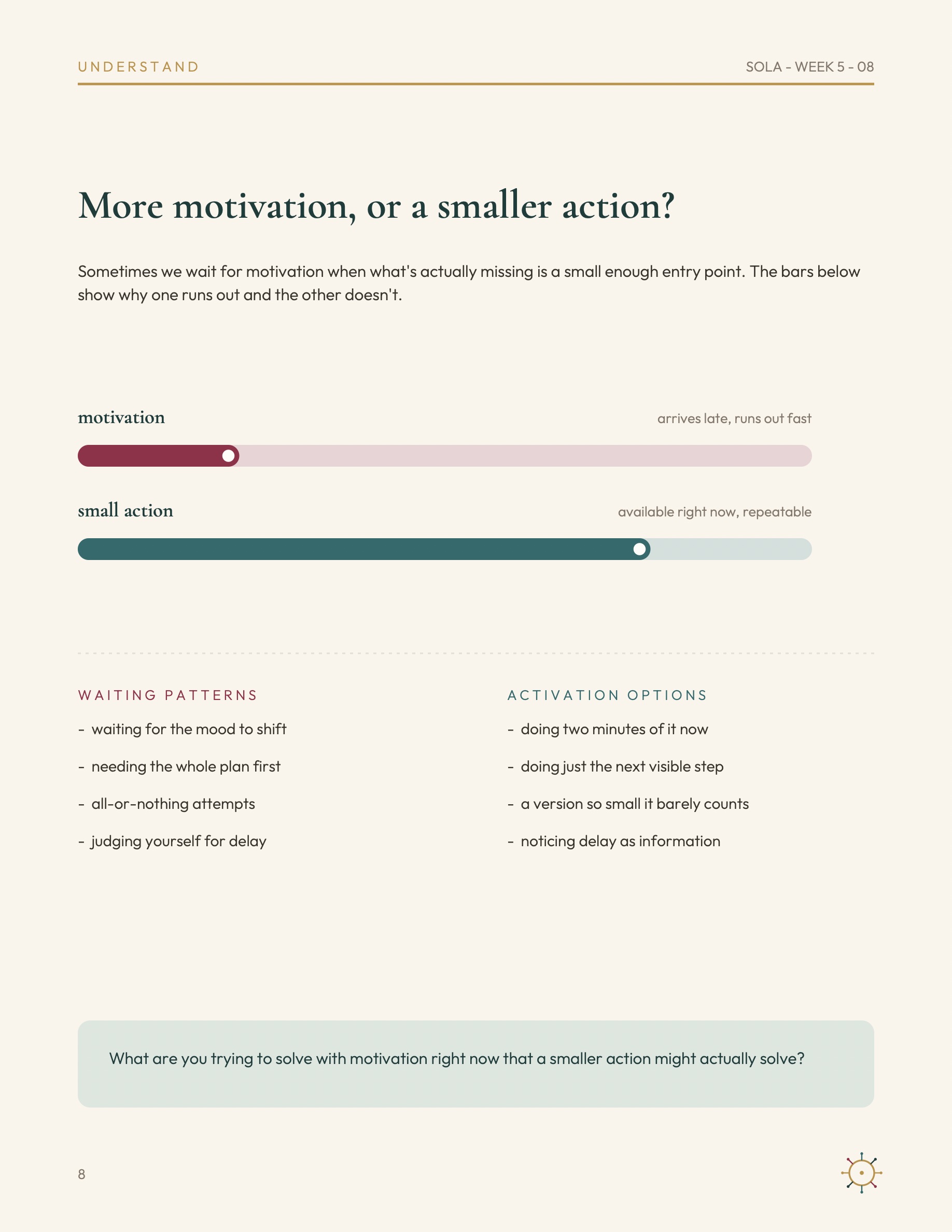
More motivation, or a smaller action?
Sometimes we wait for motivation when what's actually missing is a small enough entry point. The bars below show why one runs out and the other doesn't.
Two bars: motivation — arrives late, runs out fast (bar low). small action — available right now, repeatable (bar high).
Waiting patterns
- waiting for the mood to shift
- needing the whole plan first
- all-or-nothing attempts
- judging yourself for delay
Activation options
- doing two minutes of it now
- doing just the next visible step
- a version so small it barely counts
- noticing delay as information
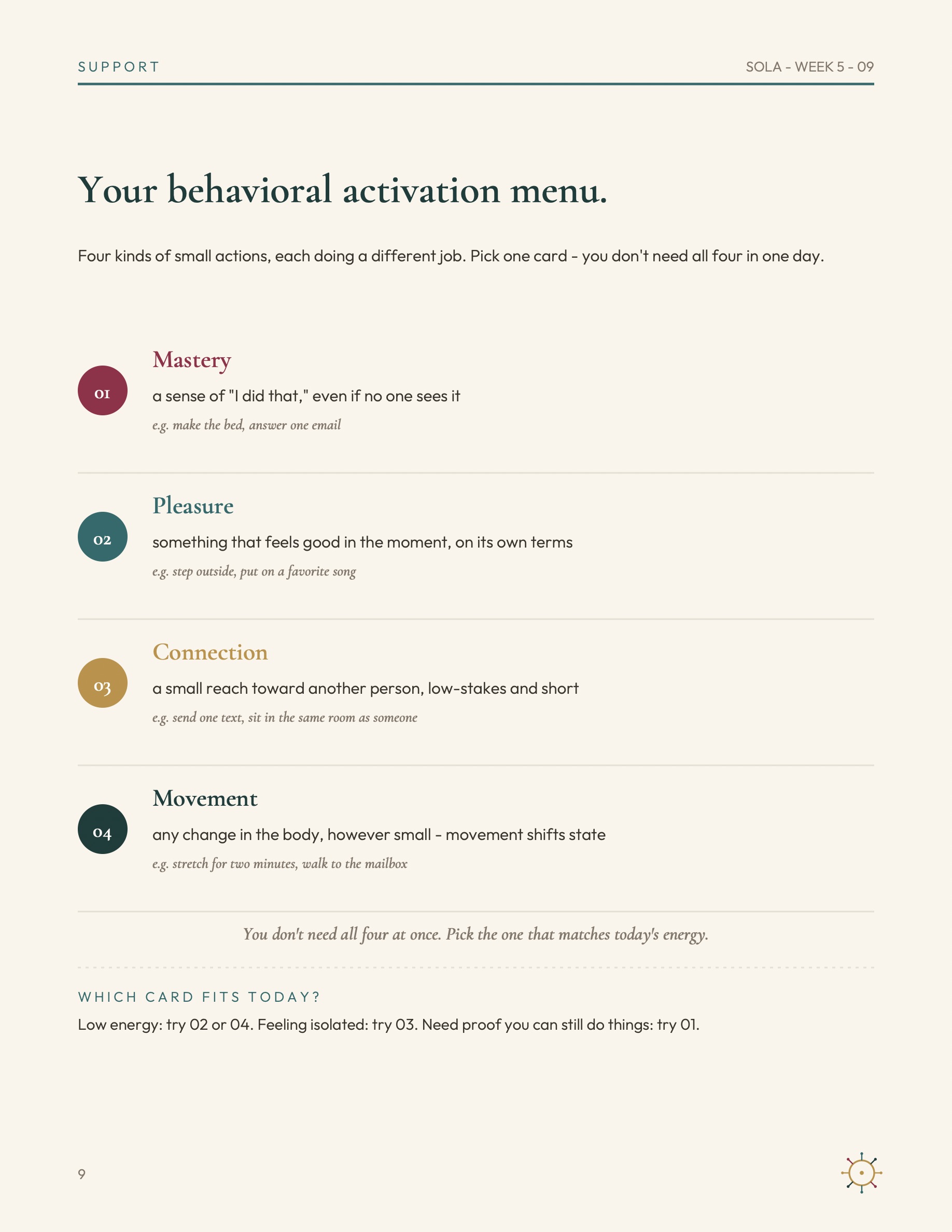
Your behavioral activation menu.
Four kinds of small actions, each doing a different job. Pick one card - you don't need all four in one day.
01 · Mastery
a sense of "I did that," even if no one sees it
e.g. make the bed, answer one email
02 · Pleasure
something that feels good in the moment, on its own terms
e.g. step outside, put on a favorite song
03 · Connection
a small reach toward another person, low-stakes and short
e.g. send one text, sit in the same room as someone
04 · Movement
any change in the body, however small - movement shifts state
e.g. stretch for two minutes, walk to the mailbox
You don't need all four at once. Pick the one that matches today's energy.
Which card fits today?
Low energy: try 02 or 04. Feeling isolated: try 03. Need proof you can still do things: try 01.
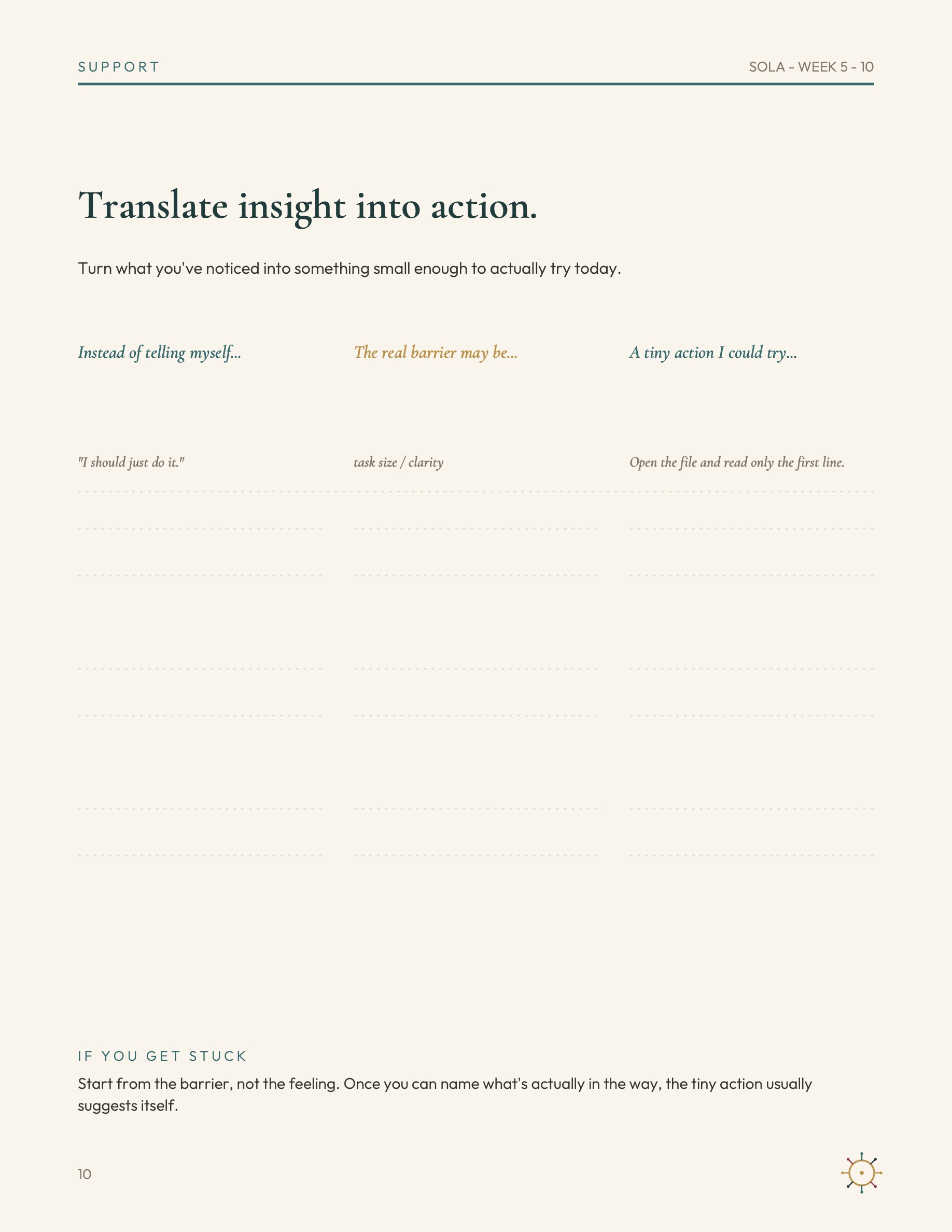
Translate insight into action.
Turn what you've noticed into something small enough to actually try today.
Example row: Instead of telling myself... "I should just do it." · The real barrier may be... task size / clarity · A tiny action I could try... Open the file and read only the first line.
| Instead of telling myself... | The real barrier may be... | A tiny action I could try... |
|---|---|---|
If you get stuck
Start from the barrier, not the feeling. Once you can name what's actually in the way, the tiny action usually suggests itself.
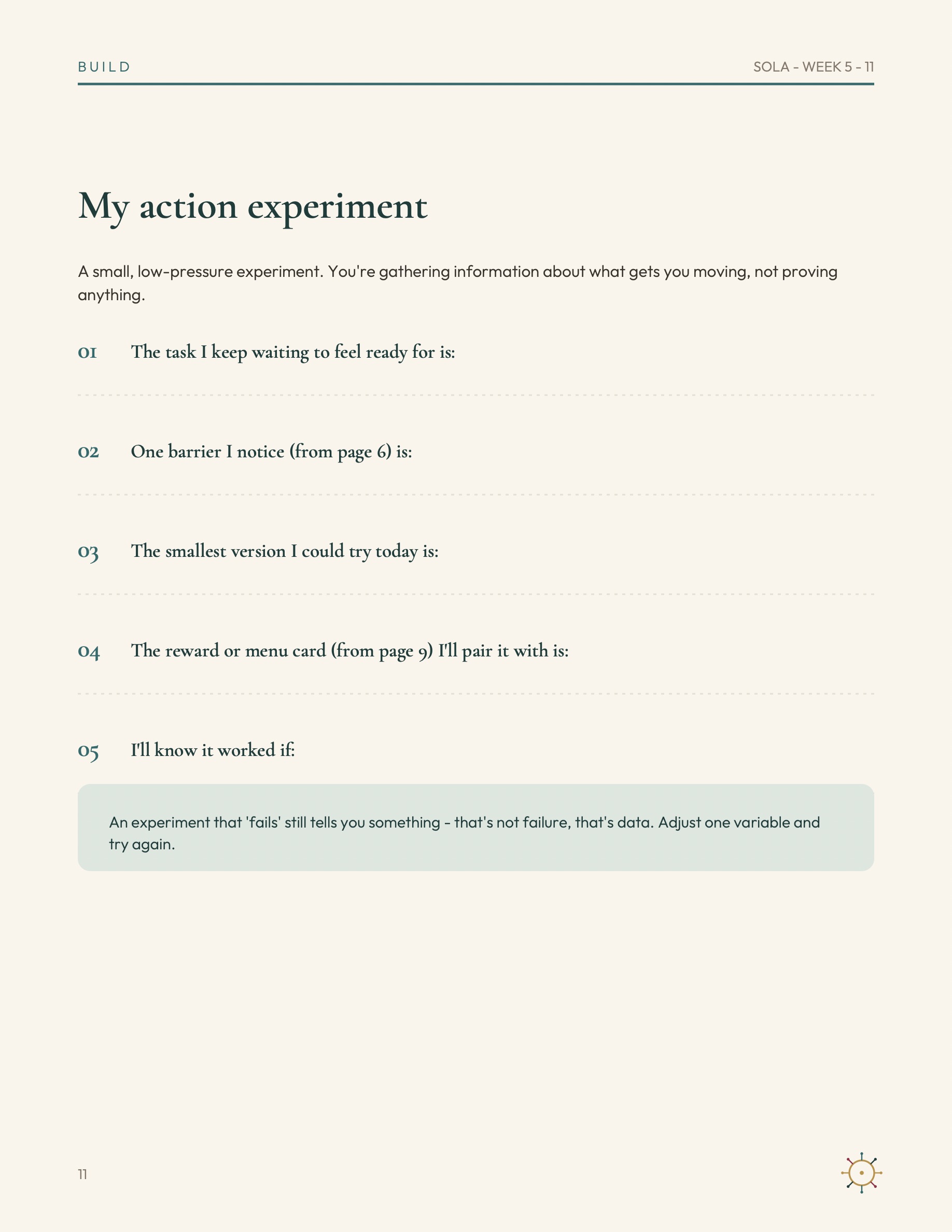
My action experiment
A small, low-pressure experiment. You're gathering information about what gets you moving, not proving anything.
An experiment that 'fails' still tells you something - that's not failure, that's data. Adjust one variable and try again.
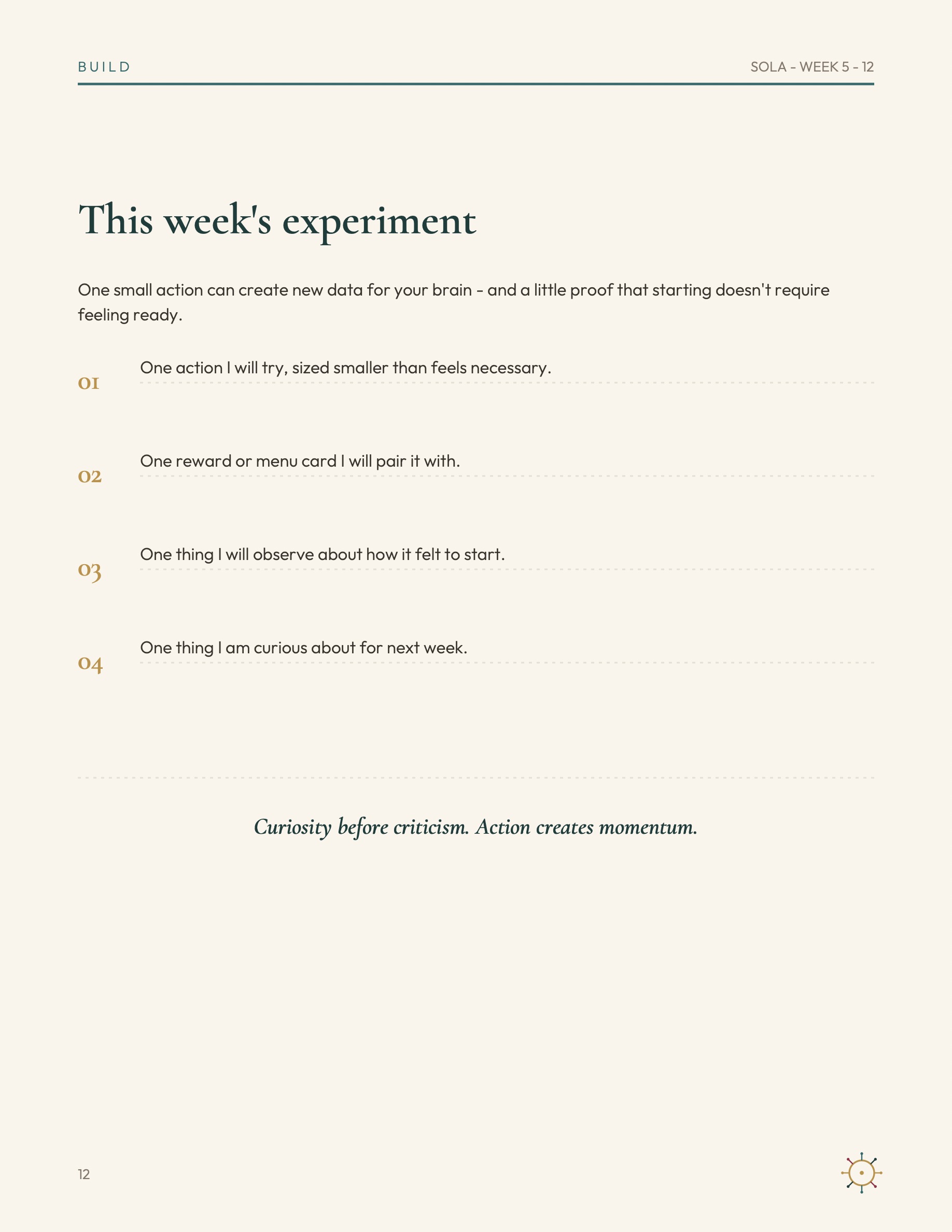
This week's experiment
One small action can create new data for your brain - and a little proof that starting doesn't require feeling ready.
Curiosity before criticism. Action creates momentum.