Learn
No is a complete sentence.
Boundaries, ND-Style
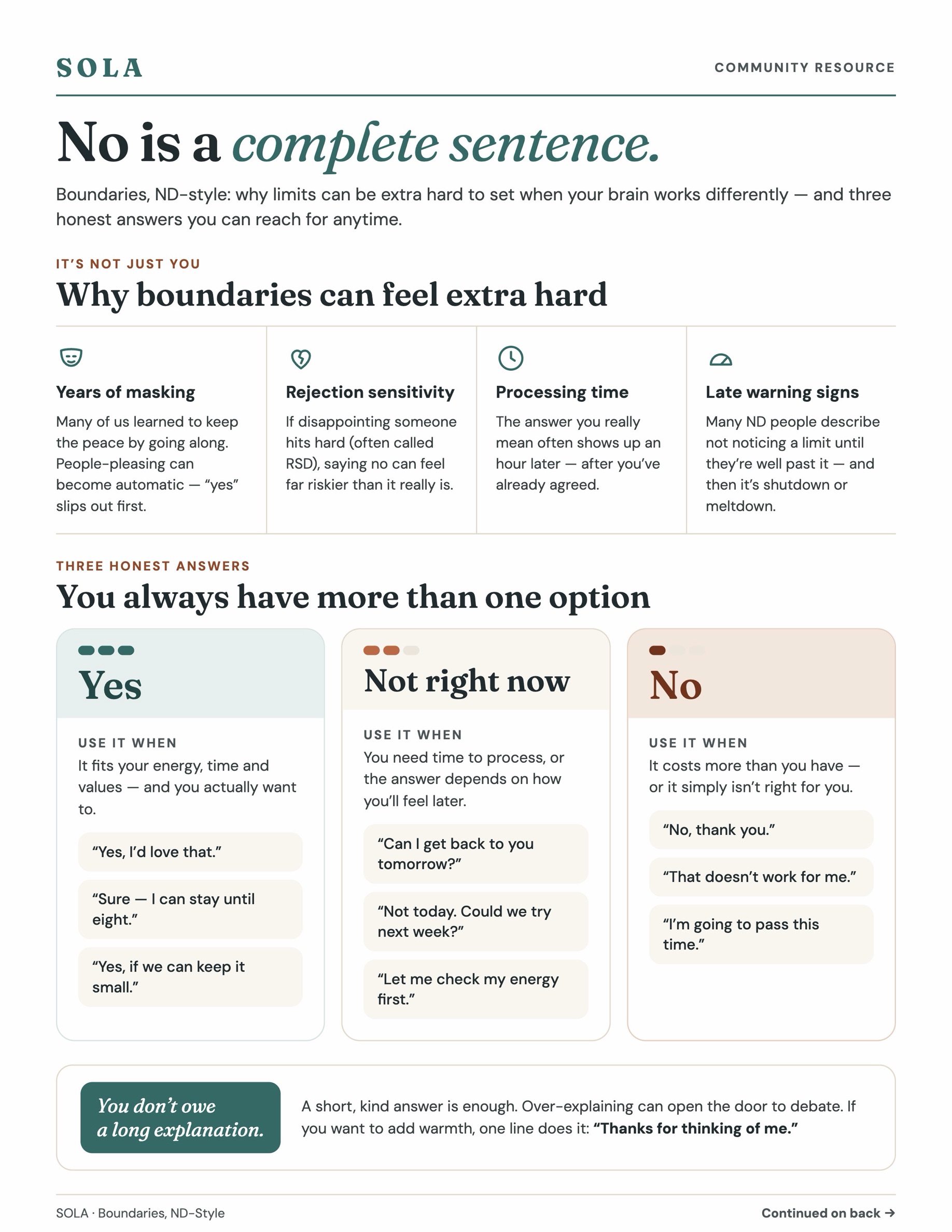
Boundaries, ND-style: why limits can be extra hard to set when your brain works differently — and three honest answers you can reach for anytime.
The guide, as designed. The same content is written out below.
See page 2
Why boundaries can feel extra hard
It’s not just you
Many of us learned to keep the peace by going along. People-pleasing can become automatic — “yes” slips out first.
If disappointing someone hits hard (often called RSD), saying no can feel far riskier than it really is.
The answer you really mean often shows up an hour later — after you’ve already agreed.
Many ND people describe not noticing a limit until they’re well past it — and then it’s shutdown or meltdown.
You always have more than one option
Three honest answers
Use it when It fits your energy, time and values — and you actually want to.
- “Yes, I’d love that.”
- “Sure — I can stay until eight.”
- “Yes, if we can keep it small.”
Use it when You need time to process, or the answer depends on how you’ll feel later.
- “Can I get back to you tomorrow?”
- “Not today. Could we try next week?”
- “Let me check my energy first.”
Use it when It costs more than you have — or it simply isn’t right for you.
- “No, thank you.”
- “That doesn’t work for me.”
- “I’m going to pass this time.”
A short, kind answer is enough. Over-explaining can open the door to debate. If you want to add warmth, one line does it: “Thanks for thinking of me.”
Boundary builder
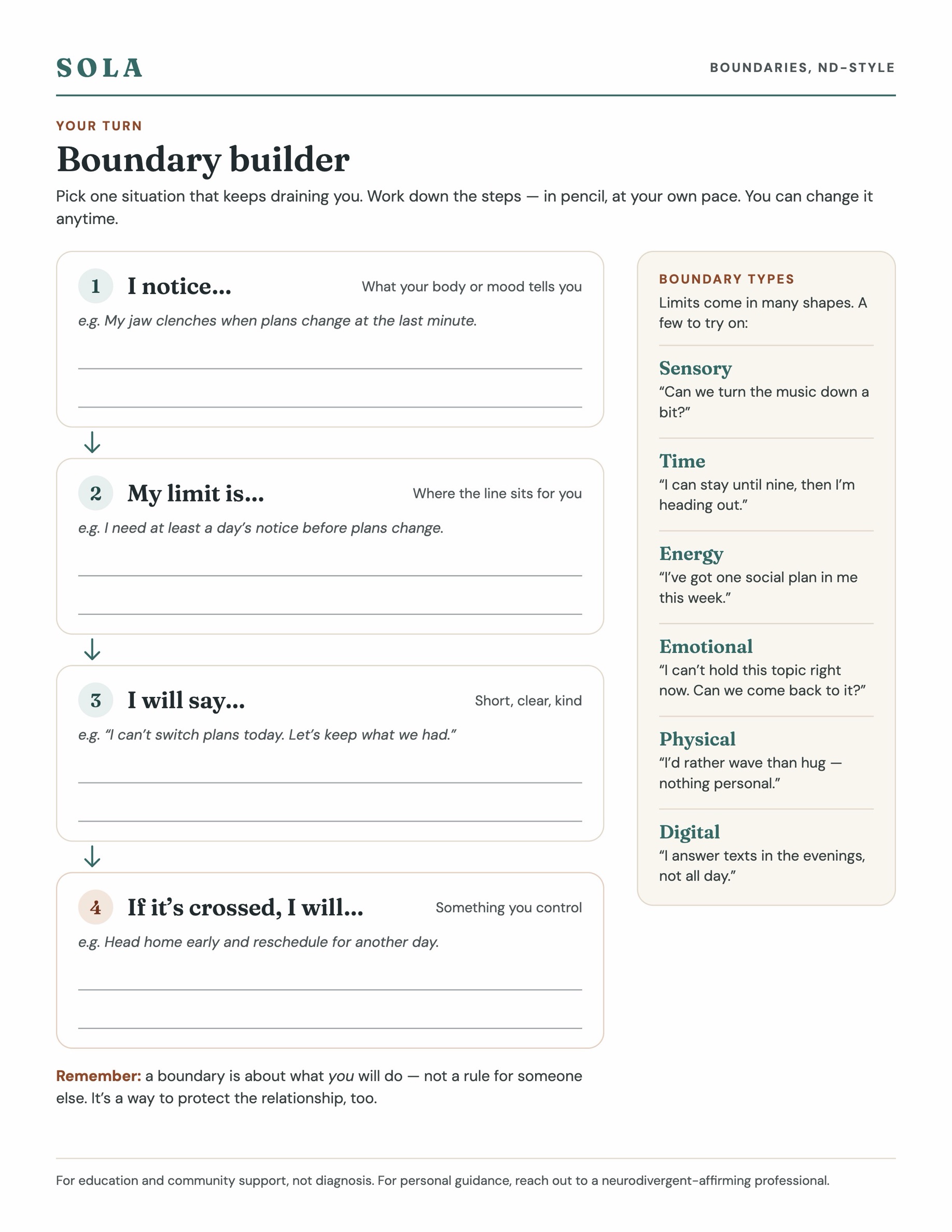
Your turn. Pick one situation that keeps draining you. Work down the steps — in pencil, at your own pace. You can change it anytime.
Remember: a boundary is about what you will do — not a rule for someone else. It’s a way to protect the relationship, too.
Boundary types
Limits come in many shapes. A few to try on:
“Can we turn the music down a bit?”
“I can stay until nine, then I’m heading out.”
“I’ve got one social plan in me this week.”
“I can’t hold this topic right now. Can we come back to it?”
“I’d rather wave than hug — nothing personal.”
“I answer texts in the evenings, not all day.”
For education and community support, not diagnosis. For personal guidance, reach out to a neurodivergent-affirming professional.
Sources and credits. SOLA · Community Resource · Boundaries, ND-Style