Practice
Running on Empty
Your nervous system in burnout
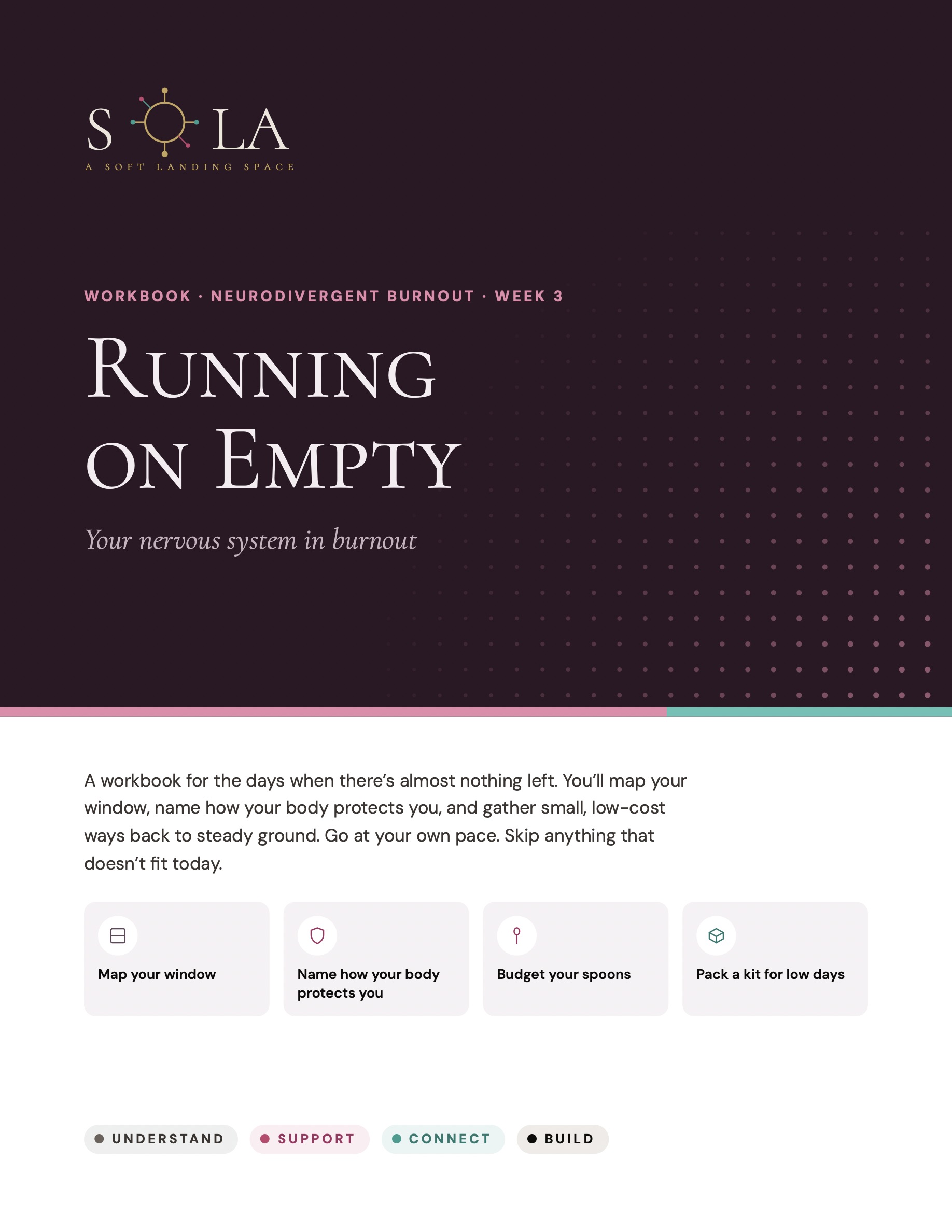
A workbook for the days when there’s almost nothing left. You’ll map your window, name how your body protects you, and gather small, low-cost ways back to steady ground. Go at your own pace. Skip anything that doesn’t fit today.
The workbook, as designed. The same content is written out below.
See the other 11 pages
Workbook · Neurodivergent Burnout · Week 3
In this workbook:
- Map your window
- Name how your body protects you
- Budget your spoons
- Pack a kit for low days
Understand · Support · Connect · Build
Welcome back.
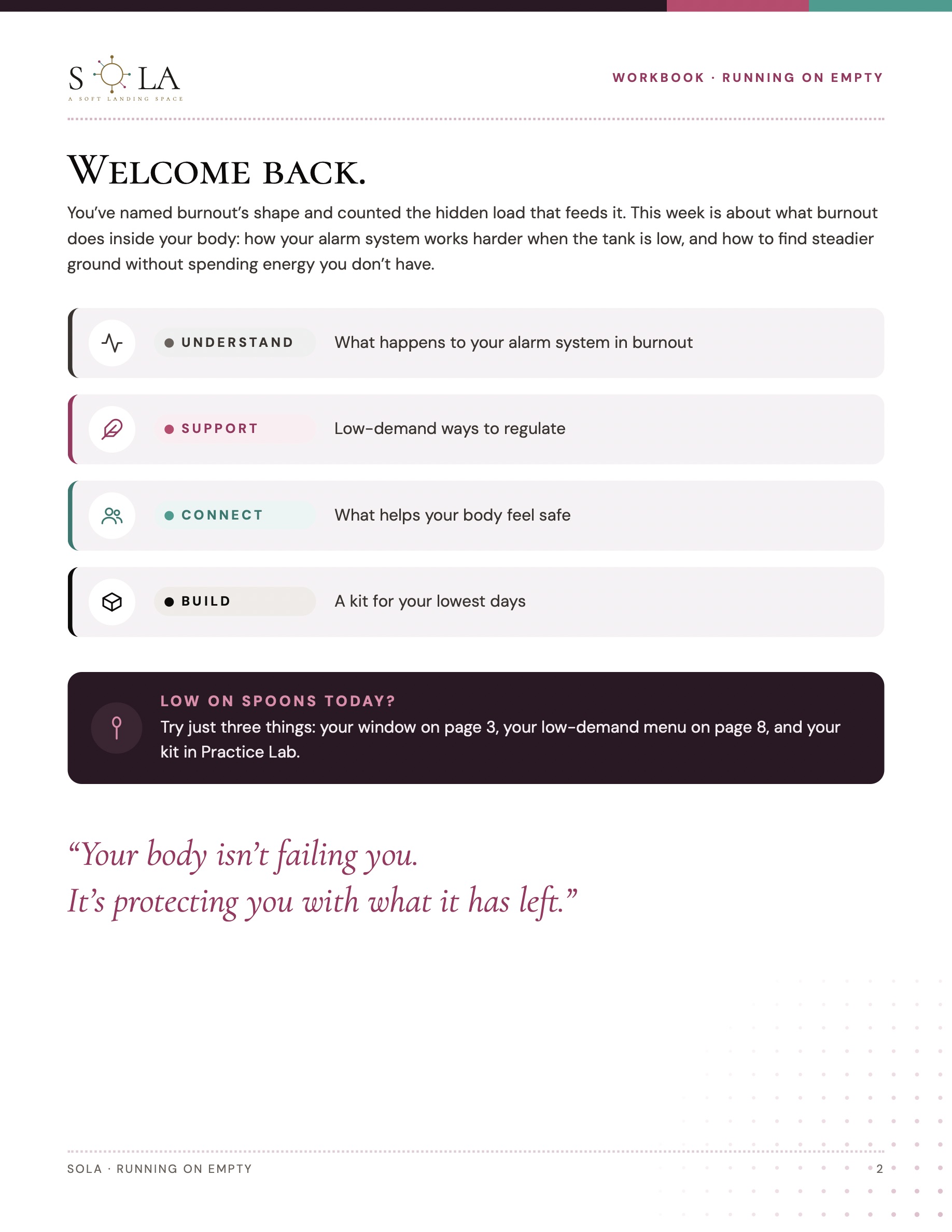
You’ve named burnout’s shape and counted the hidden load that feeds it. This week is about what burnout does inside your body: how your alarm system works harder when the tank is low, and how to find steadier ground without spending energy you don’t have.
- UNDERSTAND: What happens to your alarm system in burnout
- SUPPORT: Low-demand ways to regulate
- CONNECT: What helps your body feel safe
- BUILD: A kit for your lowest days
LOW ON SPOONS TODAY? Try just three things: your window on page 3, your low-demand menu on page 8, and your kit in Practice Lab.
“Your body isn’t failing you. It’s protecting you with what it has left.”
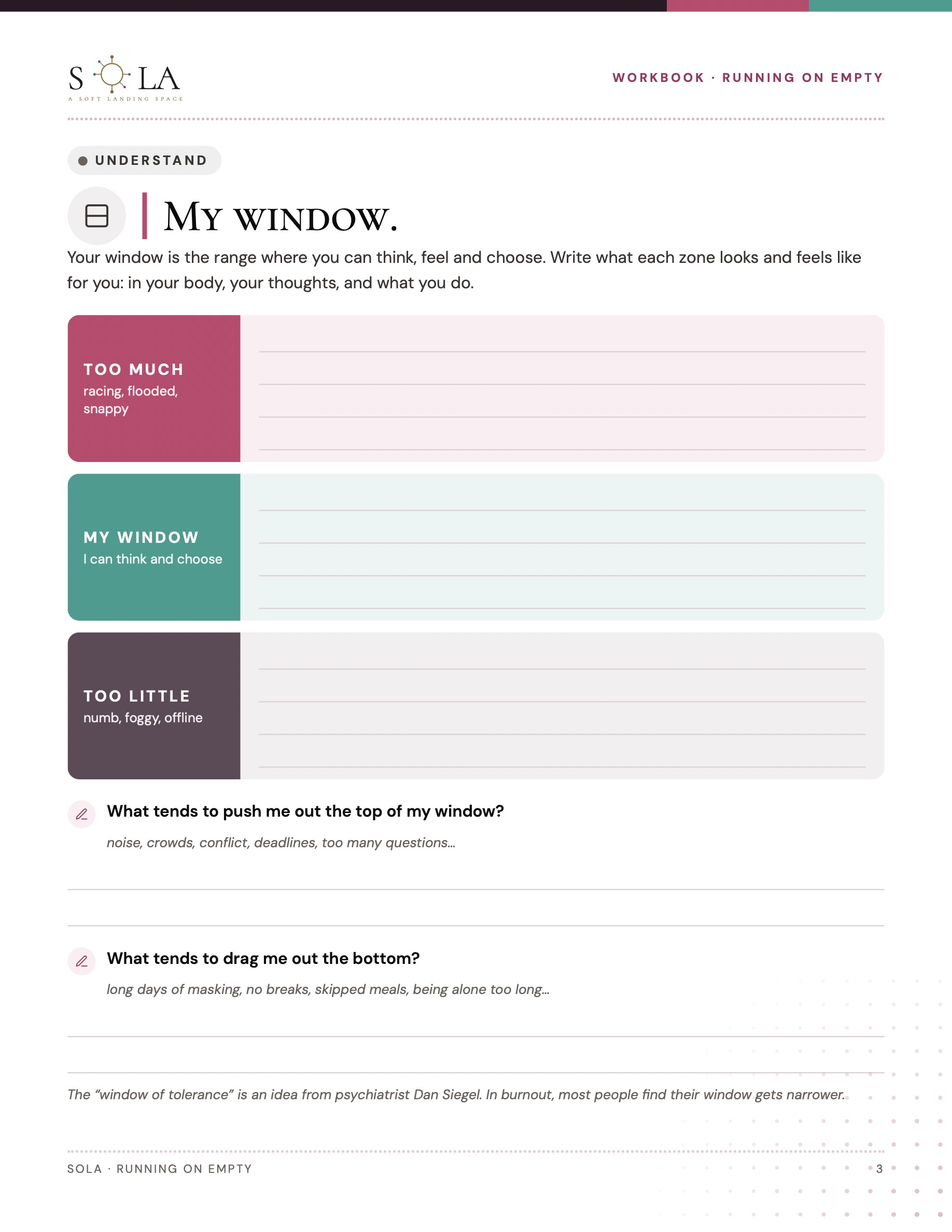
My window.
Your window is the range where you can think, feel and choose. Write what each zone looks and feels like for you: in your body, your thoughts, and what you do.
The “window of tolerance” is an idea from psychiatrist Dan Siegel. In burnout, most people find their window gets narrower.
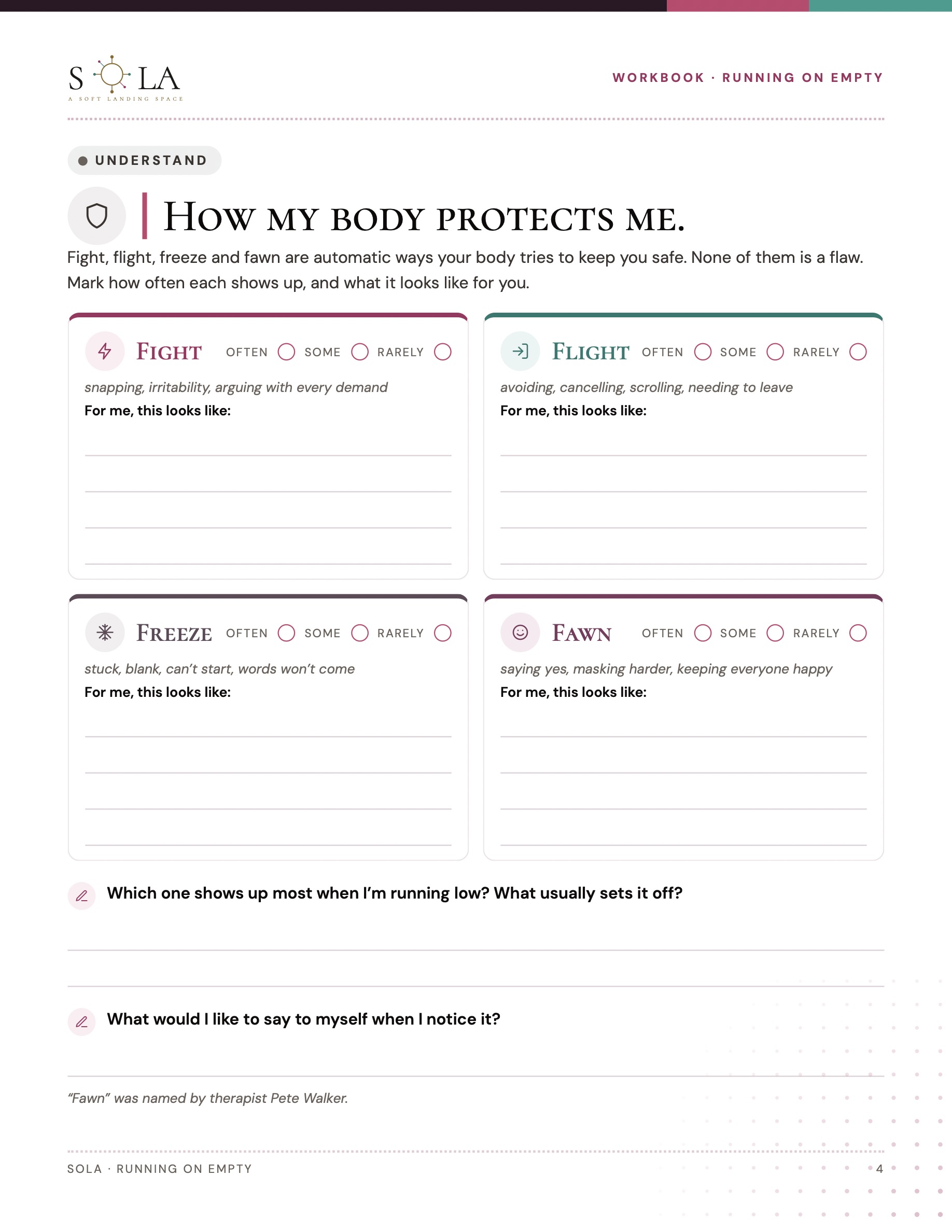
How my body protects me.
Fight, flight, freeze and fawn are automatic ways your body tries to keep you safe. None of them is a flaw. Mark how often each shows up, and what it looks like for you.
Fight Pick one
snapping, irritability, arguing with every demand- Often
- Some
- Rarely
Flight Pick one
avoiding, cancelling, scrolling, needing to leave- Often
- Some
- Rarely
Freeze Pick one
stuck, blank, can’t start, words won’t come- Often
- Some
- Rarely
Fawn Pick one
saying yes, masking harder, keeping everyone happy- Often
- Some
- Rarely
“Fawn” was named by therapist Pete Walker.
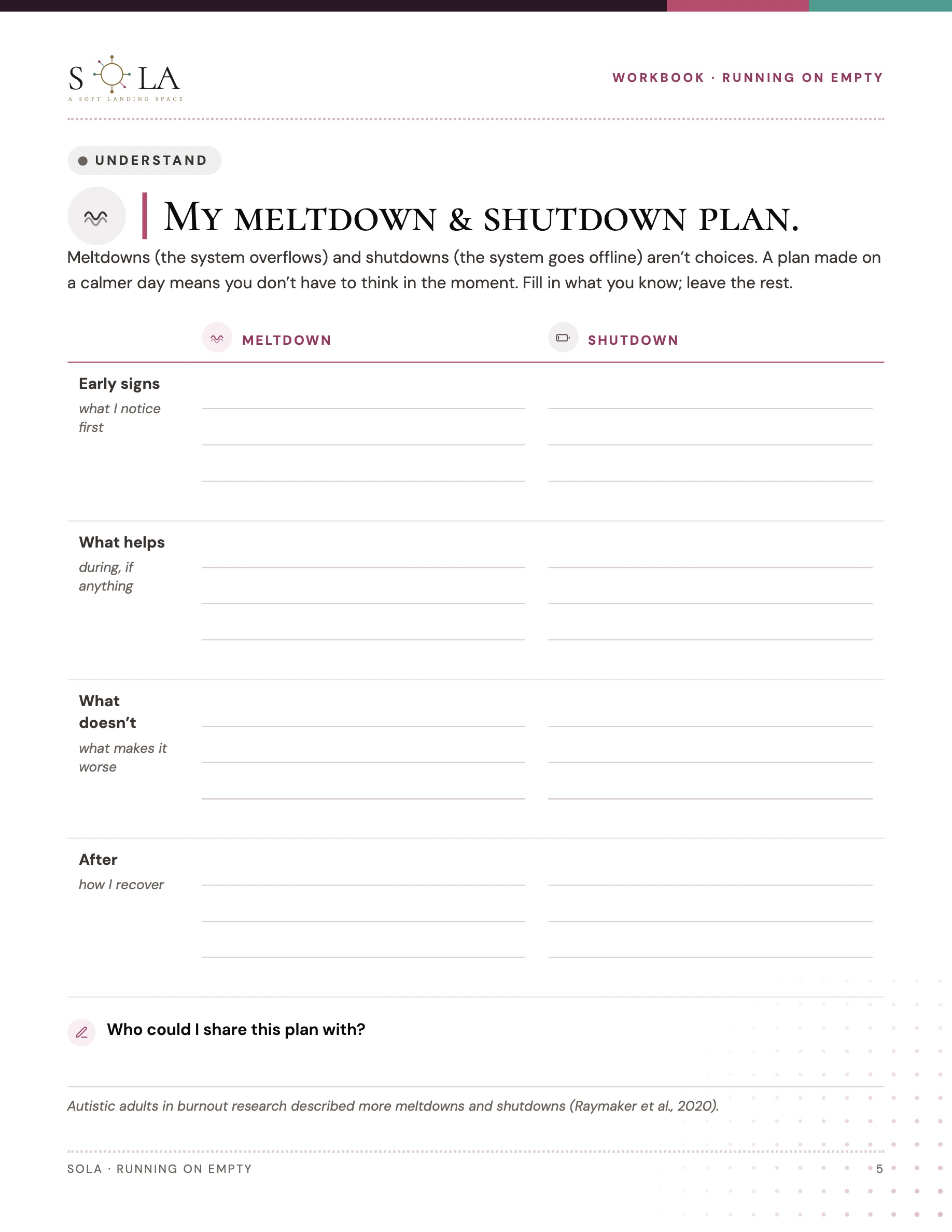
My meltdown & shutdown plan.
Meltdowns (the system overflows) and shutdowns (the system goes offline) aren’t choices. A plan made on a calmer day means you don’t have to think in the moment. Fill in what you know; leave the rest.
Autistic adults in burnout research described more meltdowns and shutdowns (Raymaker et al., 2020).
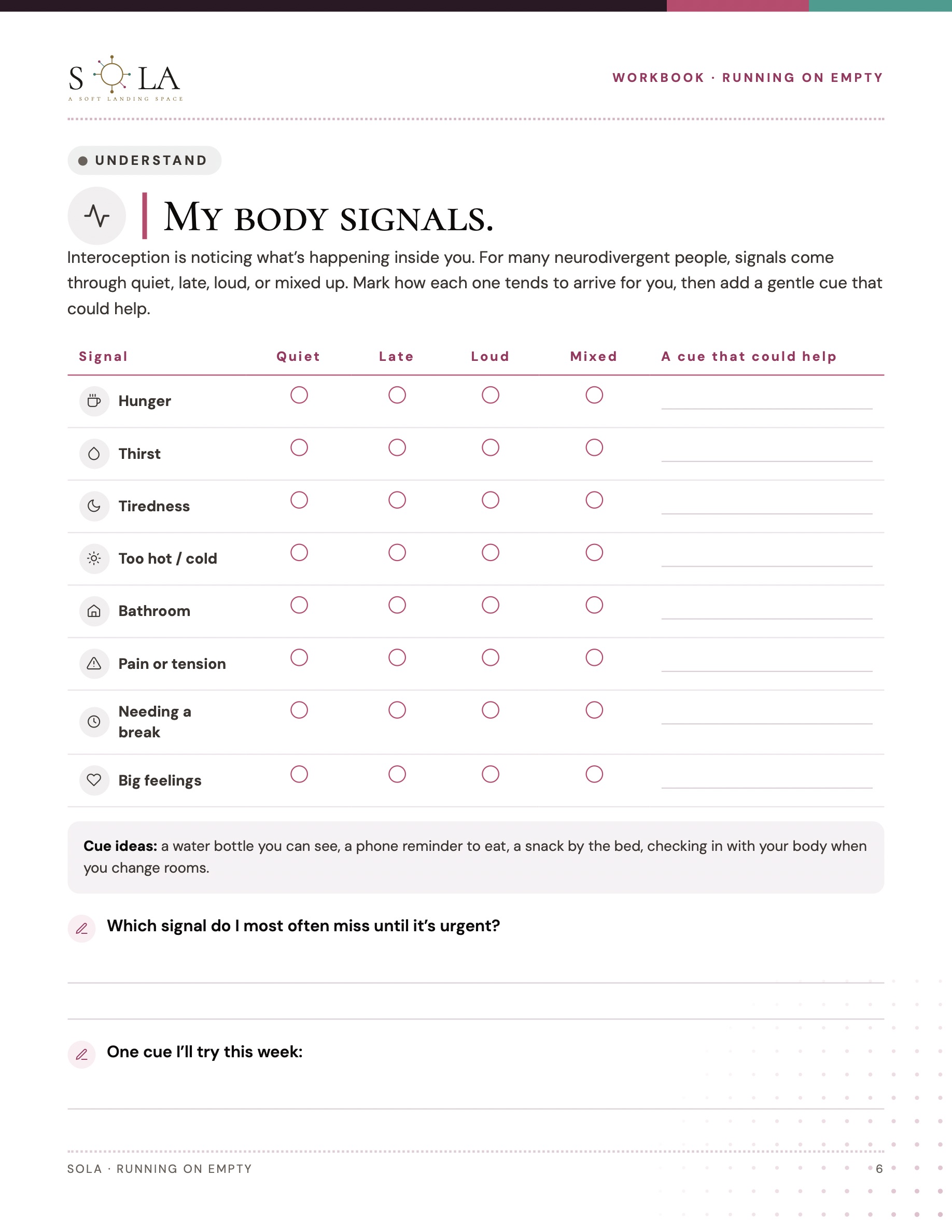
My body signals.
Interoception is noticing what’s happening inside you. For many neurodivergent people, signals come through quiet, late, loud, or mixed up. Mark how each one tends to arrive for you, then add a gentle cue that could help.
Signal
| How it arrives | A cue that could help | |
|---|---|---|
| Hunger | ||
| Thirst | ||
| Tiredness | ||
| Too hot / cold | ||
| Bathroom | ||
| Pain or tension | ||
| Needing a break | ||
| Big feelings |
Cue ideas: a water bottle you can see, a phone reminder to eat, a snack by the bed, checking in with your body when you change rooms.
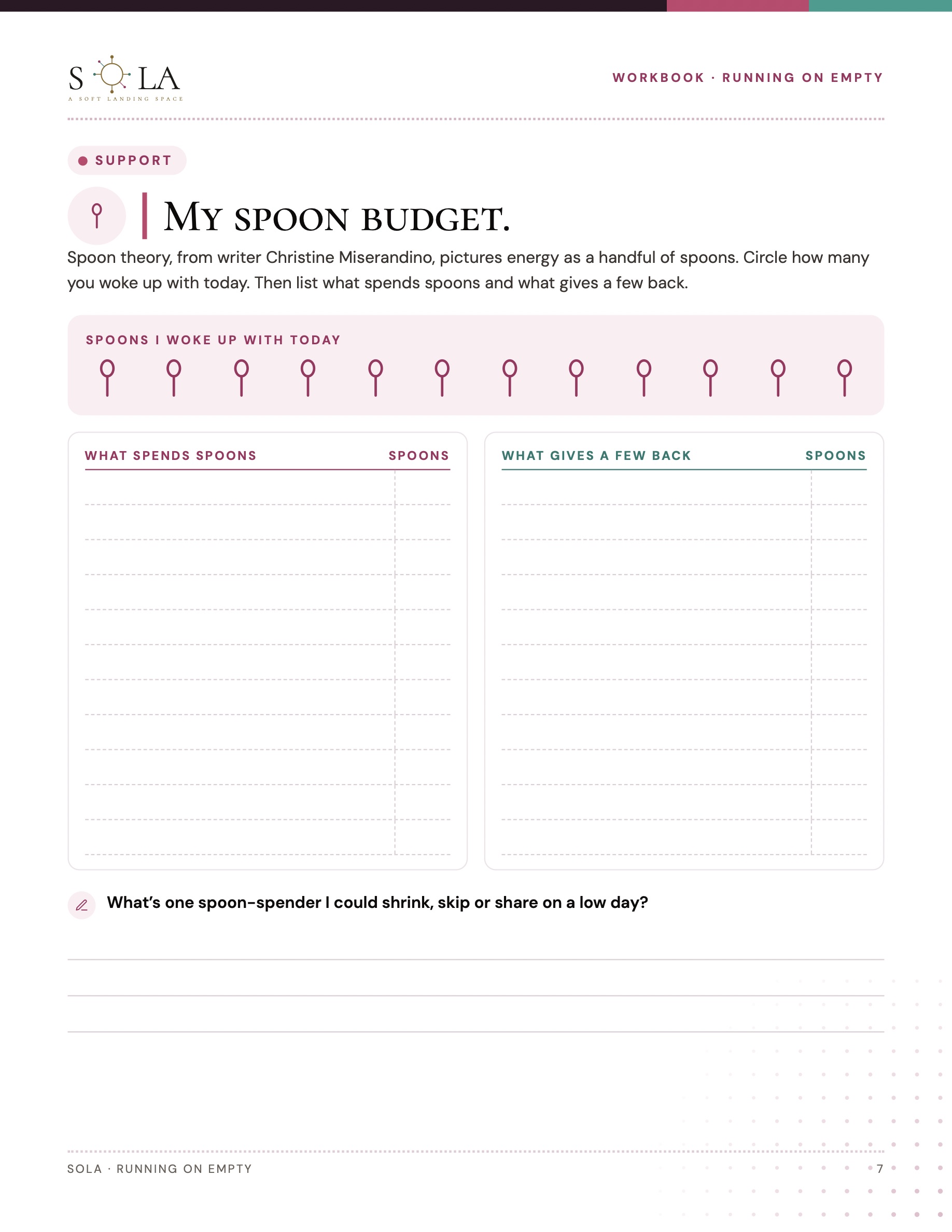
My spoon budget.
Spoon theory, from writer Christine Miserandino, pictures energy as a handful of spoons. Circle how many you woke up with today. Then list what spends spoons and what gives a few back.
SPOONS I WOKE UP WITH TODAY
WHAT SPENDS SPOONS
| What spends spoons | Spoons |
|---|---|
WHAT GIVES A FEW BACK
| What gives a few back | Spoons |
|---|---|
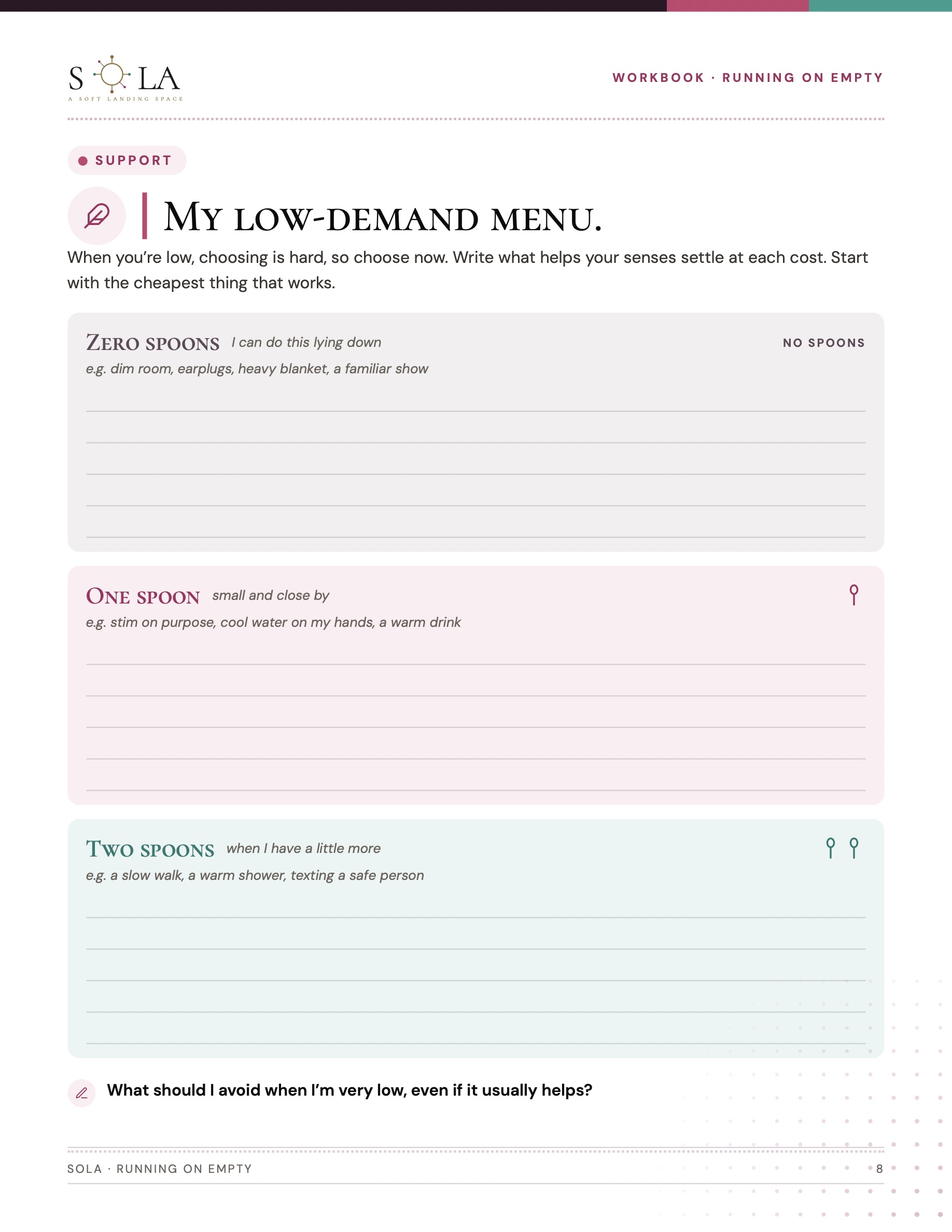
My low-demand menu.
When you’re low, choosing is hard, so choose now. Write what helps your senses settle at each cost. Start with the cheapest thing that works.
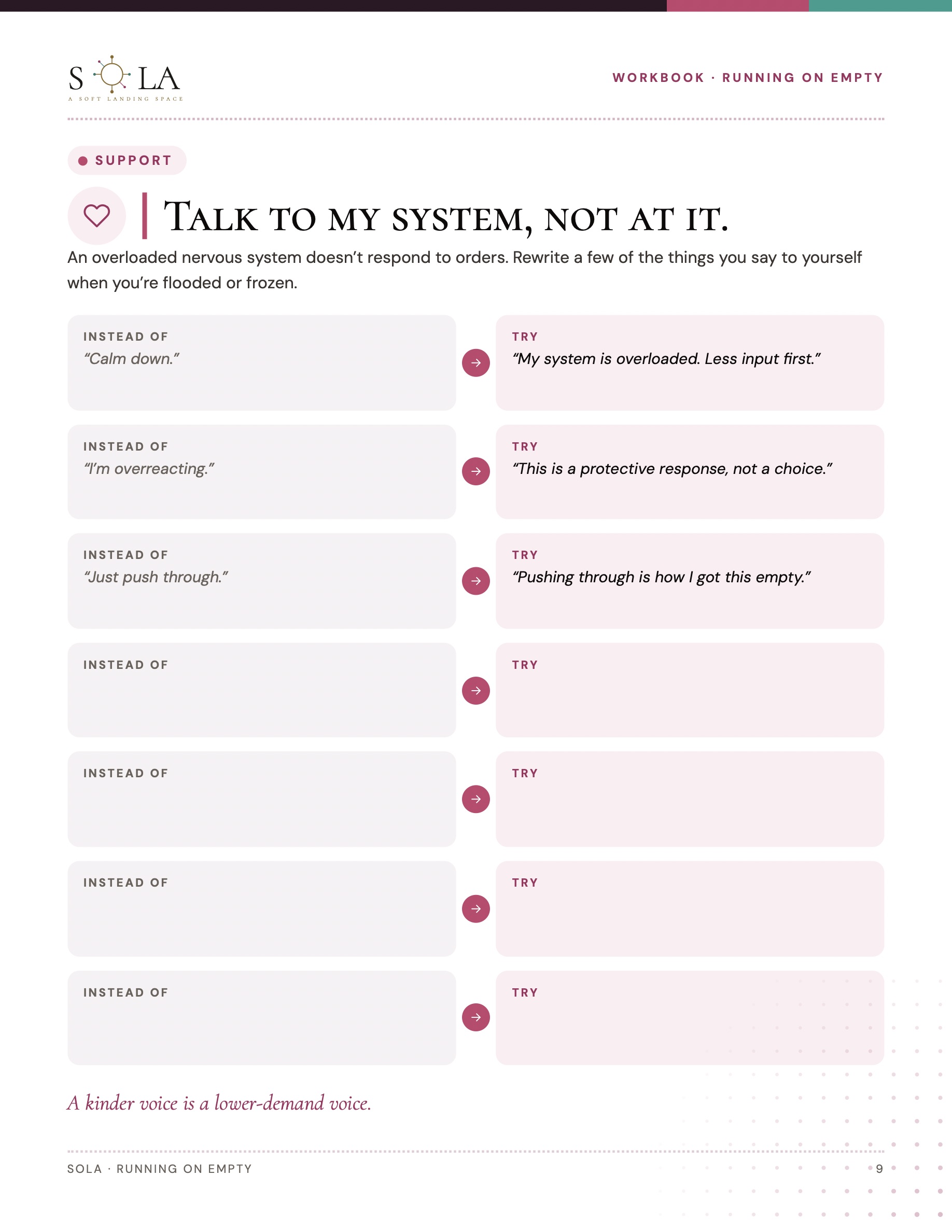
Talk to my system, not at it.
An overloaded nervous system doesn’t respond to orders. Rewrite a few of the things you say to yourself when you’re flooded or frozen.
INSTEAD OF “Calm down.” → TRY “My system is overloaded. Less input first.”
INSTEAD OF “I’m overreacting.” → TRY “This is a protective response, not a choice.”
INSTEAD OF “Just push through.” → TRY “Pushing through is how I got this empty.”
| INSTEAD OF | TRY |
|---|---|
A kinder voice is a lower-demand voice.
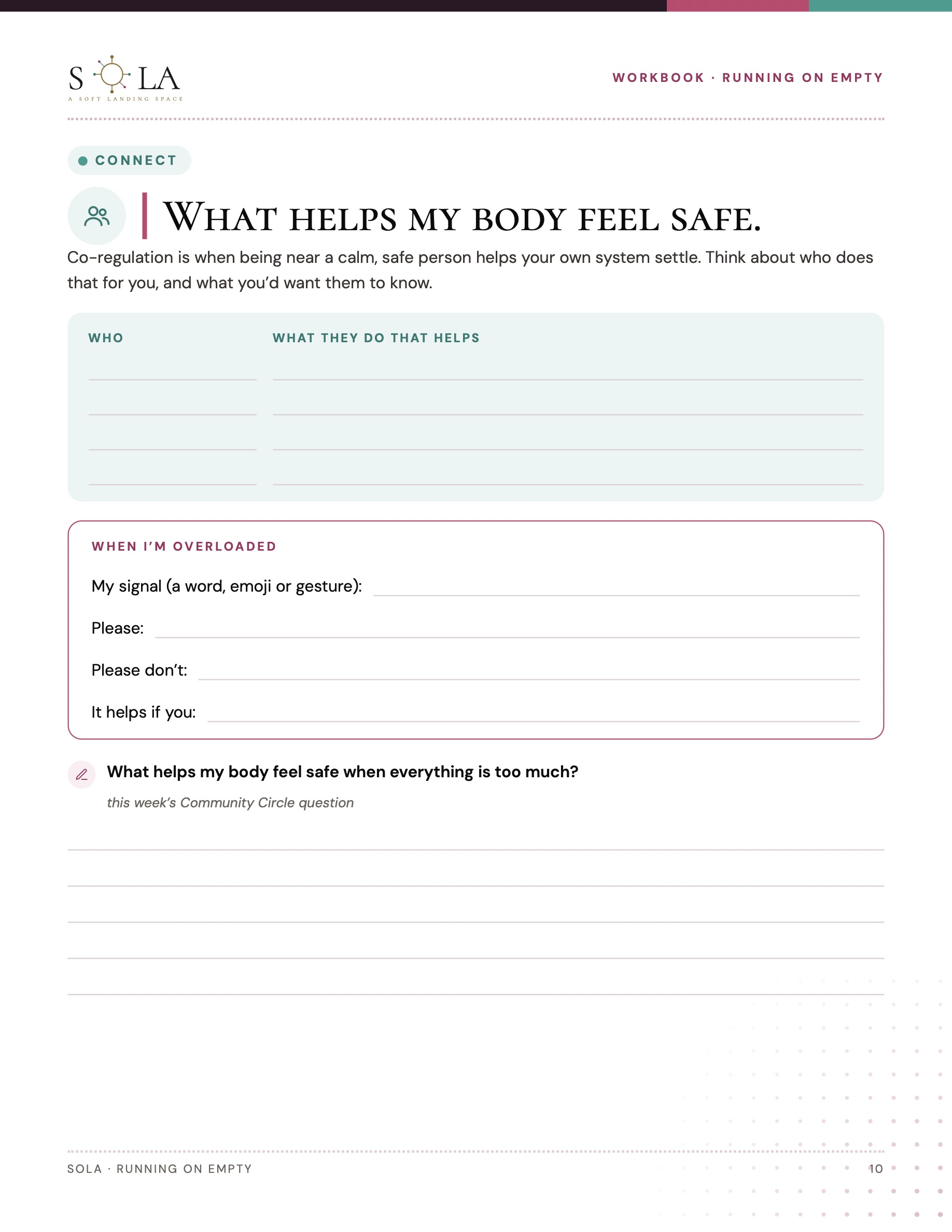
What helps my body feel safe.
Co-regulation is when being near a calm, safe person helps your own system settle. Think about who does that for you, and what you’d want them to know.
| WHO | WHAT THEY DO THAT HELPS |
|---|---|
WHEN I’M OVERLOADED
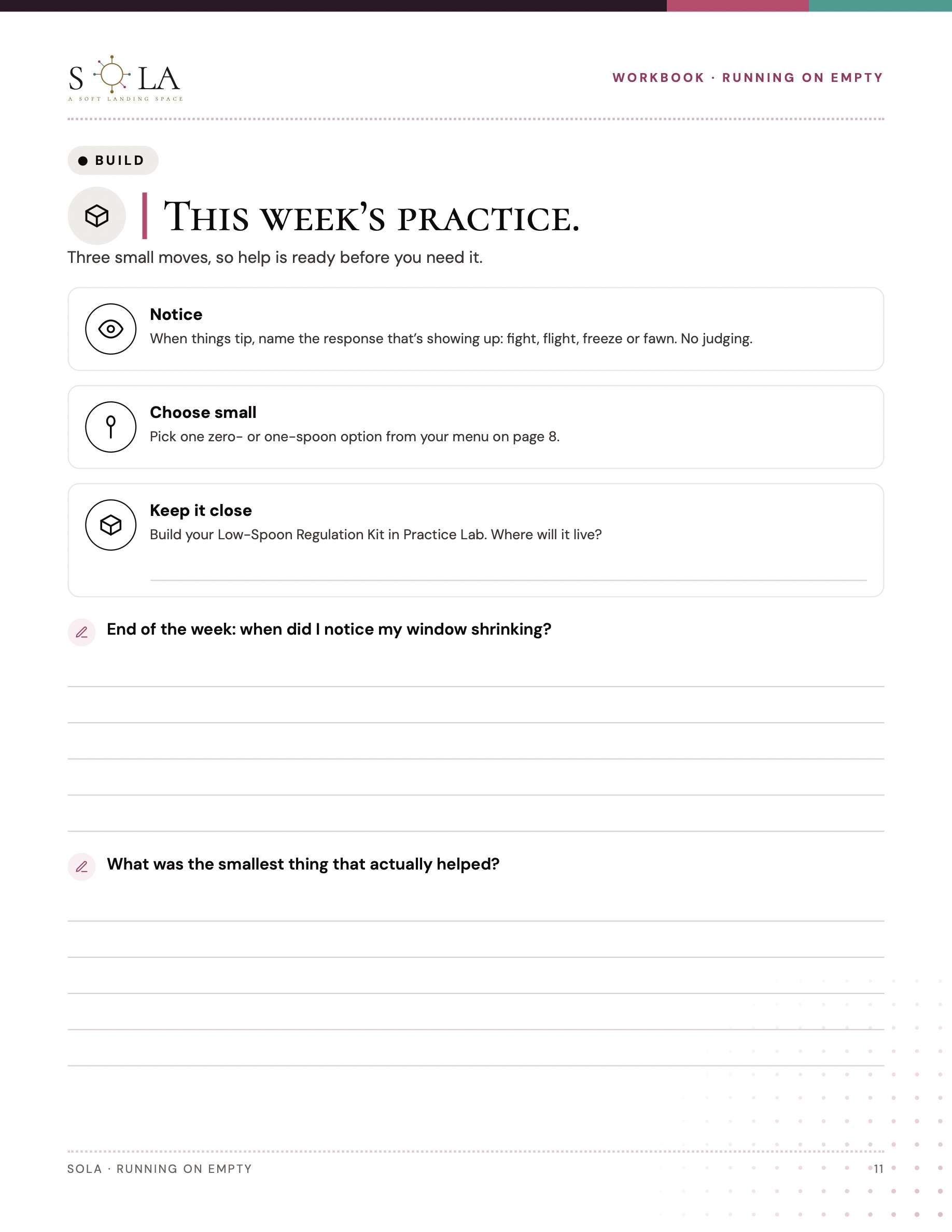
This week’s practice.
Three small moves, so help is ready before you need it.
Notice: When things tip, name the response that’s showing up: fight, flight, freeze or fawn. No judging.
Choose small: Pick one zero- or one-spoon option from your menu on page 8.
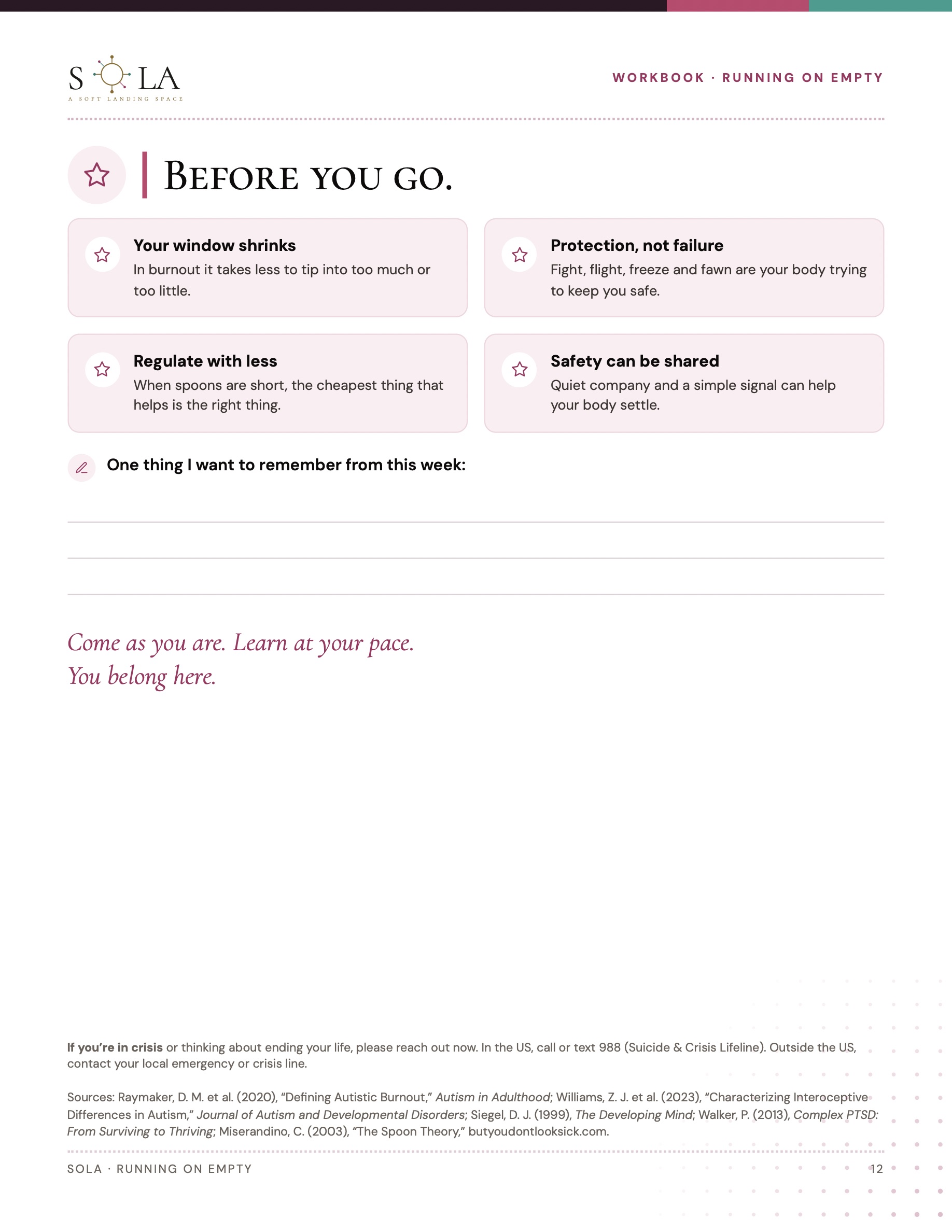
Before you go.
Your window shrinks: In burnout it takes less to tip into too much or too little.
Protection, not failure: Fight, flight, freeze and fawn are your body trying to keep you safe.
Regulate with less: When spoons are short, the cheapest thing that helps is the right thing.
Safety can be shared: Quiet company and a simple signal can help your body settle.
Come as you are. Learn at your pace. You belong here.
If you’re in crisis or thinking about ending your life, please reach out now. In the US, call or text 988 (Suicide & Crisis Lifeline). Outside the US, contact your local emergency or crisis line.
Sources and credits. Sources: Raymaker, D. M. et al. (2020), “Defining Autistic Burnout,” Autism in Adulthood; Williams, Z. J. et al. (2023), “Characterizing Interoceptive Differences in Autism,” Journal of Autism and Developmental Disorders; Siegel, D. J. (1999), The Developing Mind; Walker, P. (2013), Complex PTSD: From Surviving to Thriving; Miserandino, C. (2003), “The Spoon Theory,” butyoudontlooksick.com.