Practice
Support Isn't Cheating
scaffolding that works — the structures that carry you until you don't need carrying
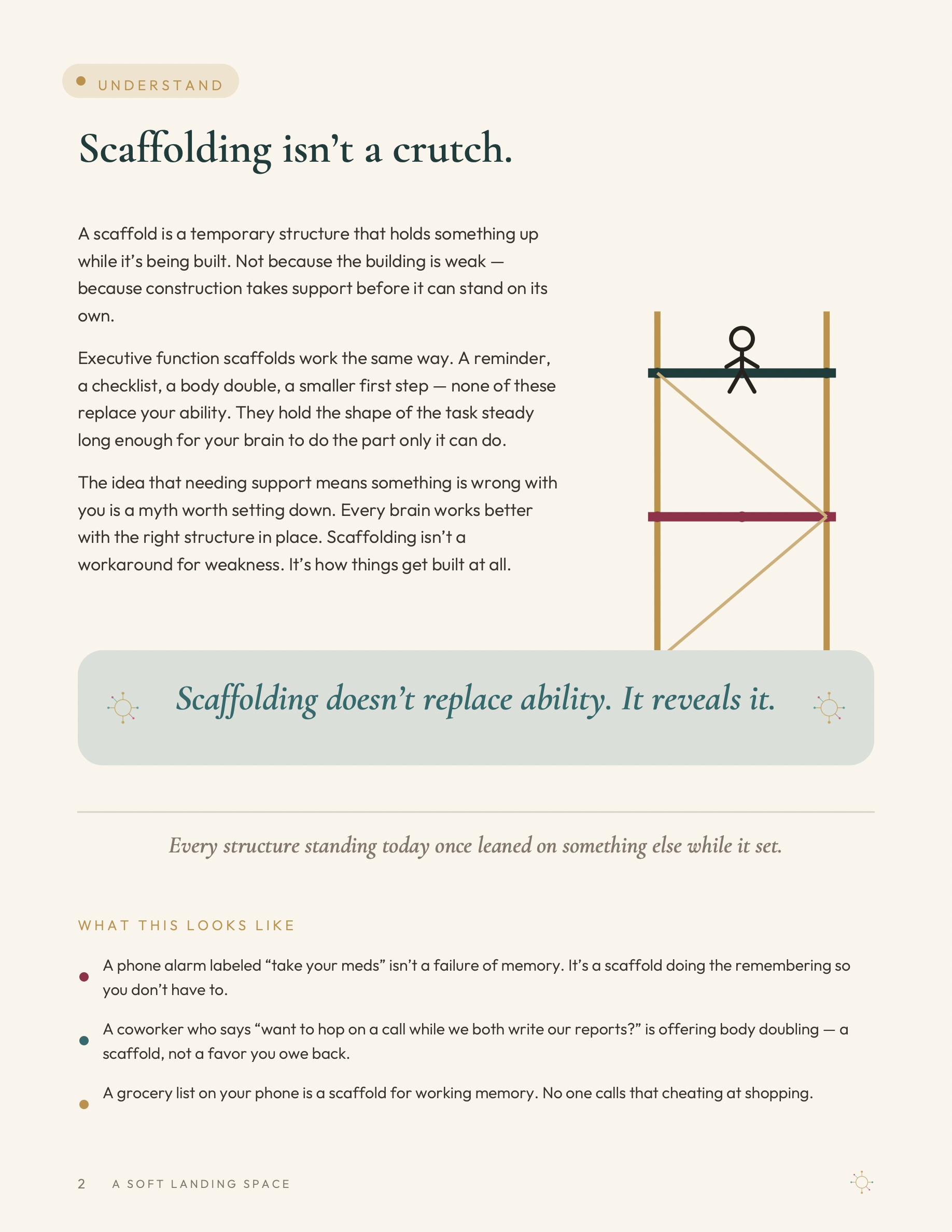
A scaffold is a temporary structure that holds something up while it's being built. Not because the building is weak — because construction takes support before it can stand on its own.
Executive function scaffolds work the same way. A reminder, a checklist, a body double, a smaller first step — none of these replace your ability. They hold the shape of the task steady long enough for your brain to do the part only it can do.
The workbook, as designed. The same content is written out below.
See the other 11 pages
Scaffolding isn't a crutch.
A scaffold is a temporary structure that holds something up while it's being built. Not because the building is weak — because construction takes support before it can stand on its own.
Executive function scaffolds work the same way. A reminder, a checklist, a body double, a smaller first step — none of these replace your ability. They hold the shape of the task steady long enough for your brain to do the part only it can do.
The idea that needing support means something is wrong with you is a myth worth setting down. Every brain works better with the right structure in place. Scaffolding isn't a workaround for weakness. It's how things get built at all.
Scaffolding doesn't replace ability. It reveals it.
Every structure standing today once leaned on something else while it set.
What this looks like
- A phone alarm labeled "take your meds" isn't a failure of memory. It's a scaffold doing the remembering so you don't have to.
- A coworker who says "want to hop on a call while we both write our reports?" is offering body doubling — a scaffold, not a favor you owe back.
- A grocery list on your phone is a scaffold for working memory. No one calls that cheating at shopping.
Why scaffolding feels like cheating
Many of us grew up being graded on what we could produce alone. Asking for a reminder, a checklist, or a body double got quietly filed away as "not really doing it yourself." That belief sticks around long after the grading stops.
But almost nothing gets done by willpower alone. Calendars, alarms, sticky notes, coworkers, recipes — these are scaffolds too, and no one calls them cheating. The only difference is how visible the need feels.
When we ask "why can't I just do this on my own?" we're usually asking the wrong question. A more useful one is: "what structure would make this easy to access right now?"
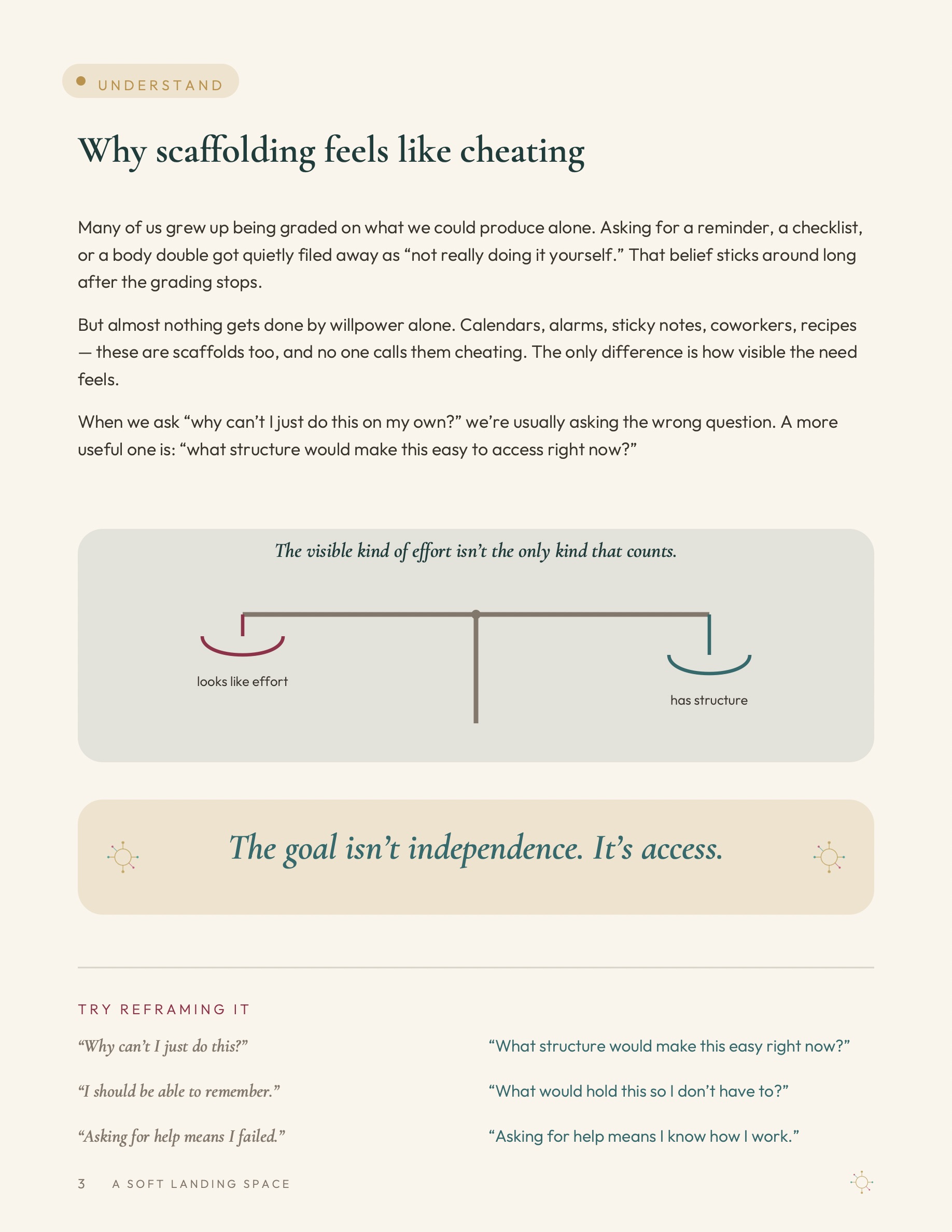
The visible kind of effort isn't the only kind that counts. (A balance scale: "looks like effort" on one side, "has structure" on the other.)
The goal isn't independence. It's access.
Try reframing it
- "Why can't I just do this?" → "What structure would make this easy right now?"
- "I should be able to remember." → "What would hold this so I don't have to?"
- "Asking for help means I failed." → "Asking for help means I know how I work."
Types of scaffolding.
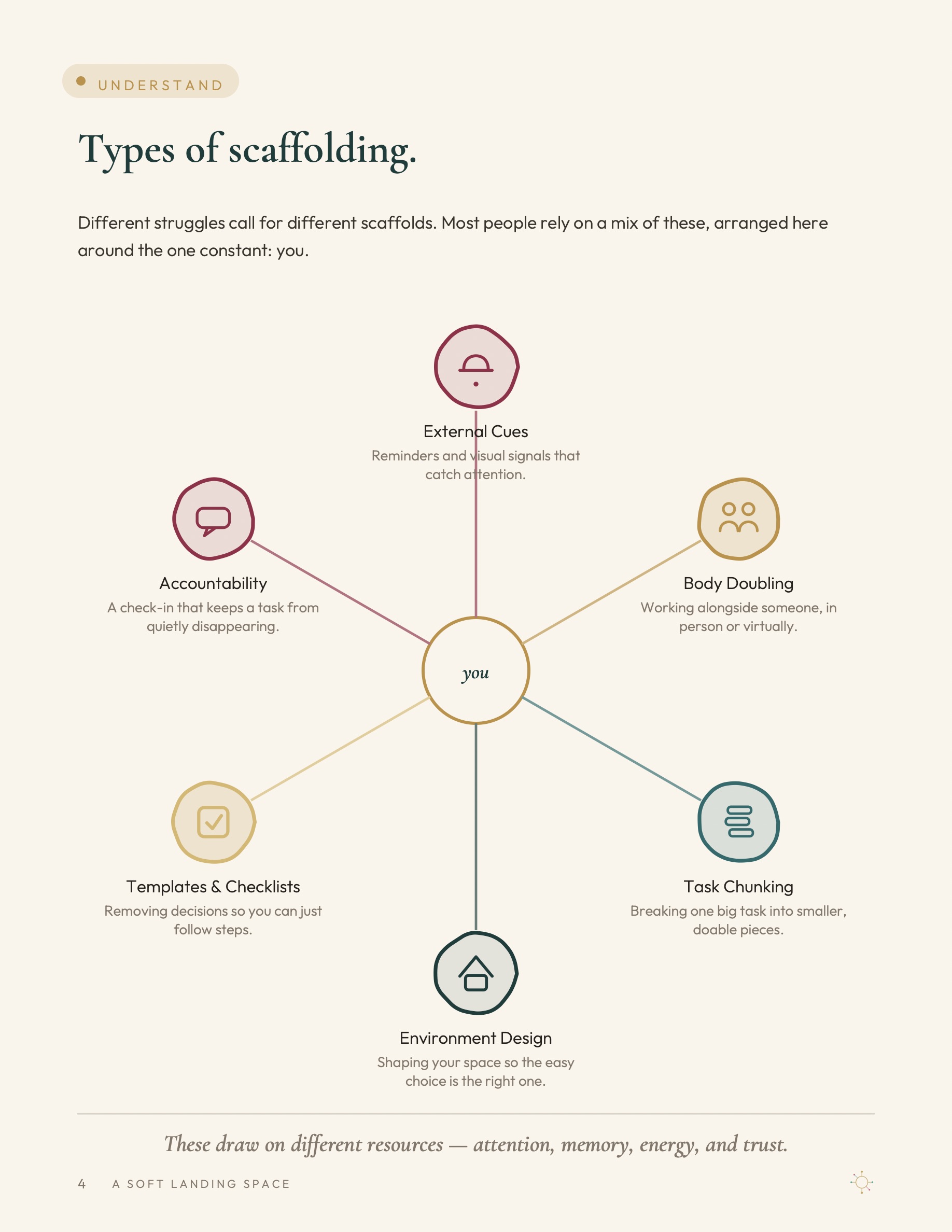
Different struggles call for different scaffolds. Most people rely on a mix of these, arranged here around the one constant: you.
Six kinds of scaffold, arranged in a circle around "you":
- External Cues — Reminders and visual signals that catch attention.
- Body Doubling — Working alongside someone, in person or virtually.
- Task Chunking — Breaking one big task into smaller, doable pieces.
- Environment Design — Shaping your space so the easy choice is the right one.
- Templates & Checklists — Removing decisions so you can just follow steps.
- Accountability — A check-in that keeps a task from quietly disappearing.
These draw on different resources — attention, memory, energy, and trust.
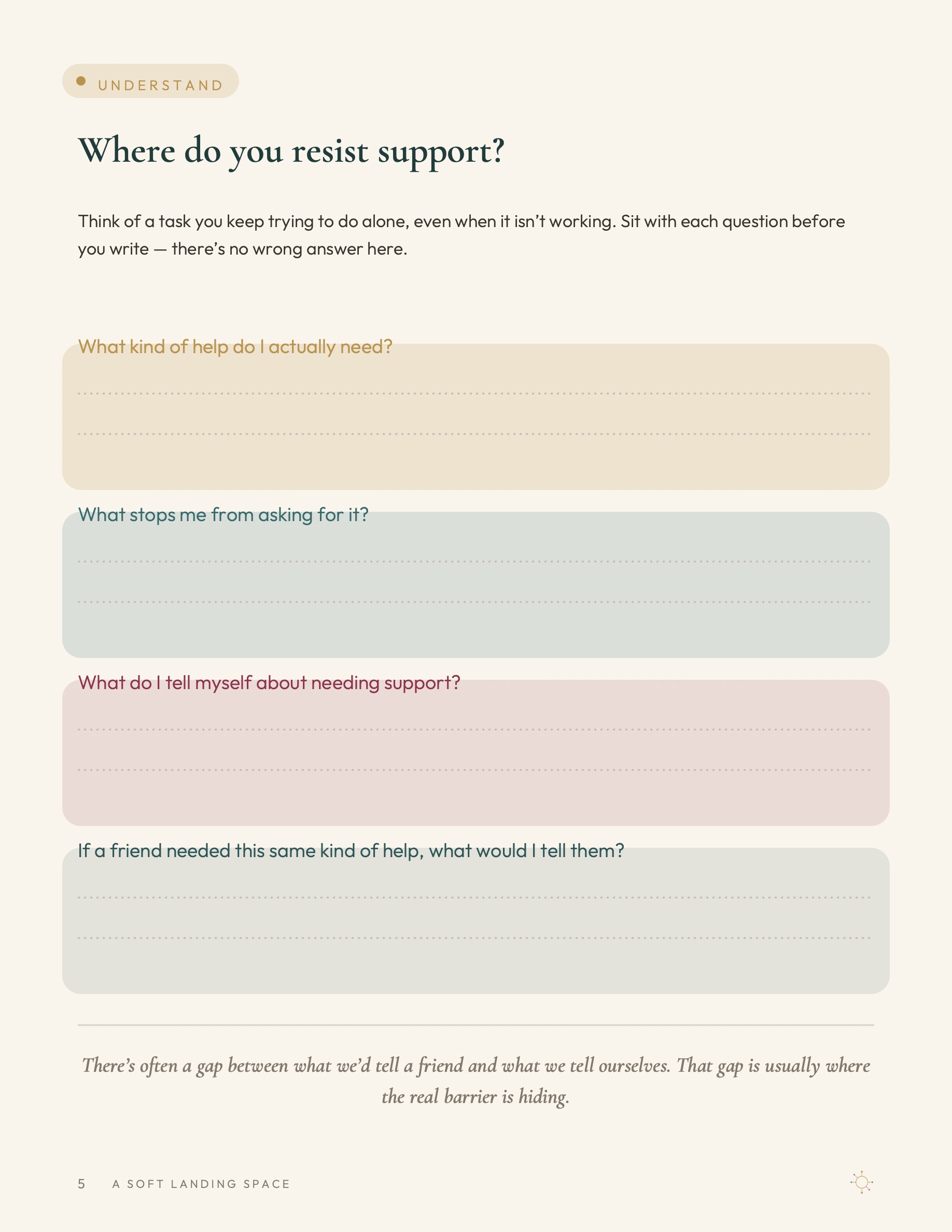
Where do you resist support?
Think of a task you keep trying to do alone, even when it isn't working. Sit with each question before you write — there's no wrong answer here.
There's often a gap between what we'd tell a friend and what we tell ourselves. That gap is usually where the real barrier is hiding.
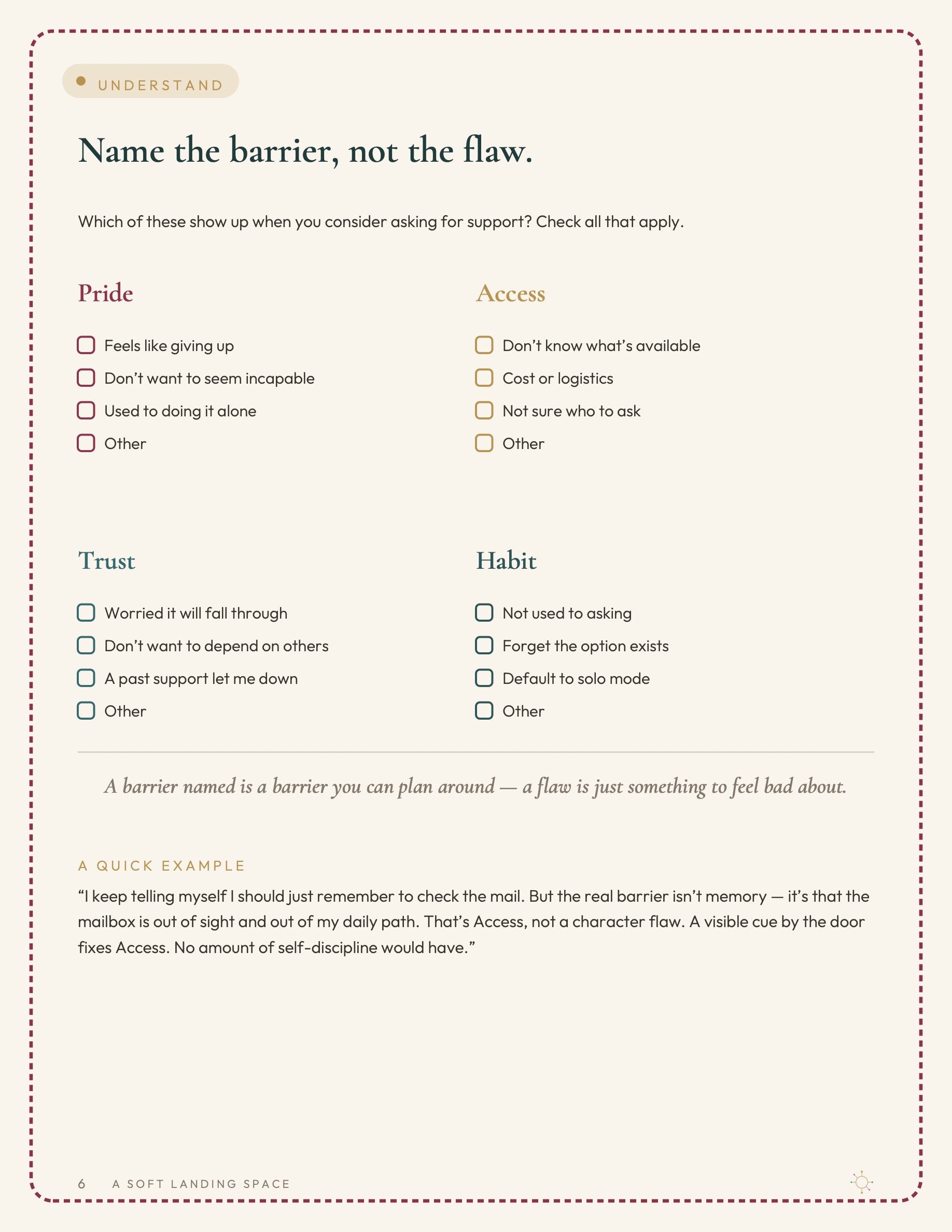
Name the barrier, not the flaw.
Which of these show up when you consider asking for support? Check all that apply.
Pride Tick all that apply
- Feels like giving up
- Don't want to seem incapable
- Used to doing it alone
- Other:
Access Tick all that apply
- Don't know what's available
- Cost or logistics
- Not sure who to ask
- Other:
Trust Tick all that apply
- Worried it will fall through
- Don't want to depend on others
- A past support let me down
- Other:
Habit Tick all that apply
- Not used to asking
- Forget the option exists
- Default to solo mode
- Other:
A barrier named is a barrier you can plan around — a flaw is just something to feel bad about.
A quick example
"I keep telling myself I should just remember to check the mail. But the real barrier isn't memory — it's that the mailbox is out of sight and out of my daily path. That's Access, not a character flaw. A visible cue by the door fixes Access. No amount of self-discipline would have."
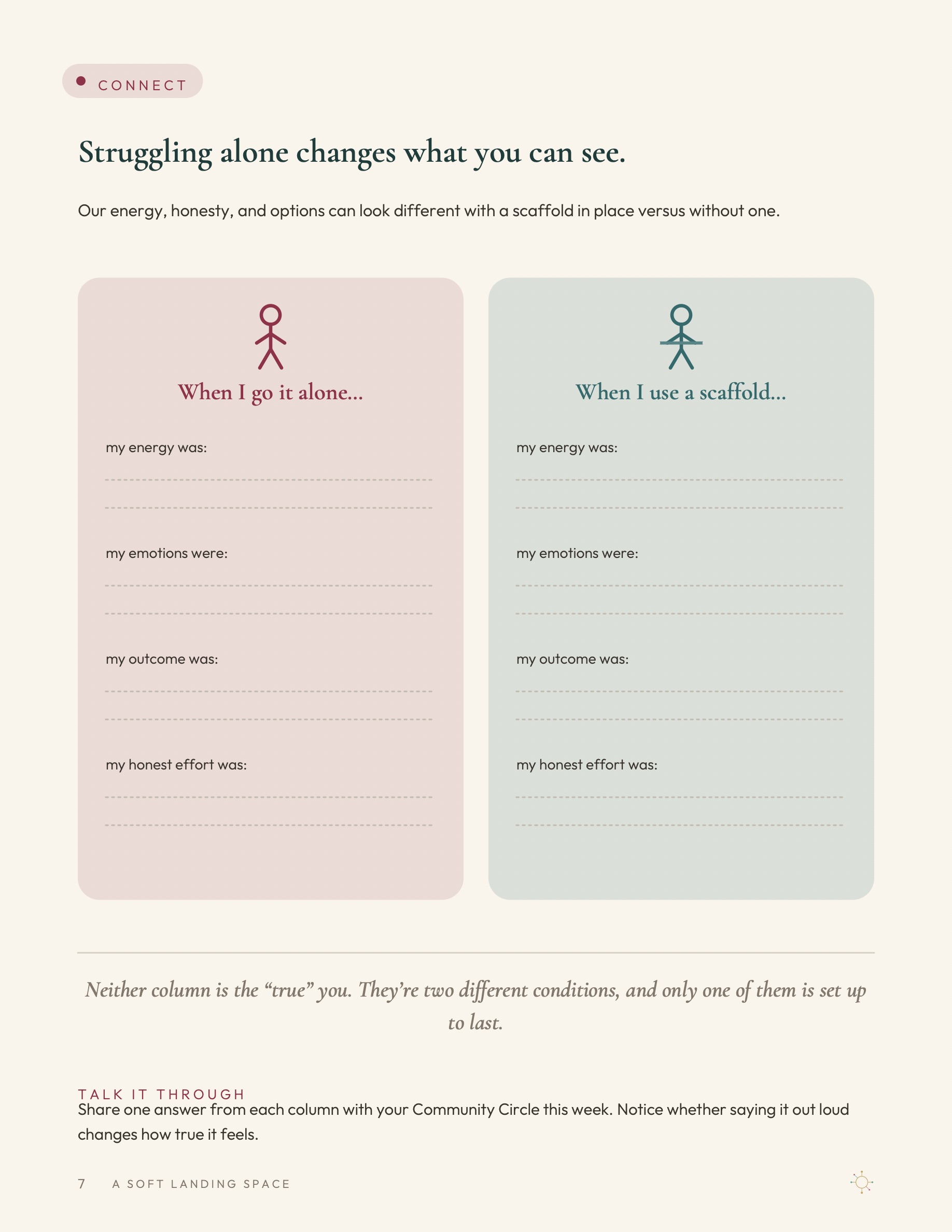
Struggling alone changes what you can see.
Our energy, honesty, and options can look different with a scaffold in place versus without one.
| When I go it alone… | When I use a scaffold… | |
|---|---|---|
| my energy was: | ||
| my emotions were: | ||
| my outcome was: | ||
| my honest effort was: |
Neither column is the "true" you. They're two different conditions, and only one of them is set up to last.
Talk it through
Share one answer from each column with your Community Circle this week. Notice whether saying it out loud changes how true it feels.
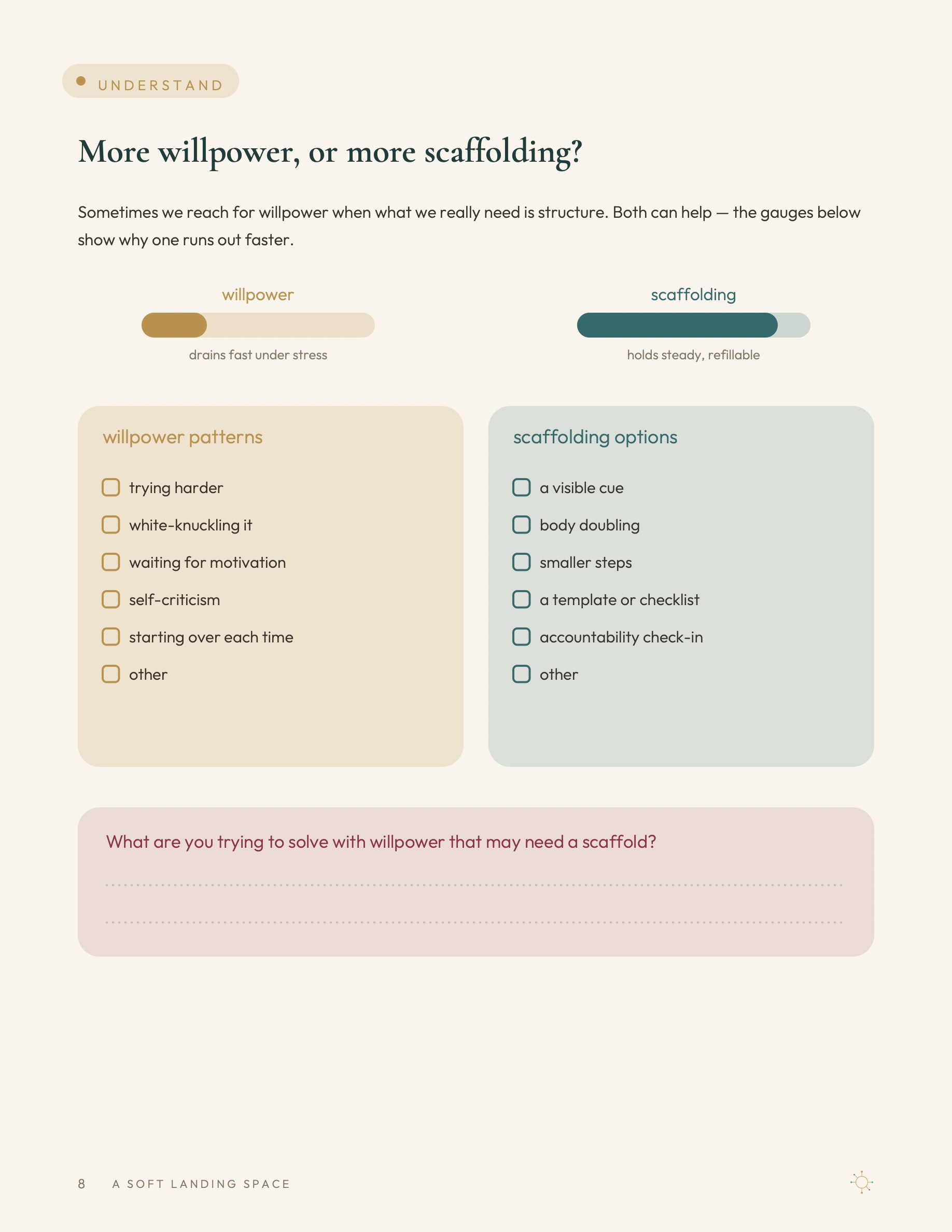
More willpower, or more scaffolding?
Sometimes we reach for willpower when what we really need is structure. Both can help — the gauges below show why one runs out faster.
Two gauges: willpower — drains fast under stress (gauge nearly empty). Scaffolding — holds steady, refillable (gauge nearly full).
willpower patterns Tick all that apply
- trying harder
- white-knuckling it
- waiting for motivation
- self-criticism
- starting over each time
- Other:
scaffolding options Tick all that apply
- a visible cue
- body doubling
- smaller steps
- a template or checklist
- accountability check-in
- Other:
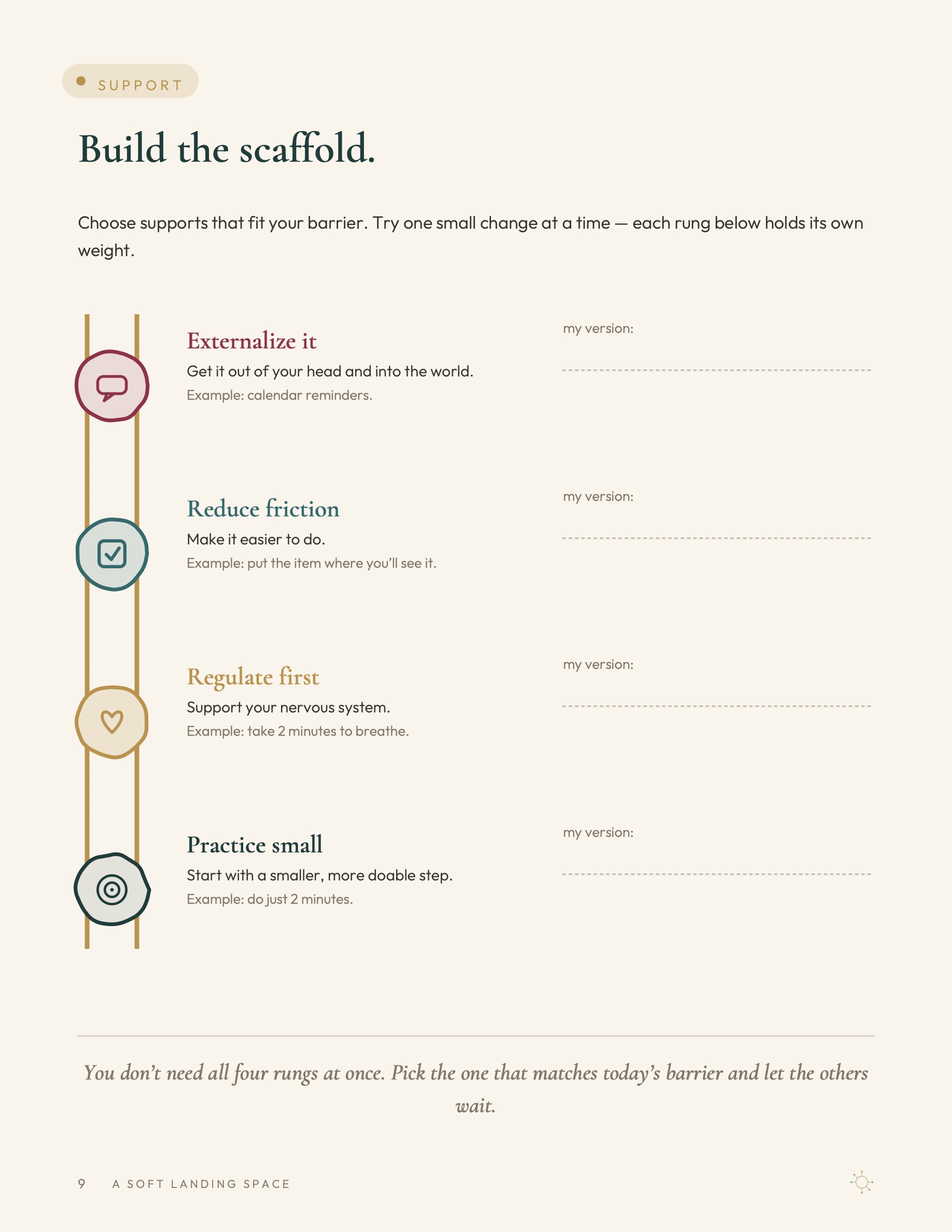
Build the scaffold.
Choose supports that fit your barrier. Try one small change at a time — each rung below holds its own weight.
You don't need all four rungs at once. Pick the one that matches today's barrier and let the others wait.
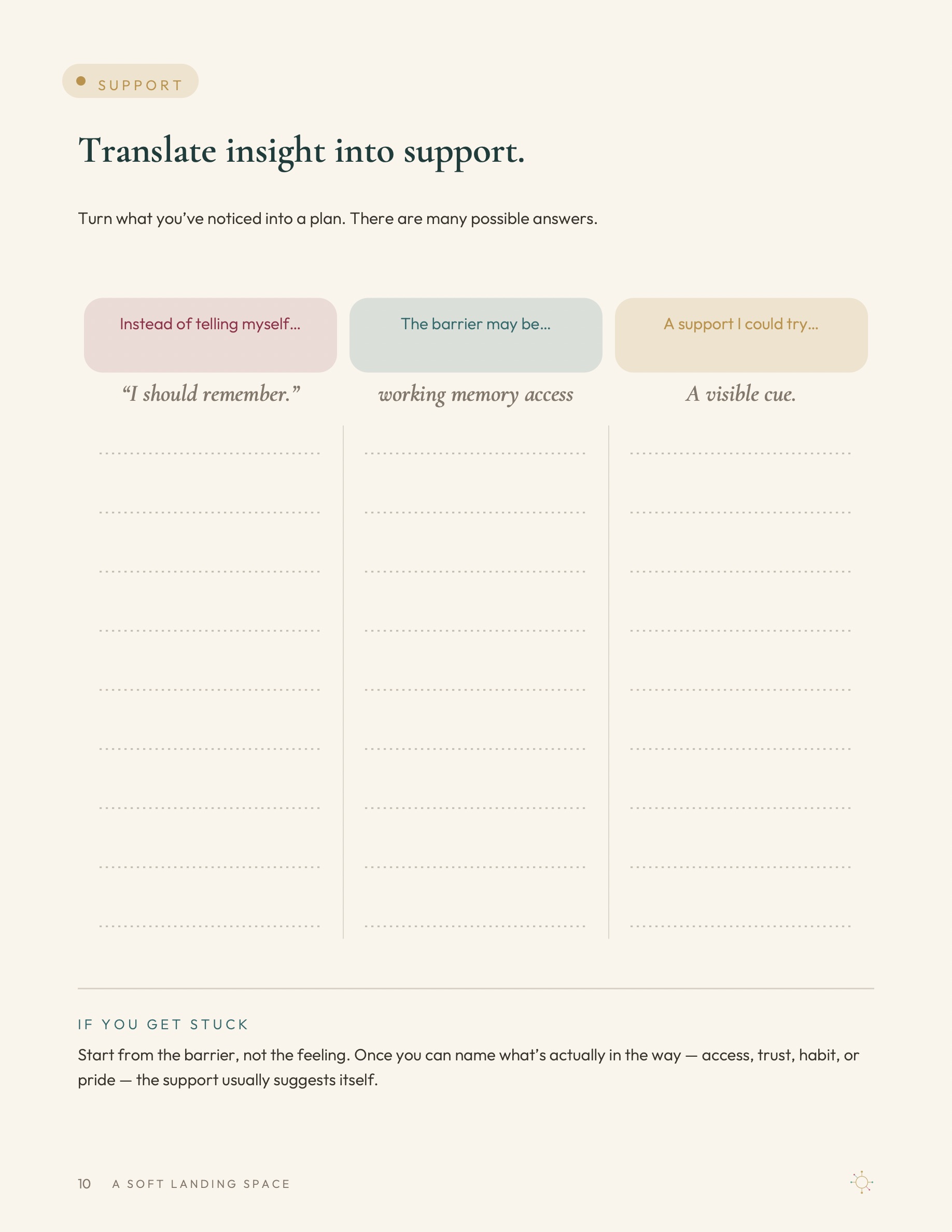
Translate insight into support.
Turn what you've noticed into a plan. There are many possible answers.
Example row: Instead of telling myself… "I should remember." · The barrier may be… working memory access · A support I could try… A visible cue.
| Instead of telling myself… | The barrier may be… | A support I could try… |
|---|---|---|
If you get stuck
Start from the barrier, not the feeling. Once you can name what's actually in the way — access, trust, habit, or pride — the support usually suggests itself.
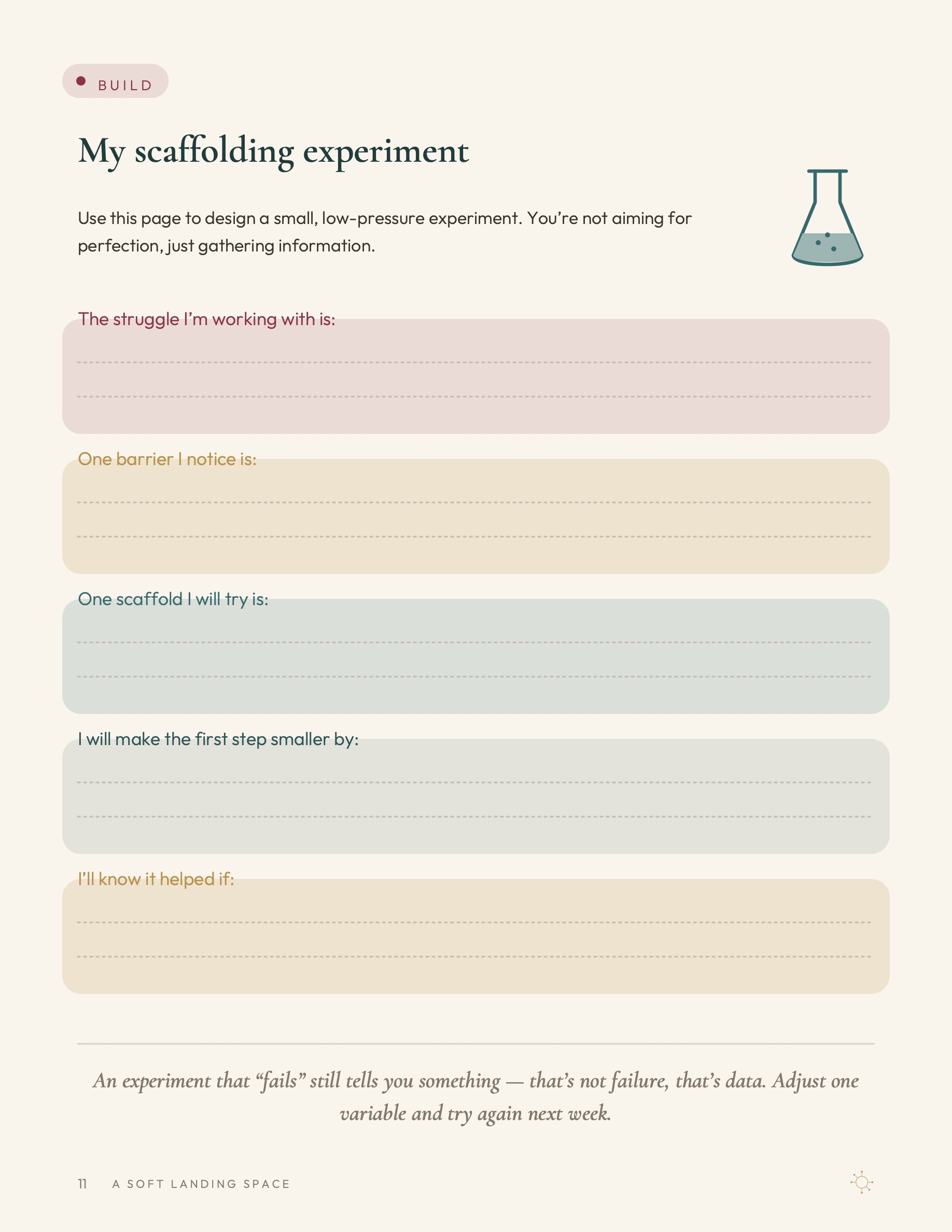
My scaffolding experiment
Use this page to design a small, low-pressure experiment. You're not aiming for perfection, just gathering information.
An experiment that "fails" still tells you something — that's not failure, that's data. Adjust one variable and try again next week.
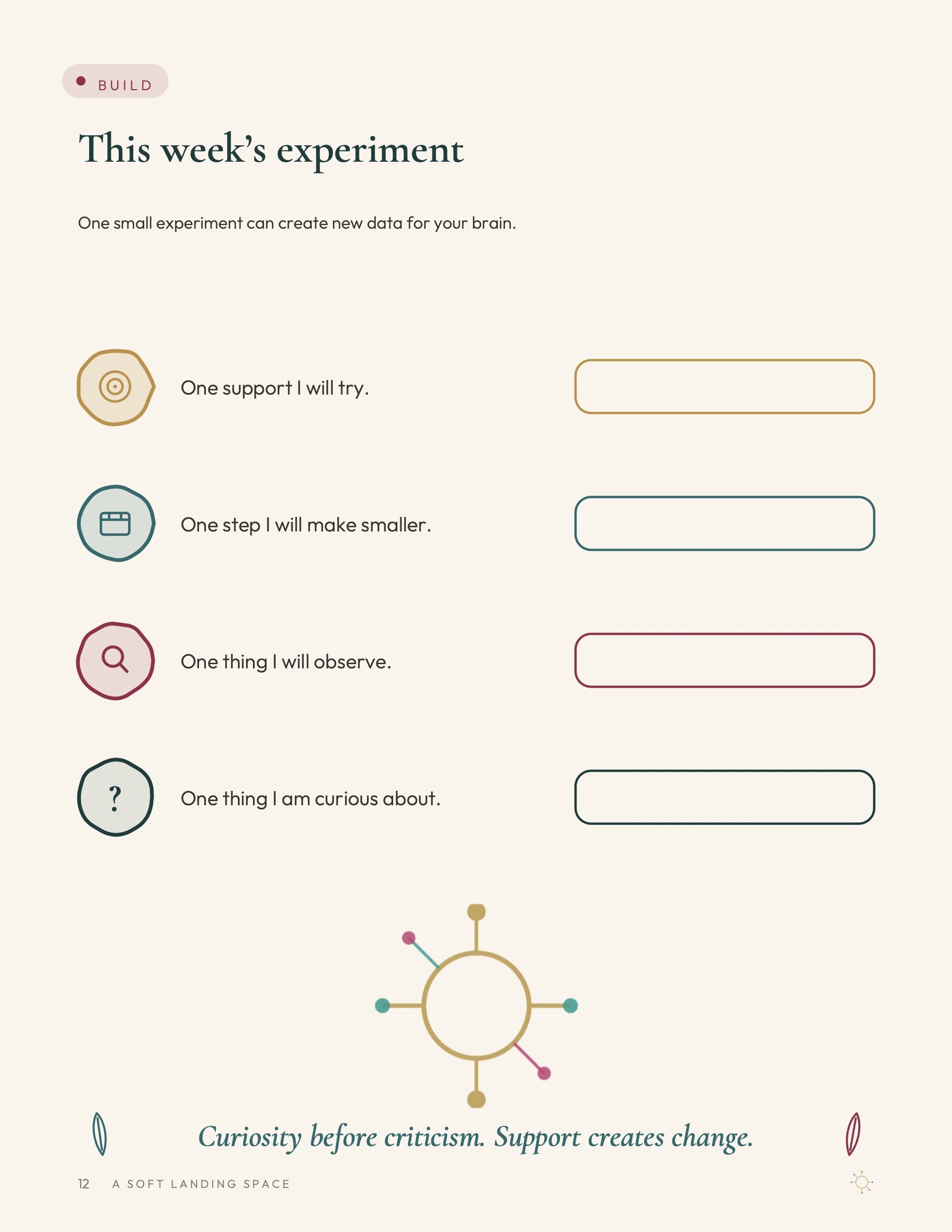
This week's experiment
One small experiment can create new data for your brain.
Curiosity before criticism. Support creates change.