Practice
The I-statement formula.
The I-Statement Formula
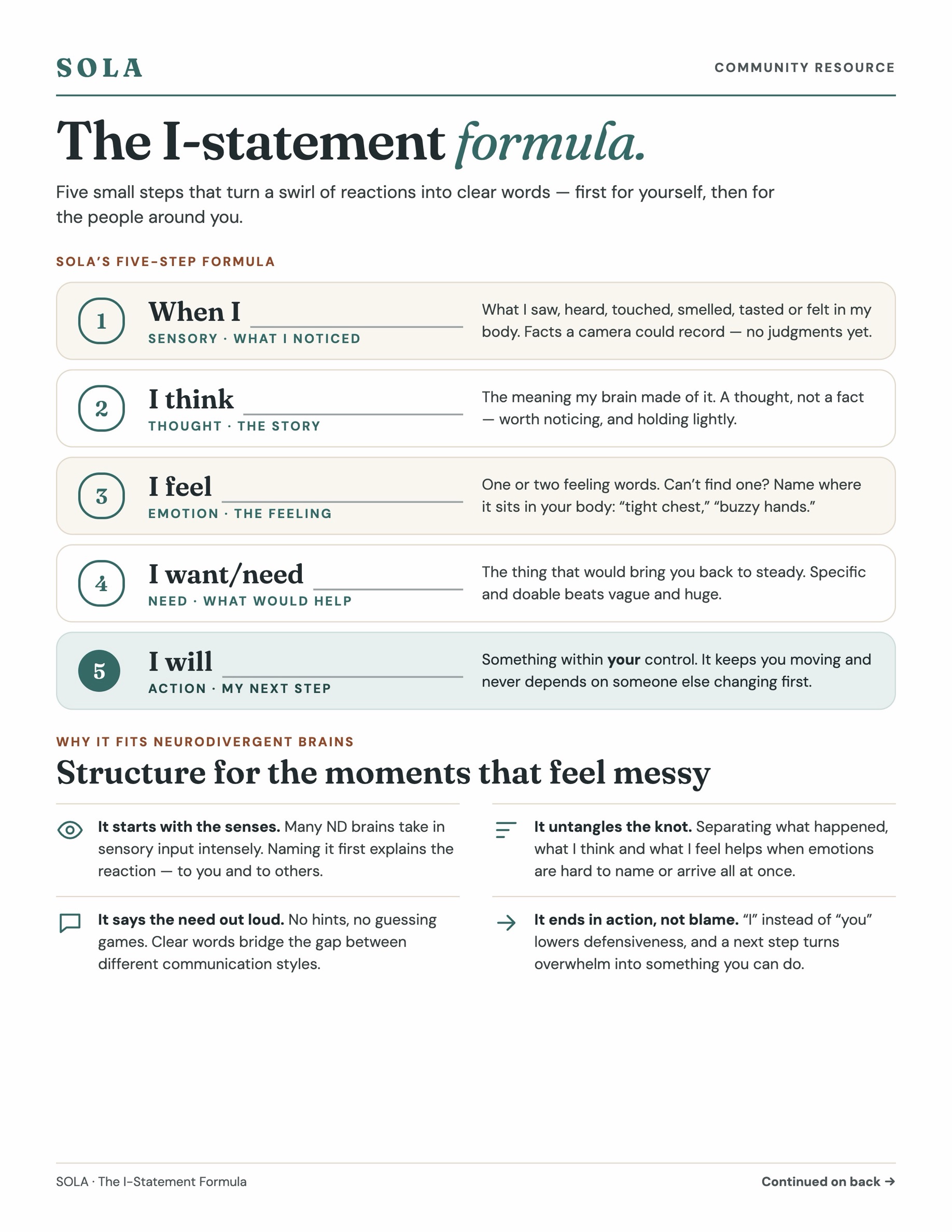
Five small steps that turn a swirl of reactions into clear words — first for yourself, then for the people around you.
The guide, as designed. The same content is written out below.
See page 2
SOLA’s five-step formula
· Sensory · what I noticed
What I saw, heard, touched, smelled, tasted or felt in my body. Facts a camera could record — no judgments yet.
· Thought · the story
The meaning my brain made of it. A thought, not a fact — worth noticing, and holding lightly.
· Emotion · the feeling
One or two feeling words. Can’t find one? Name where it sits in your body: “tight chest,” “buzzy hands.”
· Need · what would help
The thing that would bring you back to steady. Specific and doable beats vague and huge.
· Action · my next step
Something within your control. It keeps you moving and never depends on someone else changing first.
Structure for the moments that feel messy
Why it fits neurodivergent brains
Many ND brains take in sensory input intensely. Naming it first explains the reaction — to you and to others.
No hints, no guessing games. Clear words bridge the gap between different communication styles.
Separating what happened, what I think and what I feel helps when emotions are hard to name or arrive all at once.
“I” instead of “you” lowers defensiveness, and a next step turns overwhelm into something you can do.
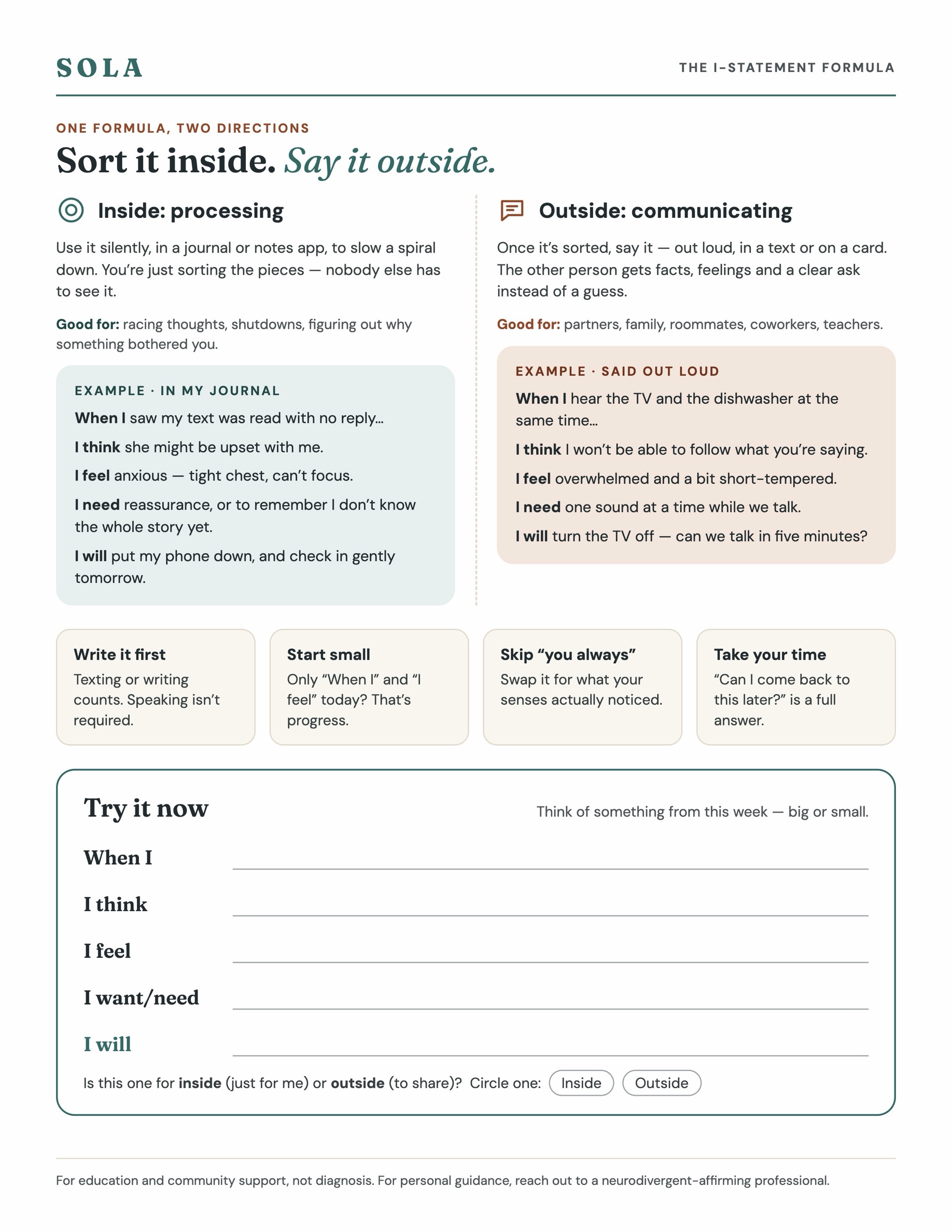
Sort it inside. Say it outside.
One formula, two directions
Use it silently, in a journal or notes app, to slow a spiral down. You’re just sorting the pieces — nobody else has to see it.
Good for: racing thoughts, shutdowns, figuring out why something bothered you.
When I saw my text was read with no reply…
I think she might be upset with me.
I feel anxious — tight chest, can’t focus.
I need reassurance, or to remember I don’t know the whole story yet.
I will put my phone down, and check in gently tomorrow.
Once it’s sorted, say it — out loud, in a text or on a card. The other person gets facts, feelings and a clear ask instead of a guess.
Good for: partners, family, roommates, coworkers, teachers.
When I hear the TV and the dishwasher at the same time…
I think I won’t be able to follow what you’re saying.
I feel overwhelmed and a bit short-tempered.
I need one sound at a time while we talk.
I will turn the TV off — can we talk in five minutes?
Texting or writing counts. Speaking isn’t required.
Only “When I” and “I feel” today? That’s progress.
Swap it for what your senses actually noticed.
“Can I come back to this later?” is a full answer.
Try it now
Think of something from this week — big or small.
Is this one for inside (just for me) or outside (to share)? Circle one: Pick one
- Inside
- Outside
For education and community support, not diagnosis. For personal guidance, reach out to a neurodivergent-affirming professional.
Sources and credits. SOLA · Community Resource · The I-Statement Formula