Learn
The avoidance loop.
Avoiding something scary brings quick relief, so your brain learns to do it again.
The guide, as designed. The same content is written out below.
See page 2
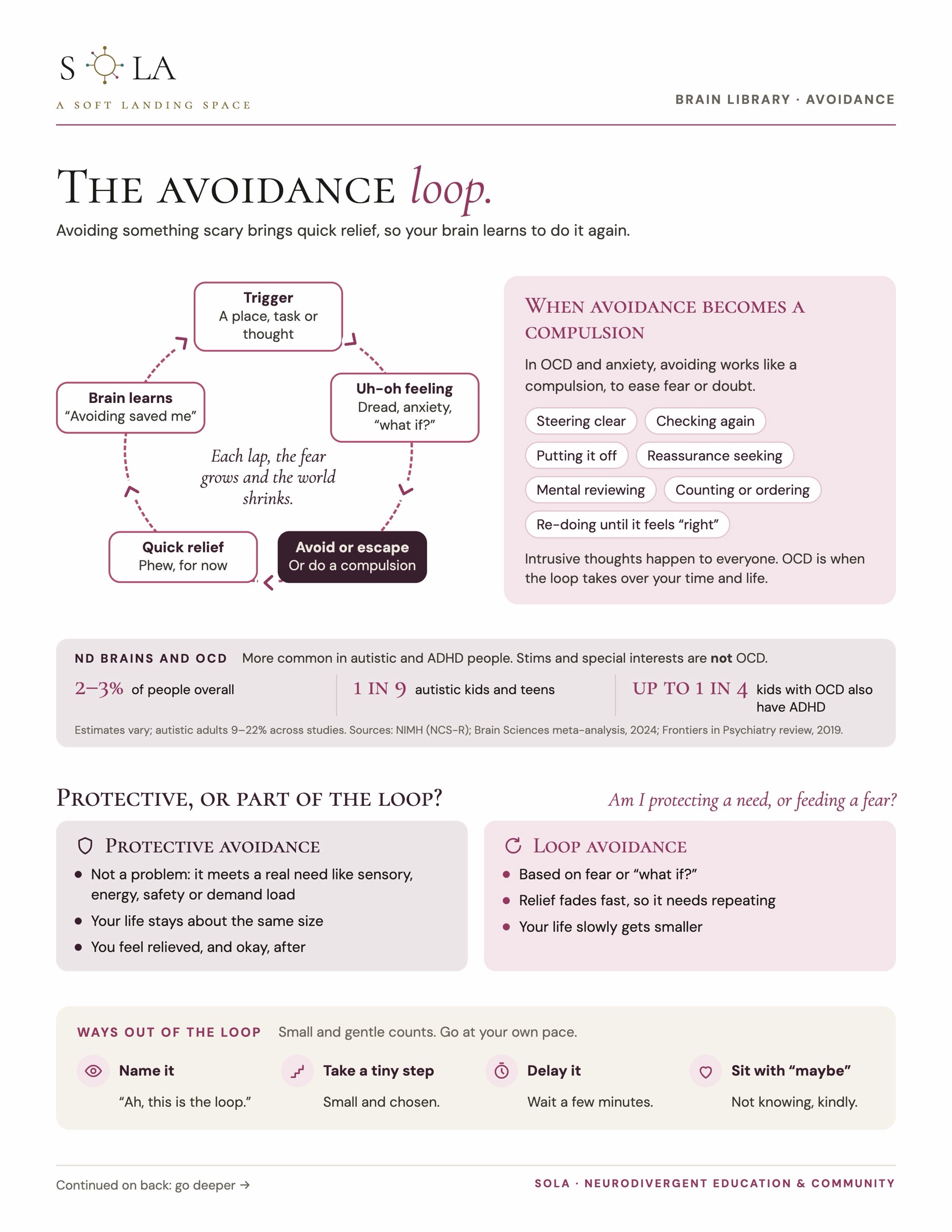
A circle of five steps, round and round:
Trigger. A place, task or thought
Uh-oh feeling. Dread, anxiety, "what if?"
Avoid or escape. Or do a compulsion
Quick relief. Phew, for now
Brain learns. "Avoiding saved me"
Each lap, the fear grows and the world shrinks.
When avoidance becomes a compulsion
In OCD and anxiety, avoiding works like a compulsion, to ease fear or doubt.
- Steering clear
- Checking again
- Putting it off
- Reassurance seeking
- Mental reviewing
- Counting or ordering
- Re-doing until it feels "right"
Intrusive thoughts happen to everyone. OCD is when the loop takes over your time and life.
ND brains and OCD
More common in autistic and ADHD people. Stims and special interests are not OCD.
2–3% of people overall
1 in 9 autistic kids and teens
Up to 1 in 4 kids with OCD also have ADHD
Estimates vary; autistic adults 9–22% across studies. Sources: NIMH (NCS-R); Brain Sciences meta-analysis, 2024; Frontiers in Psychiatry review, 2019.
Protective, or part of the loop?
Am I protecting a need, or feeding a fear?
- Not a problem: it meets a real need like sensory, energy, safety or demand load
- Your life stays about the same size
- You feel relieved, and okay, after
- Based on fear or "what if?"
- Relief fades fast, so it needs repeating
- Your life slowly gets smaller
Ways out of the loop
Small and gentle counts. Go at your own pace.
Name it. "Ah, this is the loop."
Take a tiny step. Small and chosen.
Delay it. Wait a few minutes.
Sit with "maybe". Not knowing, kindly.
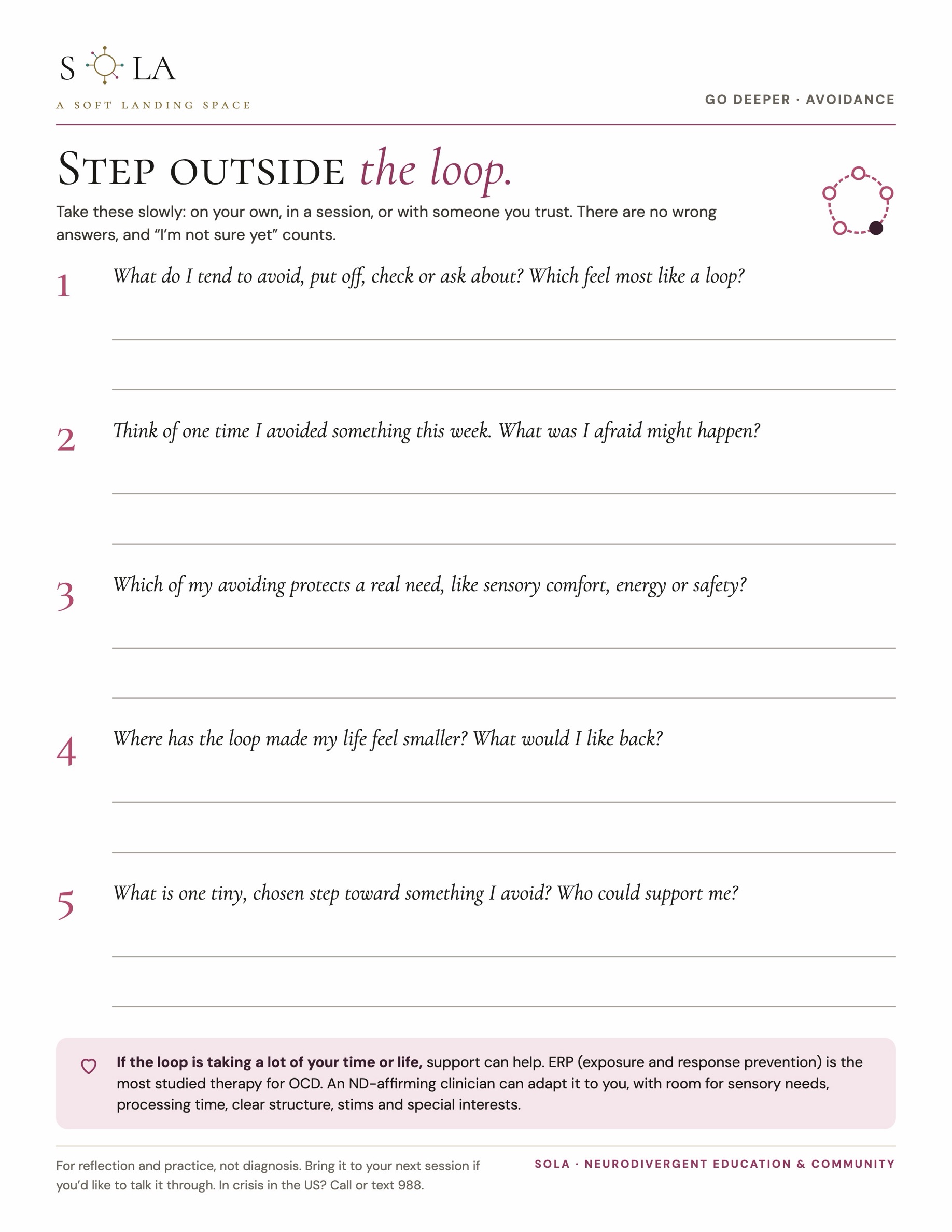
Step outside the loop.
Take these slowly: on your own, in a session, or with someone you trust. There are no wrong answers, and "I'm not sure yet" counts.
If the loop is taking a lot of your time or life, support can help. ERP (exposure and response prevention) is the most studied therapy for OCD. An ND-affirming clinician can adapt it to you, with room for sensory needs, processing time, clear structure, stims and special interests.
For reflection and practice, not diagnosis. Bring it to your next session if you'd like to talk it through. In crisis in the US? Call or text 988.
Sources and credits. Brain Library · Avoidance. SOLA · Neurodivergent education & community. Estimates vary; autistic adults 9–22% across studies. Sources: NIMH (NCS-R); Brain Sciences meta-analysis, 2024; Frontiers in Psychiatry review, 2019.