Learn
Spaciousness
ACT Skills · Spaciousness
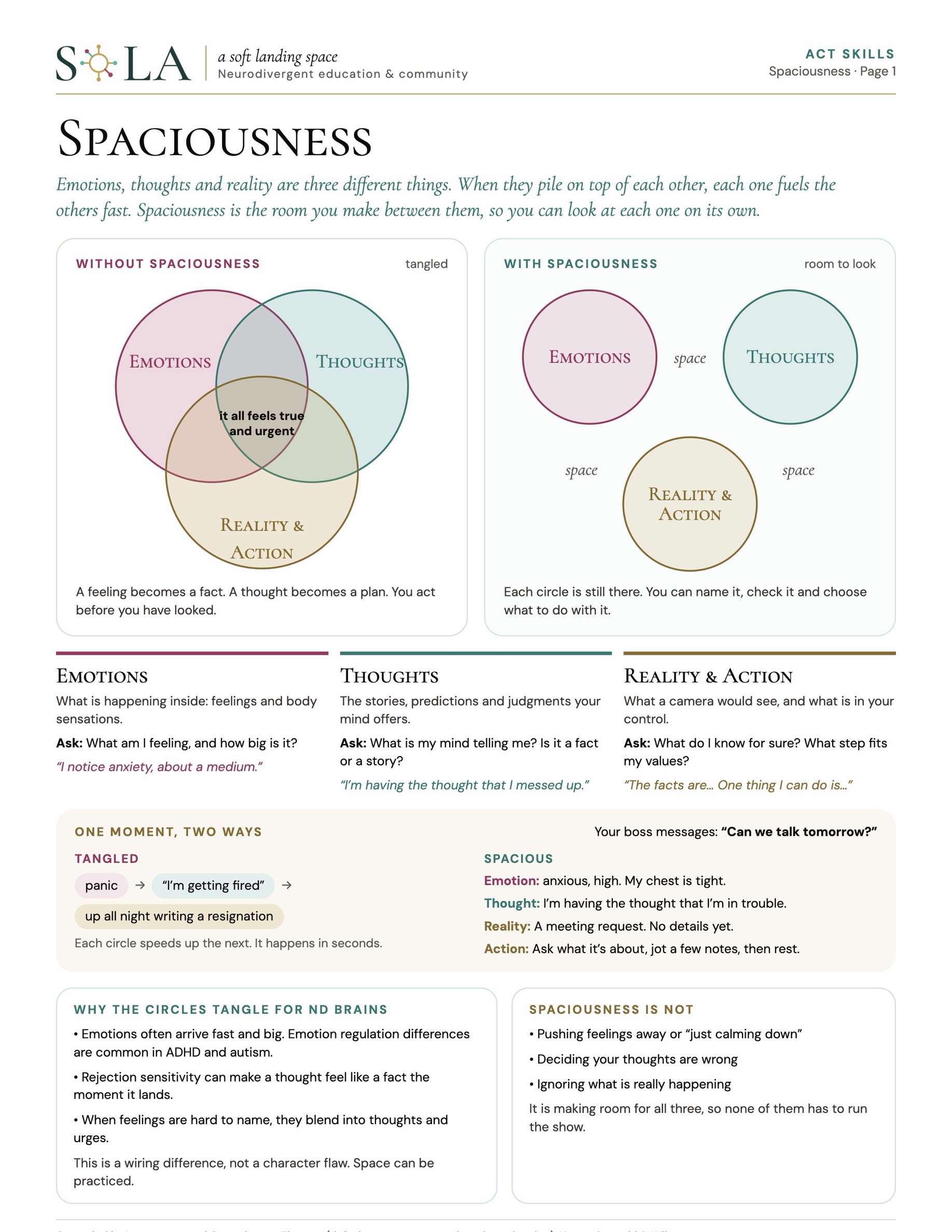
Emotions, thoughts and reality are three different things. When they pile on top of each other, each one fuels the others fast. Spaciousness is the room you make between them, so you can look at each one on its own.
Pairs with: Feelings & Sensations Scale
The guide, as designed. The same content is written out below.
See page 2
Without spaciousness
tangled
Three overlapping circles, Emotions, Thoughts and Reality & Action, with the middle reading: it all feels true and urgent.
A feeling becomes a fact. A thought becomes a plan. You act before you have looked.
With spaciousness
room to look
The same three circles, Emotions, Thoughts and Reality & Action, with space between each of them.
Each circle is still there. You can name it, check it and choose what to do with it.
What is happening inside: feelings and body sensations.
Ask: What am I feeling, and how big is it?
"I notice anxiety, about a medium."
The stories, predictions and judgments your mind offers.
Ask: What is my mind telling me? Is it a fact or a story?
"I'm having the thought that I messed up."
What a camera would see, and what is in your control.
Ask: What do I know for sure? What step fits my values?
"The facts are… One thing I can do is…"
One moment, two ways
Your boss messages: "Can we talk tomorrow?"
panic → "I'm getting fired" → up all night writing a resignation
Each circle speeds up the next. It happens in seconds.
- Emotion: anxious, high. My chest is tight.
- Thought: I'm having the thought that I'm in trouble.
- Reality: A meeting request. No details yet.
- Action: Ask what it's about, jot a few notes, then rest.
Why the circles tangle for ND brains
- Emotions often arrive fast and big. Emotion regulation differences are common in ADHD and autism.
- Rejection sensitivity can make a thought feel like a fact the moment it lands.
- When feelings are hard to name, they blend into thoughts and urges.
This is a wiring difference, not a character flaw. Space can be practiced.
Spaciousness is not
- Pushing feelings away or "just calming down"
- Deciding your thoughts are wrong
- Ignoring what is really happening
It is making room for all three, so none of them has to run the show.
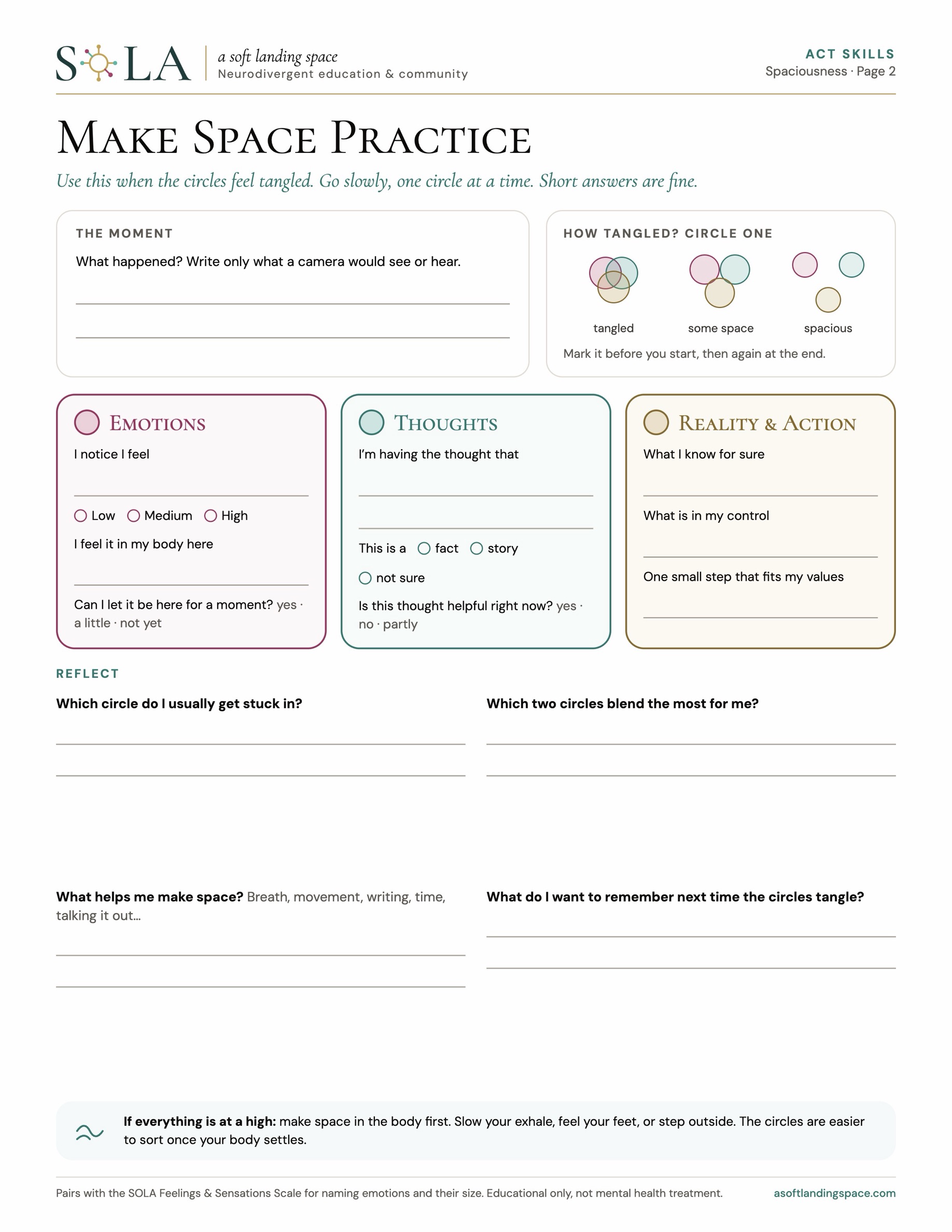
Make Space Practice
Use this when the circles feel tangled. Go slowly, one circle at a time. Short answers are fine.
How tangled? Circle one Pick one
Mark it before you start, then again at the end.- tangled
- some space
- spacious
Emotions
How big Pick one
- Low
- Medium
- High
Can I let it be here for a moment? Pick one
- yes
- a little
- not yet
Thoughts
This is a Pick one
- fact
- story
- not sure
Is this thought helpful right now? Pick one
- yes
- no
- partly
Reality & Action
Reflect
If everything is at a high: make space in the body first. Slow your exhale, feel your feet, or step outside. The circles are easier to sort once your body settles.
Educational only, not mental health treatment.
Sources and credits. Pairs with the SOLA Feelings & Sensations Scale for naming emotions and their size.