Learn
Misunderstanding goes both ways.
Brain Library · Double Empathy
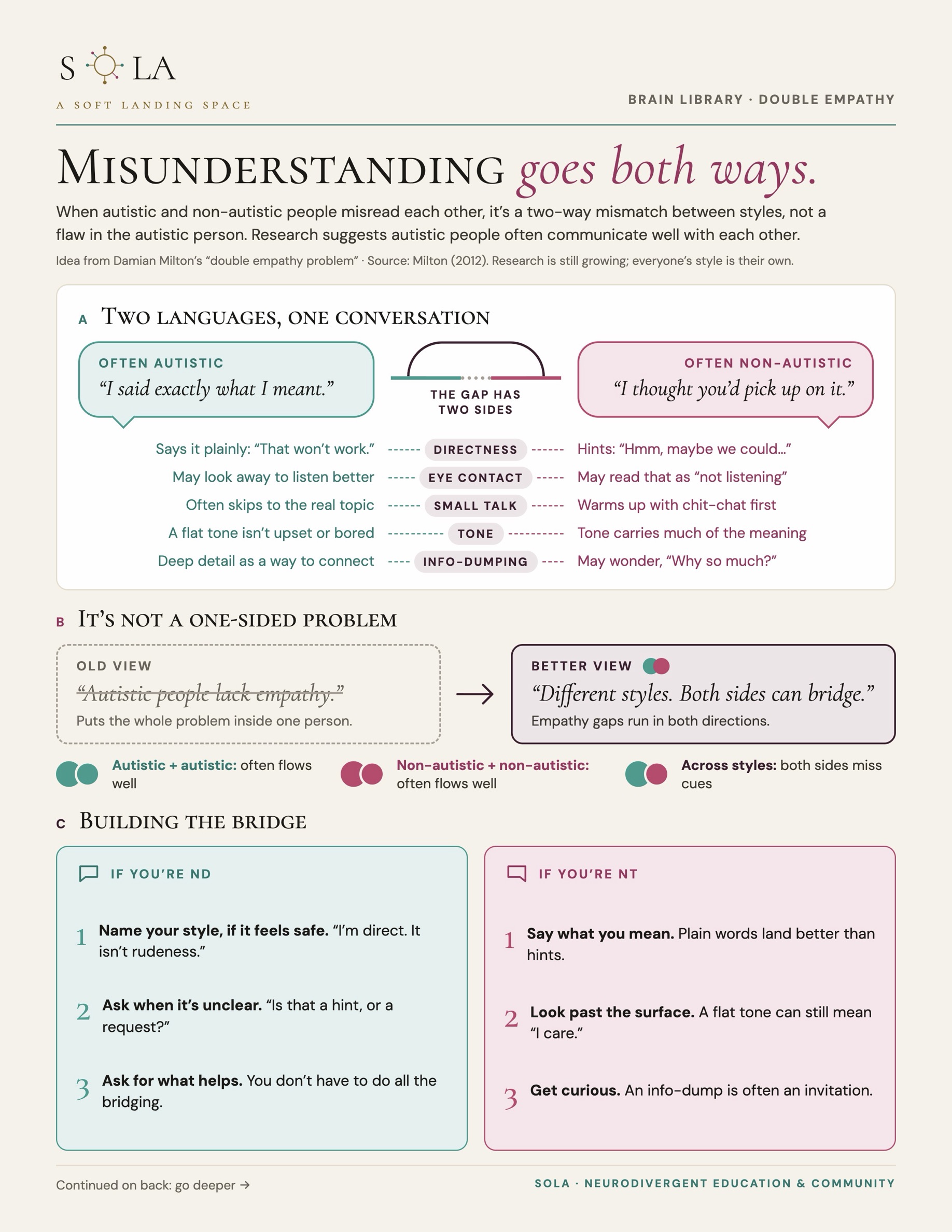
When autistic and non-autistic people misread each other, it’s a two-way mismatch between styles, not a flaw in the autistic person. Research suggests autistic people often communicate well with each other.
The guide, as designed. The same content is written out below.
See page 2
A · Two languages, one conversation
“I said exactly what I meant.”
“I thought you’d pick up on it.”
Says it plainly: “That won’t work.” / Hints: “Hmm, maybe we could…”
May look away to listen better / May read that as “not listening”
Often skips to the real topic / Warms up with chit-chat first
A flat tone isn’t upset or bored / Tone carries much of the meaning
Deep detail as a way to connect / May wonder, “Why so much?”
B · It’s not a one-sided problem
“Autistic people lack empathy.” Puts the whole problem inside one person.
“Different styles. Both sides can bridge.” Empathy gaps run in both directions.
- Autistic + autistic: often flows well
- Non-autistic + non-autistic: often flows well
- Across styles: both sides miss cues
C · Building the bridge
- 1 Name your style, if it feels safe. “I’m direct. It isn’t rudeness.”
- 2 Ask when it’s unclear. “Is that a hint, or a request?”
- 3 Ask for what helps. You don’t have to do all the bridging.
- 1 Say what you mean. Plain words land better than hints.
- 2 Look past the surface. A flat tone can still mean “I care.”
- 3 Get curious. An info-dump is often an invitation.
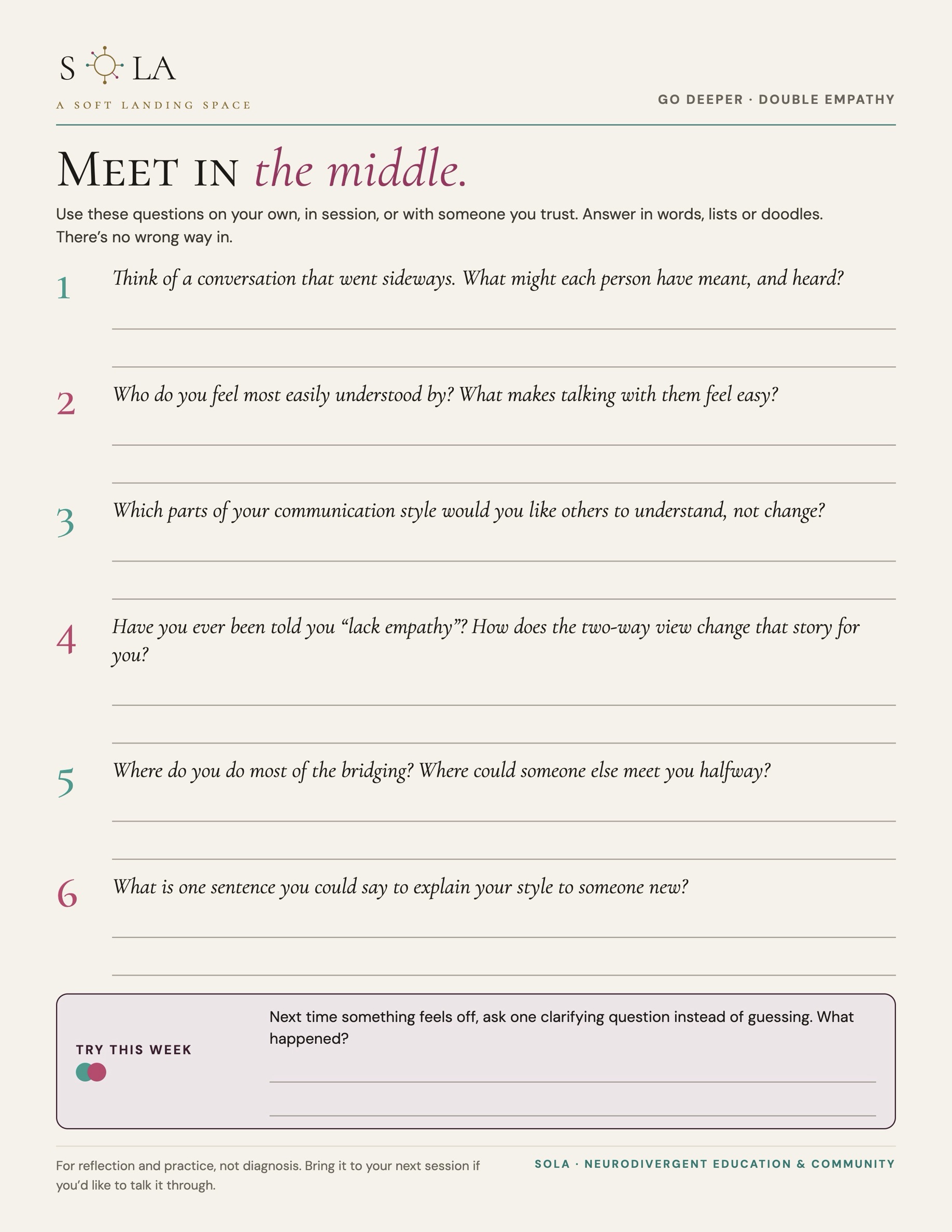
Meet in the middle.
Use these questions on your own, in session, or with someone you trust. Answer in words, lists or doodles. There’s no wrong way in.
Try this week
For reflection and practice, not diagnosis. Bring it to your next session if you’d like to talk it through.
Sources and credits. Idea from Damian Milton’s “double empathy problem” · Source: Milton (2012). Research is still growing; everyone’s style is their own. SOLA · Neurodivergent Education & Community