Learn
Transitions and Change
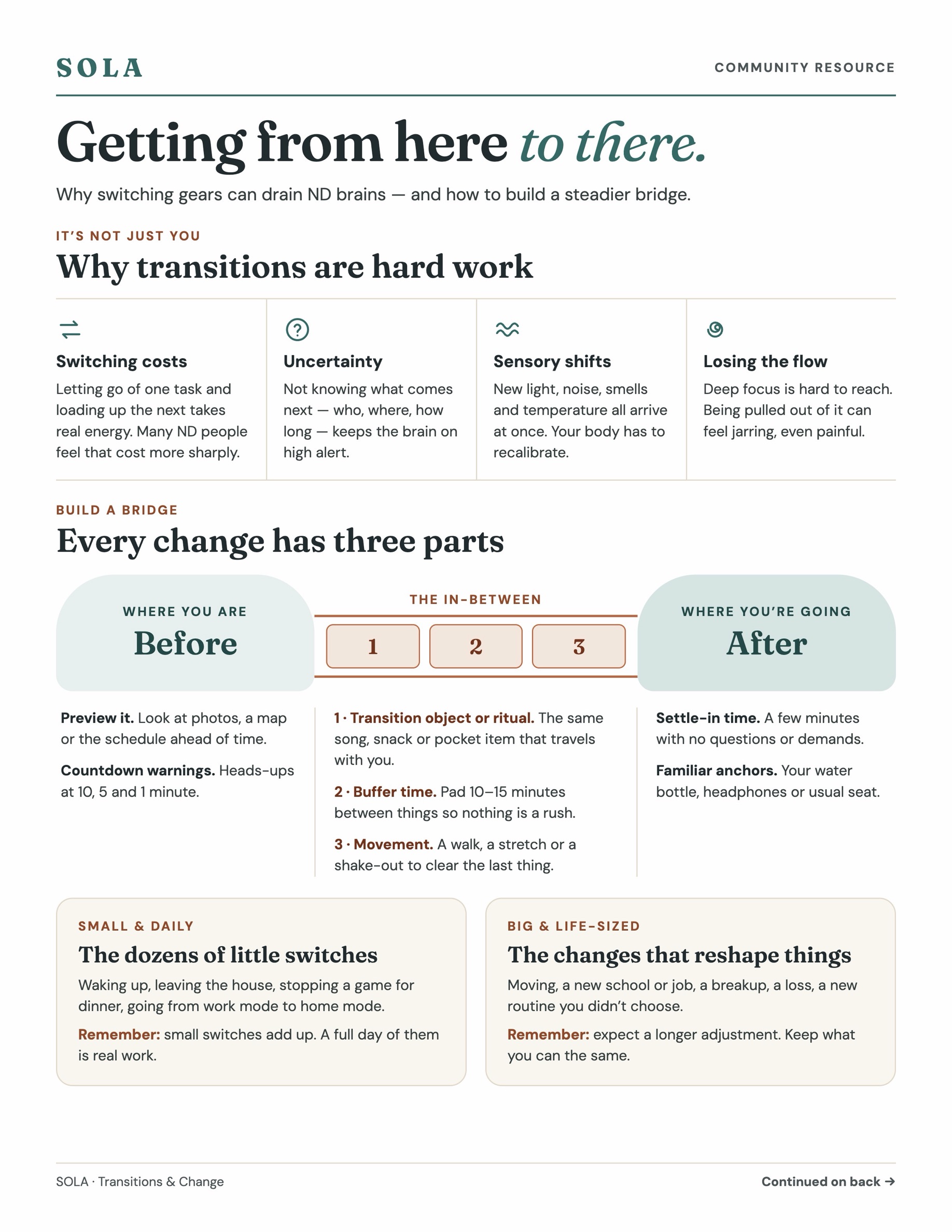
Getting from here to there.
Why switching gears can drain ND brains — and how to build a steadier bridge.
The guide, as designed. The same content is written out below.
See page 2
Why transitions are hard work
It's not just you
Letting go of one task and loading up the next takes real energy. Many ND people feel that cost more sharply.
Not knowing what comes next — who, where, how long — keeps the brain on high alert.
New light, noise, smells and temperature all arrive at once. Your body has to recalibrate.
Deep focus is hard to reach. Being pulled out of it can feel jarring, even painful.
Every change has three parts
Build a bridge
Preview it. Look at photos, a map or the schedule ahead of time.
Countdown warnings. Heads-ups at 10, 5 and 1 minute.
1 · Transition object or ritual. The same song, snack or pocket item that travels with you.
2 · Buffer time. Pad 10–15 minutes between things so nothing is a rush.
3 · Movement. A walk, a stretch or a shake-out to clear the last thing.
Settle-in time. A few minutes with no questions or demands.
Familiar anchors. Your water bottle, headphones or usual seat.
Waking up, leaving the house, stopping a game for dinner, going from work mode to home mode.
Remember: small switches add up. A full day of them is real work.
Moving, a new school or job, a breakup, a loss, a new routine you didn't choose.
Remember: expect a longer adjustment. Keep what you can the same.
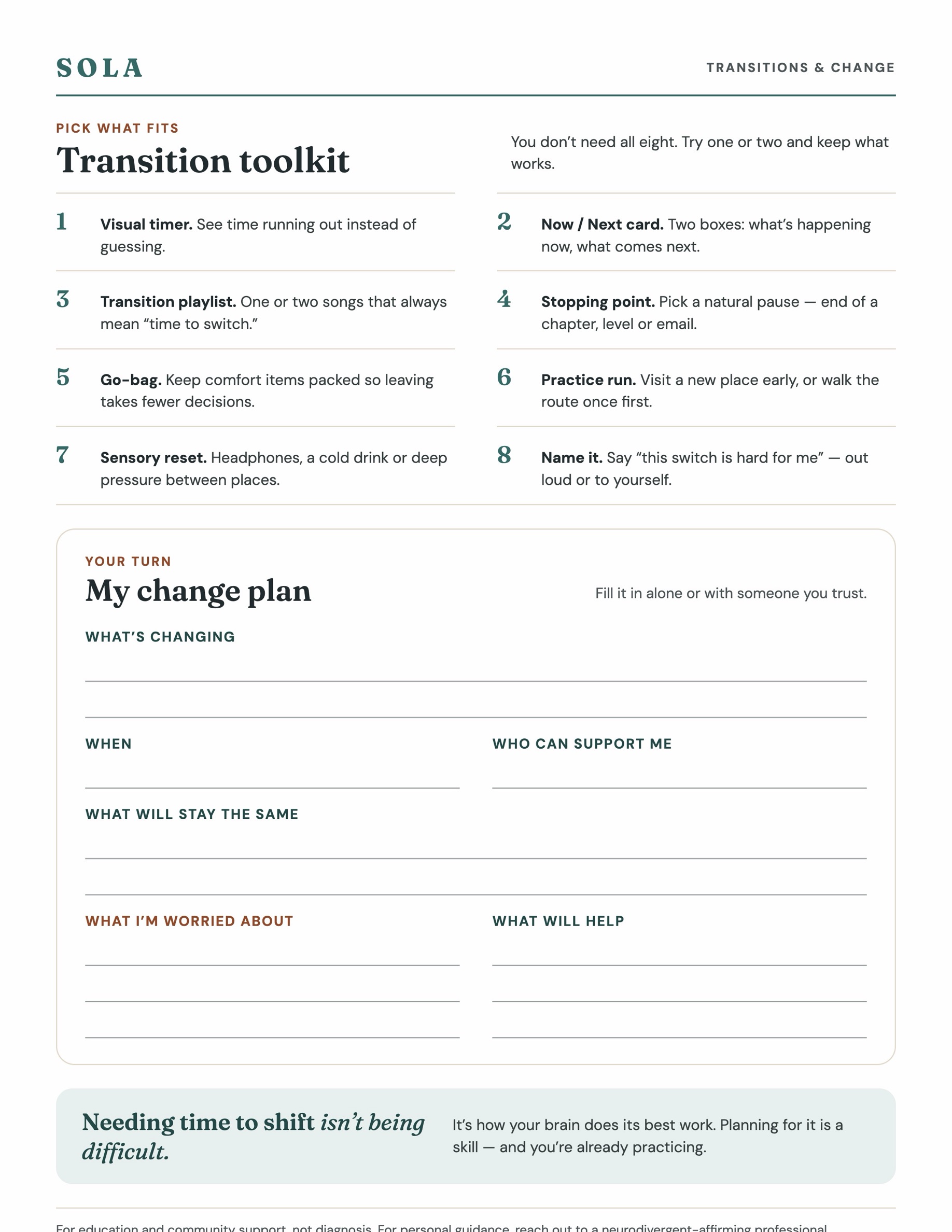
Transition toolkit
Pick what fits. You don't need all eight. Try one or two and keep what works.
See time running out instead of guessing.
Two boxes: what's happening now, what comes next.
One or two songs that always mean "time to switch."
Pick a natural pause — end of a chapter, level or email.
Keep comfort items packed so leaving takes fewer decisions.
Visit a new place early, or walk the route once first.
Headphones, a cold drink or deep pressure between places.
Say "this switch is hard for me" — out loud or to yourself.
My change plan
Your turn. Fill it in alone or with someone you trust.
Needing time to shift isn't being difficult. It's how your brain does its best work. Planning for it is a skill — and you're already practicing.
For education and community support, not diagnosis. For personal guidance, reach out to a neurodivergent-affirming professional.