Support
Fed Is Best
Low-spoon ways to feed yourself when cooking is not happening
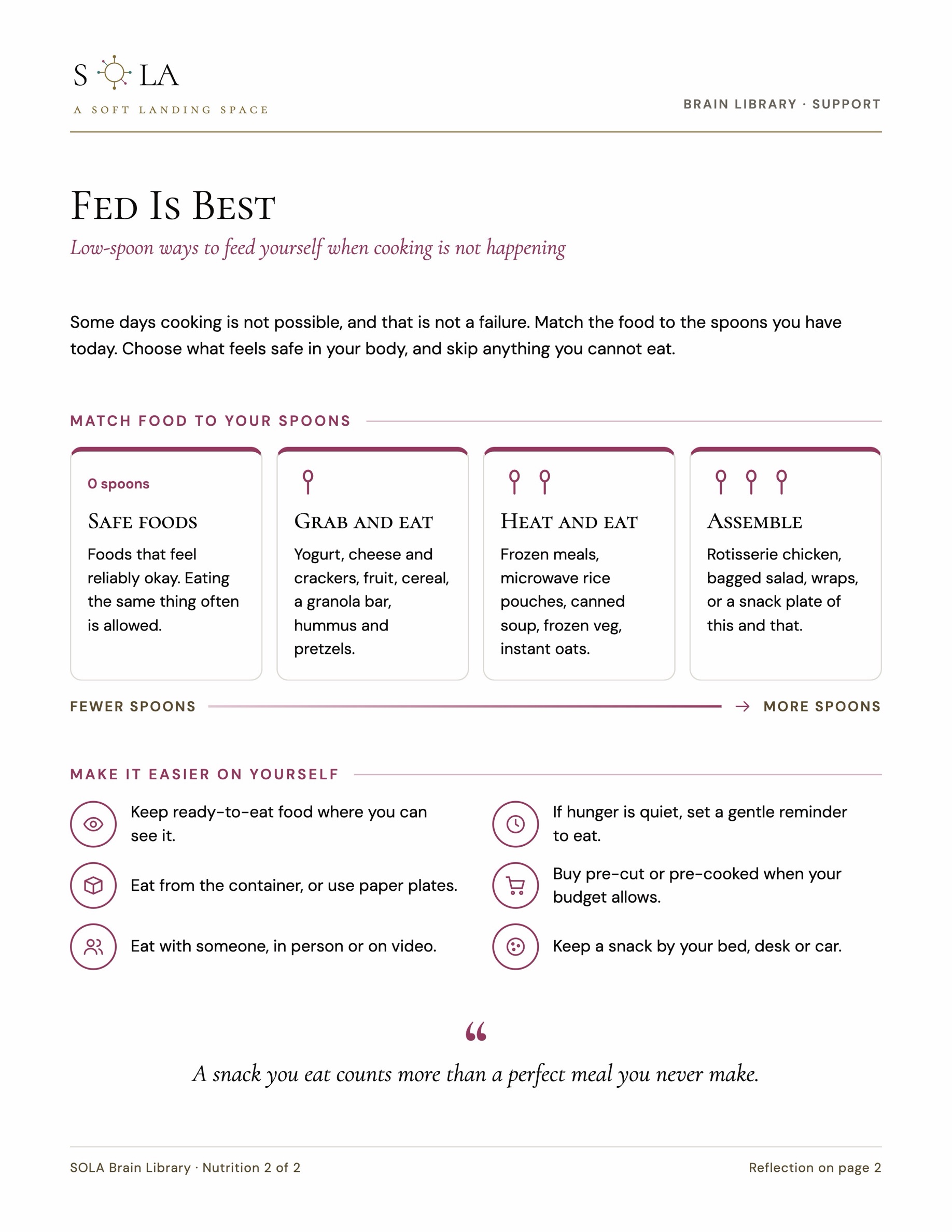
Some days cooking is not possible, and that is not a failure. Match the food to the spoons you have today. Choose what feels safe in your body, and skip anything you cannot eat.
The guide, as designed. The same content is written out below.
See page 2
Match food to your spoons
Fewer spoons → more spoons
(0 spoons): Foods that feel reliably okay. Eating the same thing often is allowed.
(1 spoon): Yogurt, cheese and crackers, fruit, cereal, a granola bar, hummus and pretzels.
(2 spoons): Frozen meals, microwave rice pouches, canned soup, frozen veg, instant oats.
(3 spoons): Rotisserie chicken, bagged salad, wraps, or a snack plate of this and that.
Make it easier on yourself
- Keep ready-to-eat food where you can see it.
- Eat from the container, or use paper plates.
- Eat with someone, in person or on video.
- If hunger is quiet, set a gentle reminder to eat.
- Buy pre-cut or pre-cooked when your budget allows.
- Keep a snack by your bed, desk or car.
A snack you eat counts more than a perfect meal you never make.
Why low-spoon eating matters
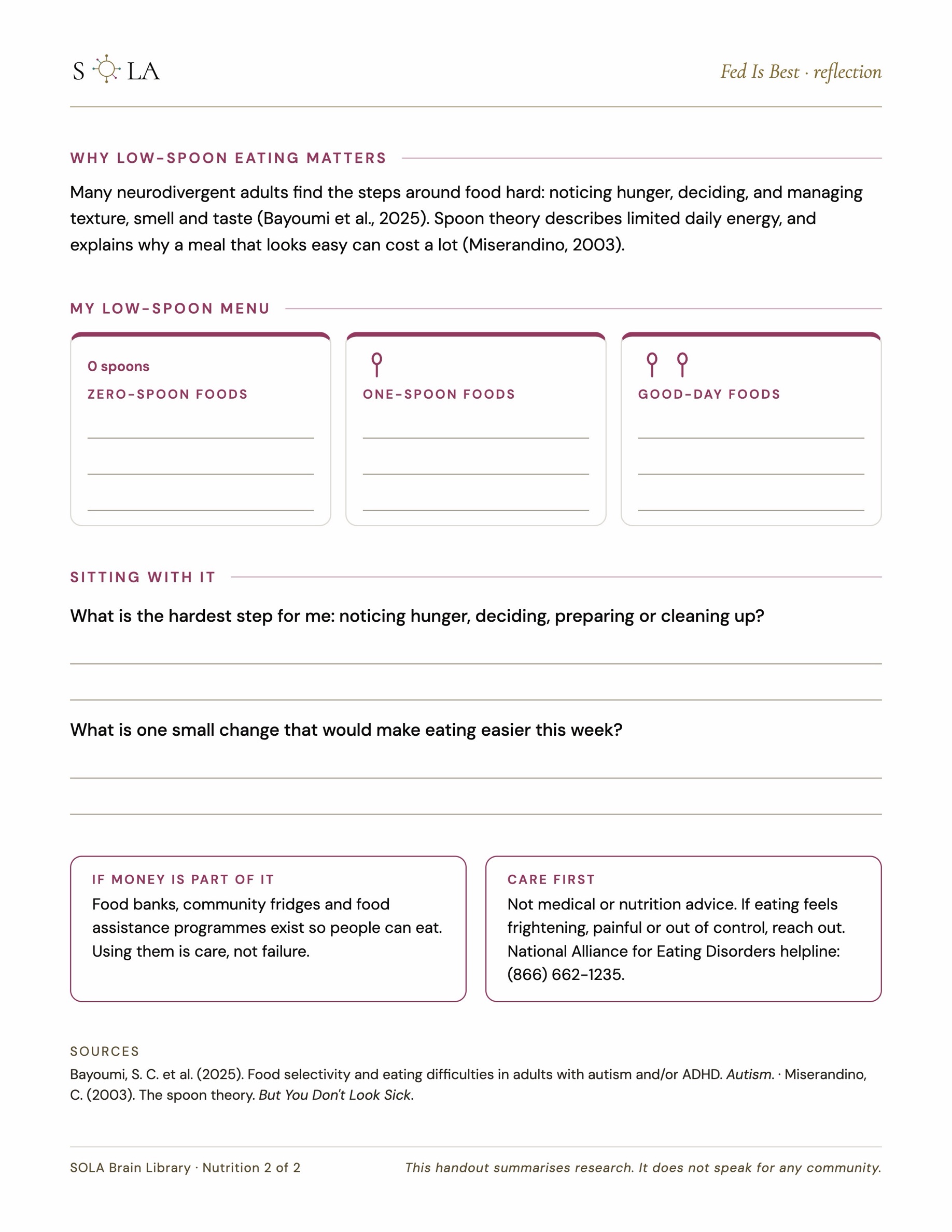
Many neurodivergent adults find the steps around food hard: noticing hunger, deciding, and managing texture, smell and taste (Bayoumi et al., 2025). Spoon theory describes limited daily energy, and explains why a meal that looks easy can cost a lot (Miserandino, 2003).
My low-spoon menu
Zero-spoon foods
0 spoonsOne-spoon foods
1 spoonGood-day foods
2 spoonsSitting with it
If money is part of it
Food banks, community fridges and food assistance programmes exist so people can eat. Using them is care, not failure.
Care first
Not medical or nutrition advice. If eating feels frightening, painful or out of control, reach out. National Alliance for Eating Disorders helpline: (866) 662-1235.
Care first. Not medical or nutrition advice. If eating feels frightening, painful or out of control, reach out. National Alliance for Eating Disorders helpline: (866) 662-1235.
Sources and credits. SOLA Brain Library · Nutrition 2 of 2. This handout summarises research. It does not speak for any community. Sources: Bayoumi, S. C. et al. (2025). Food selectivity and eating difficulties in adults with autism and/or ADHD. Autism. · Miserandino, C. (2003). The spoon theory. But You Don't Look Sick.