Learn
Hard to start, hard to stop.
Brain Library · Inertia and Hyperfocus
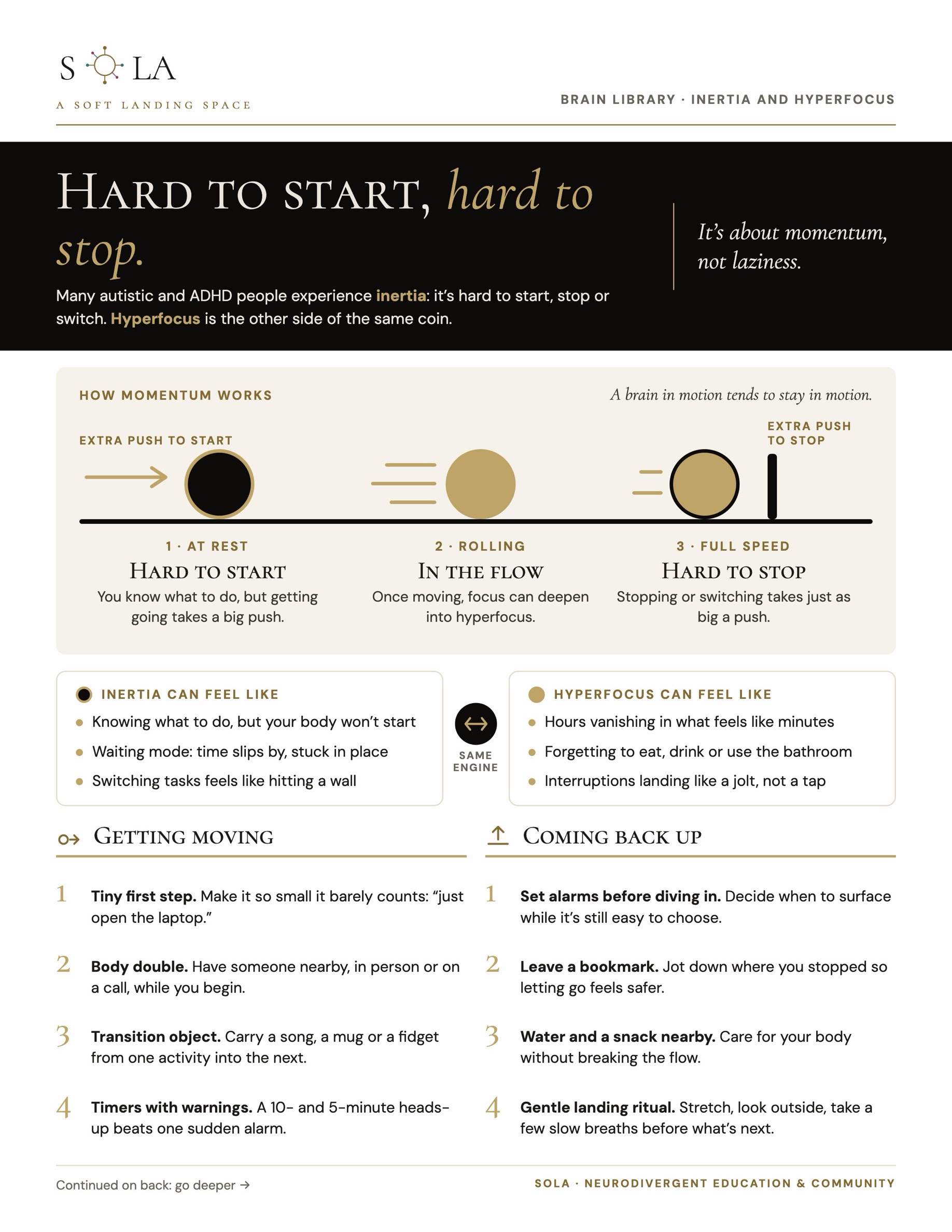
Many autistic and ADHD people experience inertia: it’s hard to start, stop or switch. Hyperfocus is the other side of the same coin.
It’s about momentum, not laziness.
The guide, as designed. The same content is written out below.
See page 2
How momentum works
A brain in motion tends to stay in motion.
A ball on a line: it takes an extra push to start, and an extra push to stop.
You know what to do, but getting going takes a big push.
Once moving, focus can deepen into hyperfocus.
Stopping or switching takes just as big a push.
Inertia can feel like
- Knowing what to do, but your body won’t start
- Waiting mode: time slips by, stuck in place
- Switching tasks feels like hitting a wall
Same engine.
Hyperfocus can feel like
- Hours vanishing in what feels like minutes
- Forgetting to eat, drink or use the bathroom
- Interruptions landing like a jolt, not a tap
Getting moving
Make it so small it barely counts: “just open the laptop.”
Have someone nearby, in person or on a call, while you begin.
Carry a song, a mug or a fidget from one activity into the next.
A 10- and 5-minute heads-up beats one sudden alarm.
Coming back up
Decide when to surface while it’s still easy to choose.
Jot down where you stopped so letting go feels safer.
Care for your body without breaking the flow.
Stretch, look outside, take a few slow breaths before what’s next.
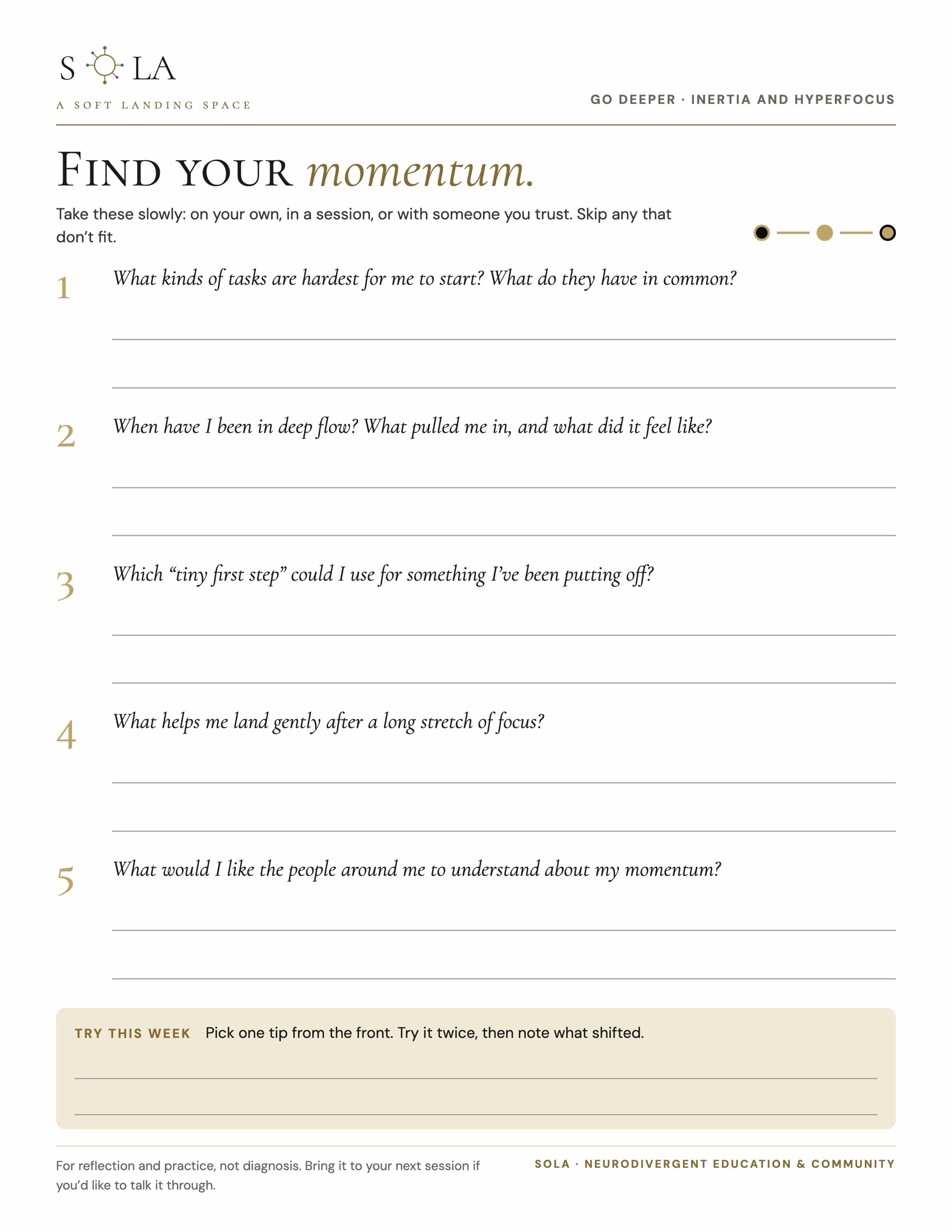
Find your momentum.
Take these slowly: on your own, in a session, or with someone you trust. Skip any that don’t fit.
Try this week
For reflection and practice, not diagnosis. Bring it to your next session if you’d like to talk it through.