Practice
The Cost of Holding It Together
Masking, hidden load & capacity
A workbook for noticing the work under the work: the energy it takes to mask, to filter, to keep up. Go at your own pace. Skip anything that doesn’t fit today.
The workbook, as designed. The same content is written out below.
See the other 11 pages
Workbook · Neurodivergent Burnout · Week 2
Understand · Support · Connect · Build
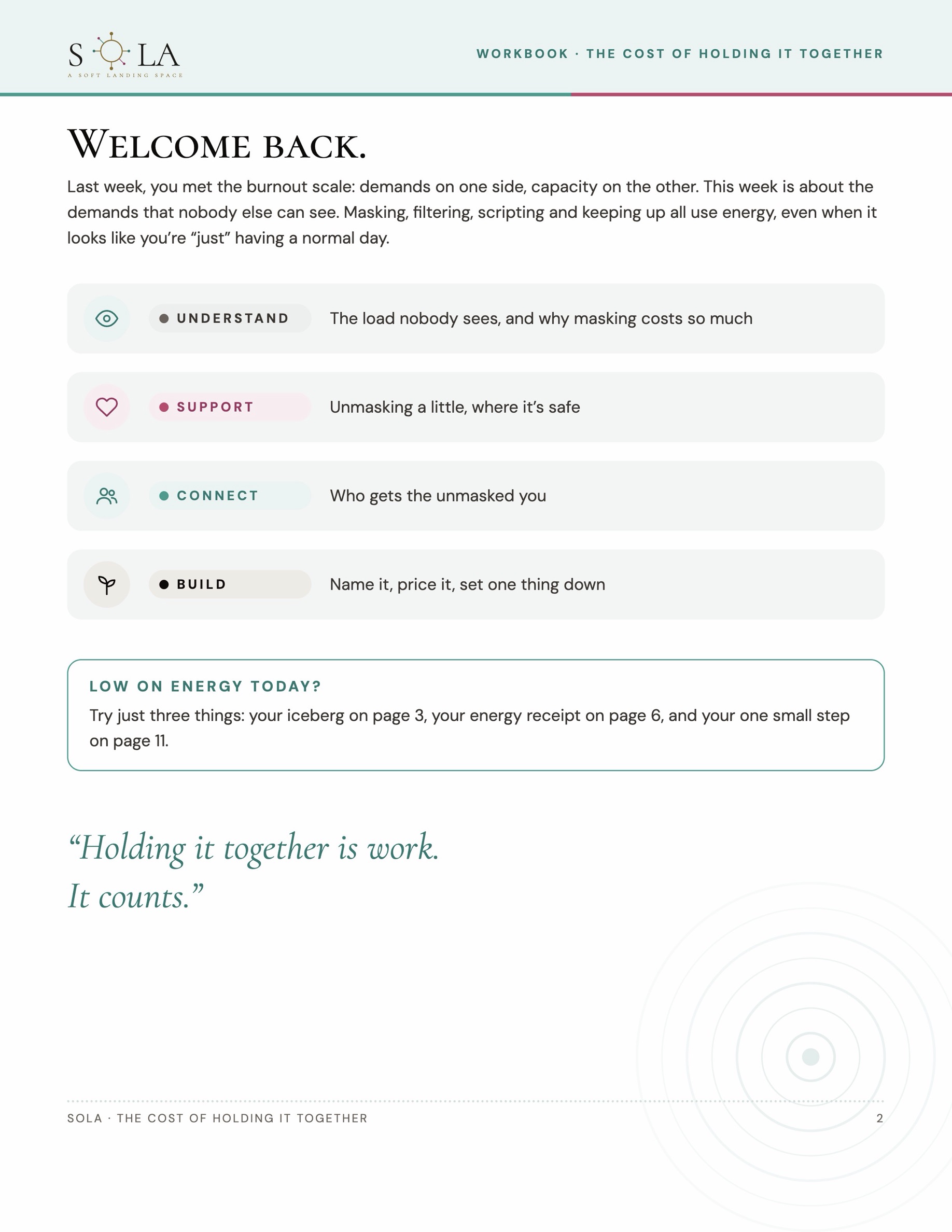
Welcome back.
Last week, you met the burnout scale: demands on one side, capacity on the other. This week is about the demands that nobody else can see. Masking, filtering, scripting and keeping up all use energy, even when it looks like you’re “just” having a normal day.
- UNDERSTAND: The load nobody sees, and why masking costs so much
- SUPPORT: Unmasking a little, where it’s safe
- CONNECT: Who gets the unmasked you
- BUILD: Name it, price it, set one thing down
LOW ON ENERGY TODAY? Try just three things: your iceberg on page 3, your energy receipt on page 6, and your one small step on page 11.
“Holding it together is work. It counts.”
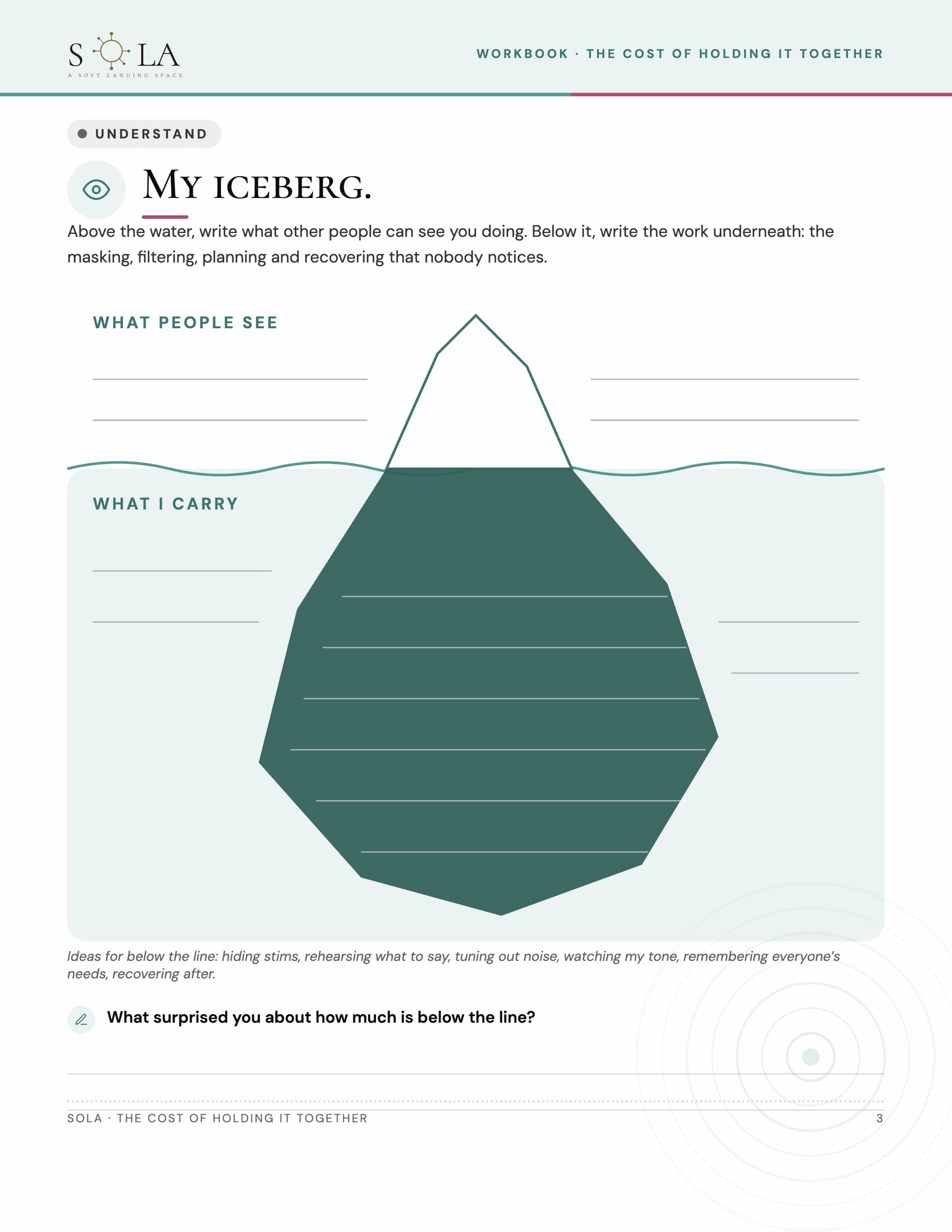
My iceberg.
Above the water, write what other people can see you doing. Below it, write the work underneath: the masking, filtering, planning and recovering that nobody notices.
On the sheet this is an iceberg: a few lines above the waterline, and many more inside and around the submerged part below.
WHAT PEOPLE SEE
WHAT I CARRY
Ideas for below the line: hiding stims, rehearsing what to say, tuning out noise, watching my tone, remembering everyone’s needs, recovering after.Why I mask.
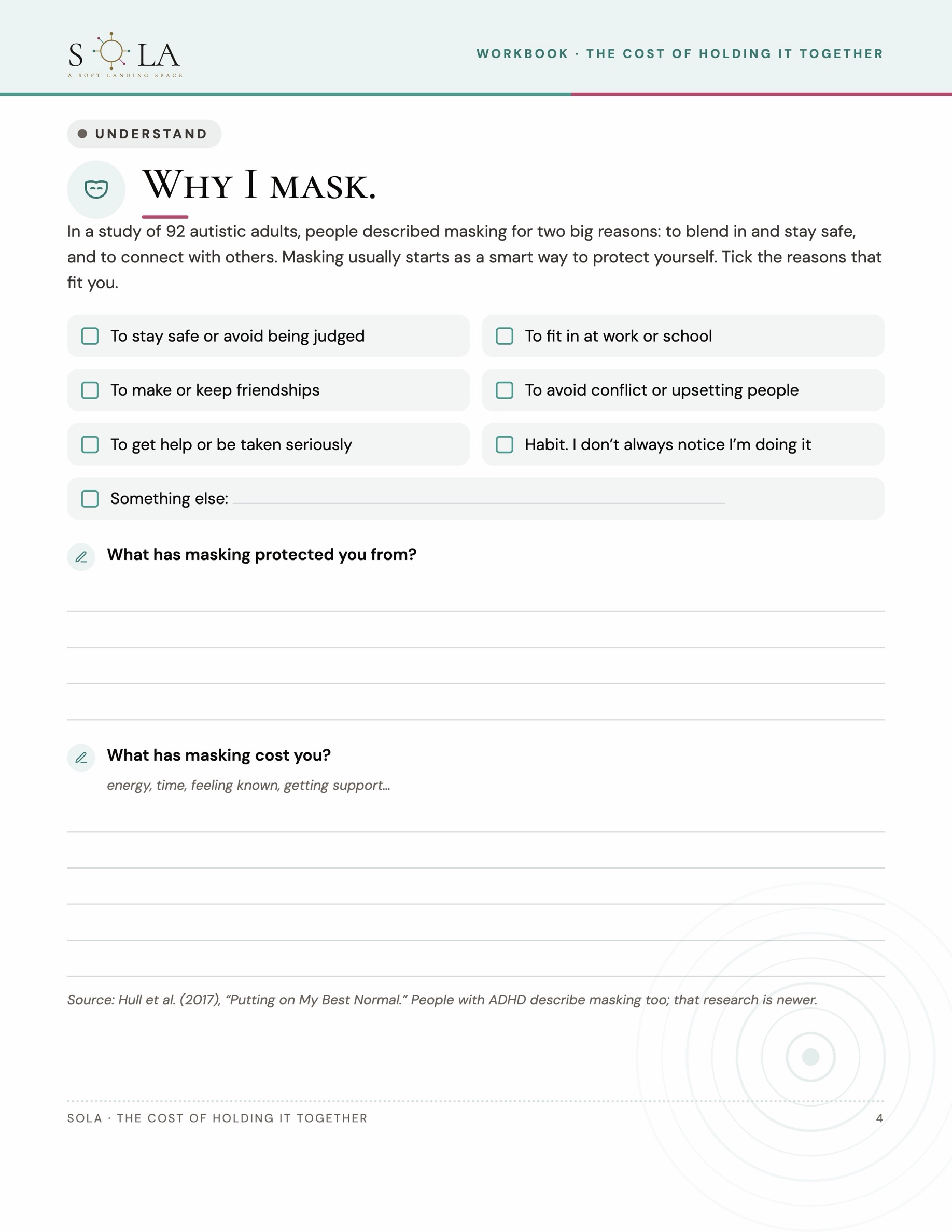
In a study of 92 autistic adults, people described masking for two big reasons: to blend in and stay safe, and to connect with others. Masking usually starts as a smart way to protect yourself. Tick the reasons that fit you.
Tick the reasons that fit you. Tick all that apply
- To stay safe or avoid being judged
- To fit in at work or school
- To make or keep friendships
- To avoid conflict or upsetting people
- To get help or be taken seriously
- Habit. I don’t always notice I’m doing it
- Other:
Source: Hull et al. (2017), “Putting on My Best Normal.” People with ADHD describe masking too; that research is newer.
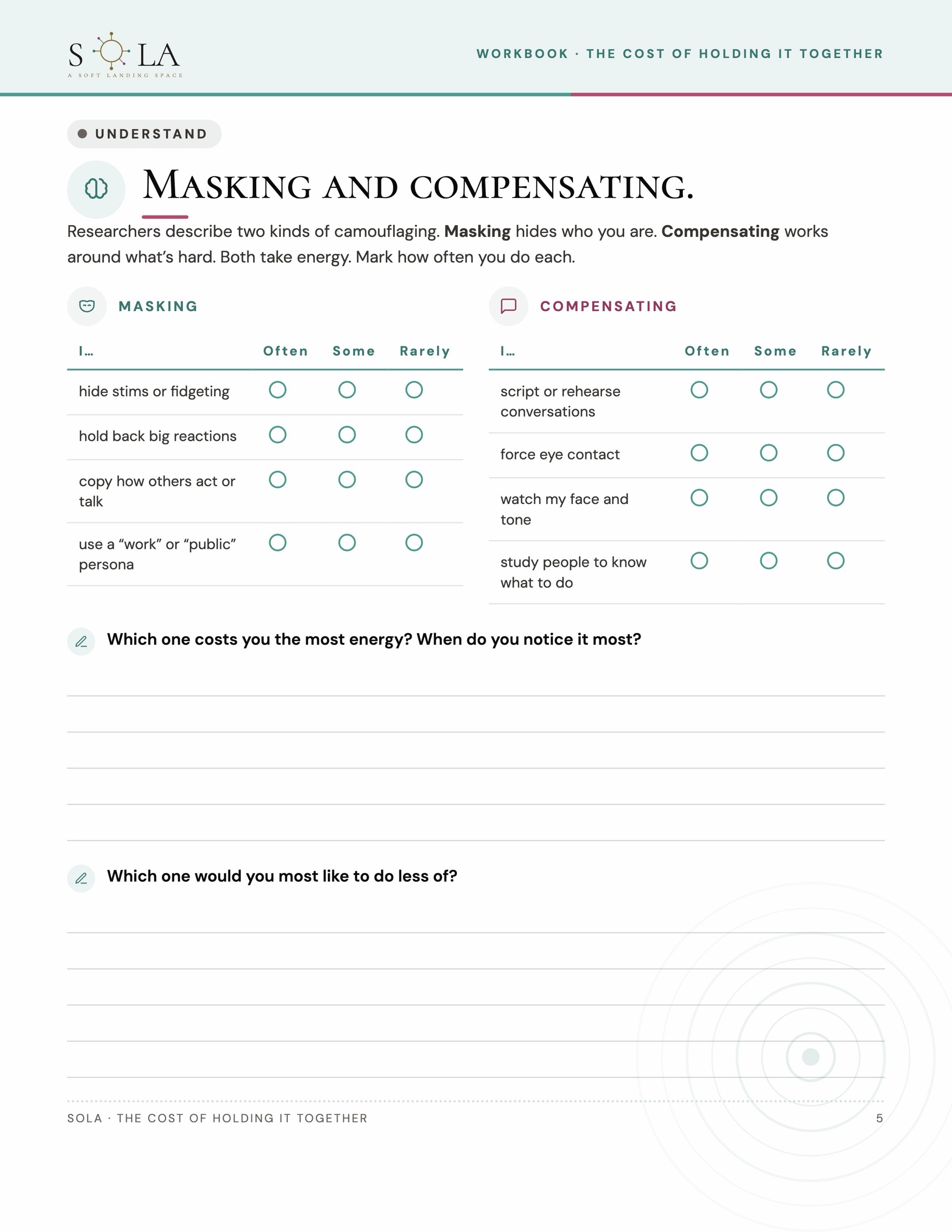
Masking and compensating.
Researchers describe two kinds of camouflaging. Masking hides who you are. Compensating works around what’s hard. Both take energy. Mark how often you do each.
MASKING
| I… | |
|---|---|
| hide stims or fidgeting | |
| hold back big reactions | |
| copy how others act or talk | |
| use a “work” or “public” persona |
COMPENSATING
| I… | |
|---|---|
| script or rehearse conversations | |
| force eye contact | |
| watch my face and tone | |
| study people to know what to do |
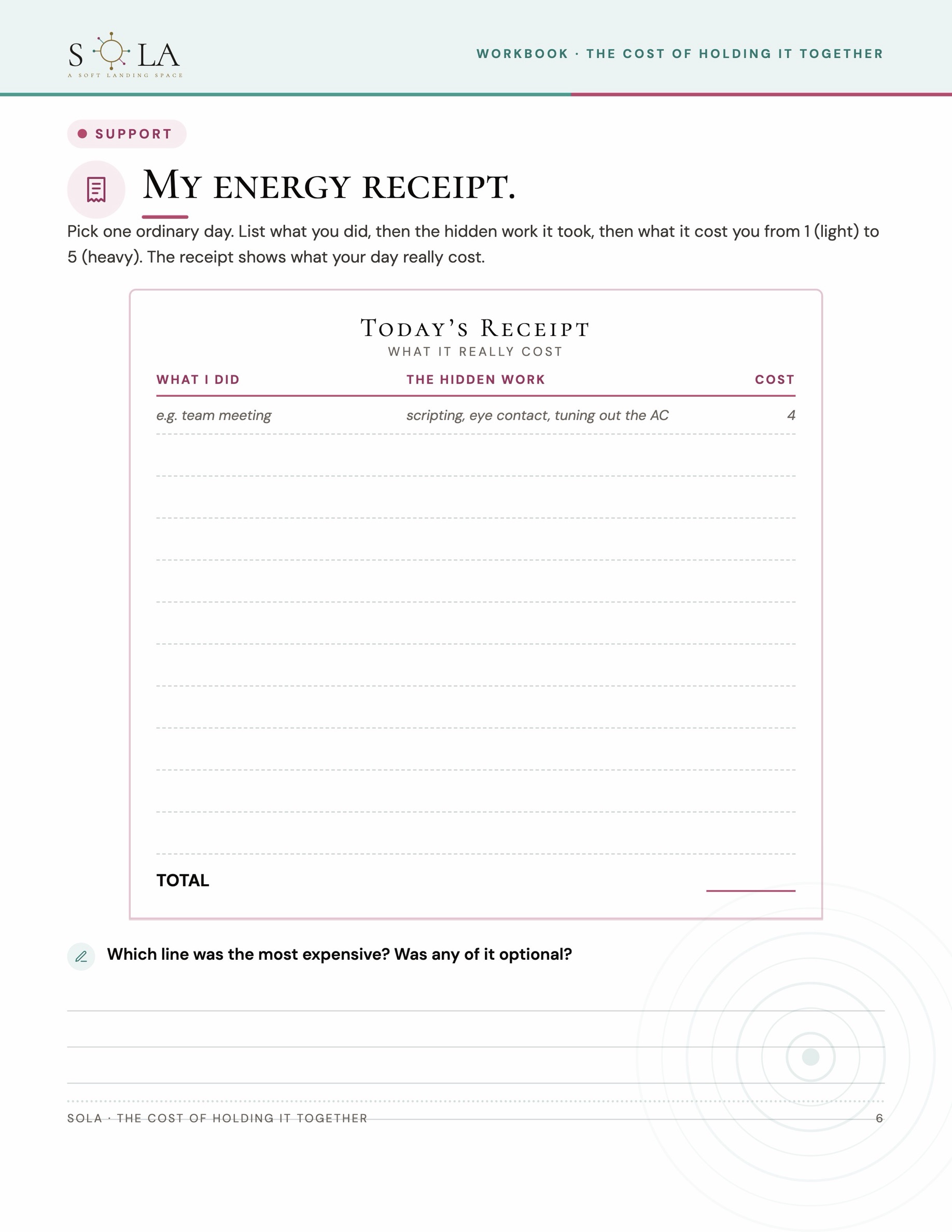
My energy receipt.
Pick one ordinary day. List what you did, then the hidden work it took, then what it cost you from 1 (light) to 5 (heavy). The receipt shows what your day really cost.
Today’s Receipt — WHAT IT REALLY COST
e.g. team meeting · scripting, eye contact, tuning out the AC · 4
Today’s Receipt
| WHAT I DID | THE HIDDEN WORK | COST |
|---|---|---|
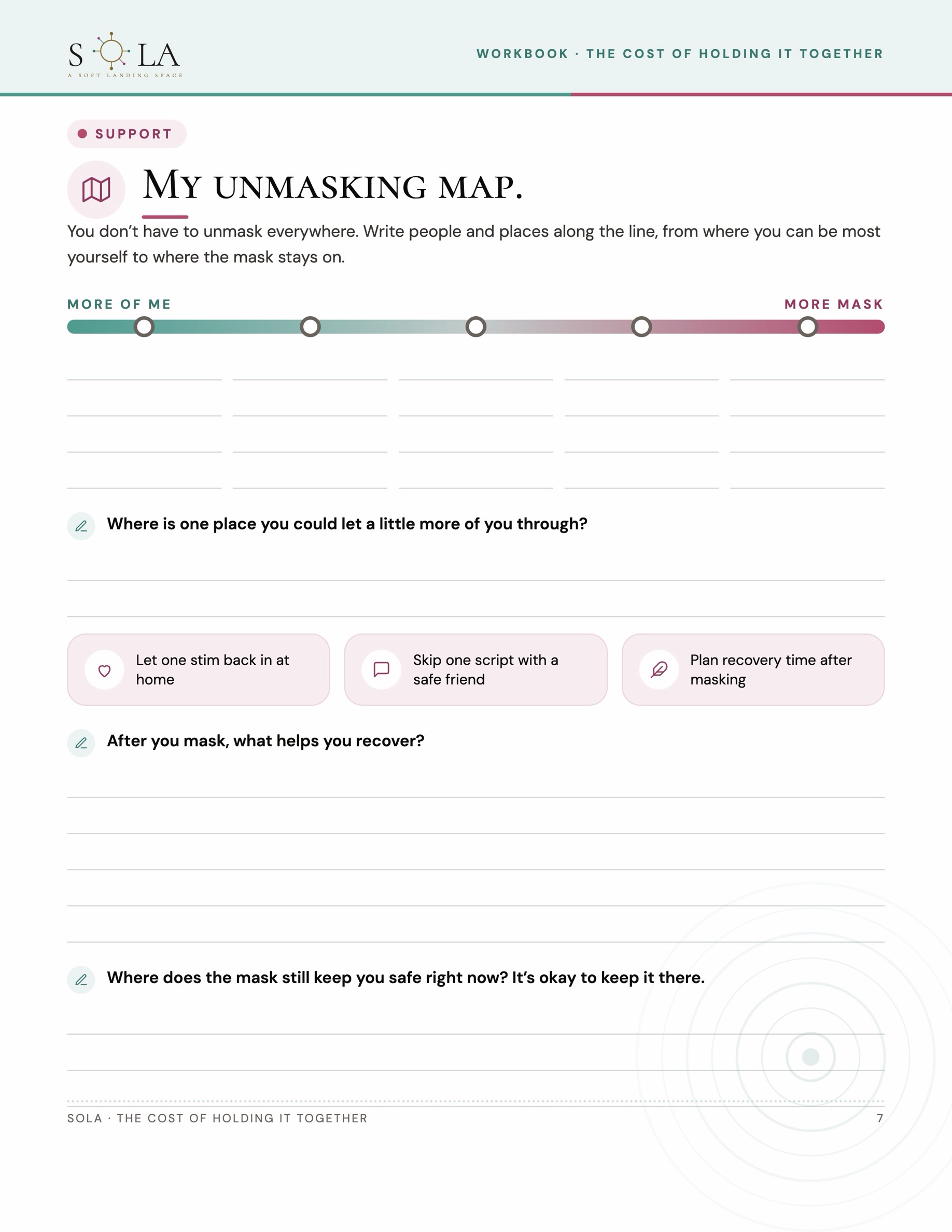
My unmasking map.
You don’t have to unmask everywhere. Write people and places along the line, from where you can be most yourself to where the mask stays on.
The sheet shows a line with five points running from MORE OF ME (left) to MORE MASK (right), with space to write under each point.
MORE OF ME → MORE MASK
| People and places | |
|---|---|
| 1 · More of me | |
| 2 | |
| 3 | |
| 4 | |
| 5 · More mask |
- Let one stim back in at home
- Skip one script with a safe friend
- Plan recovery time after masking
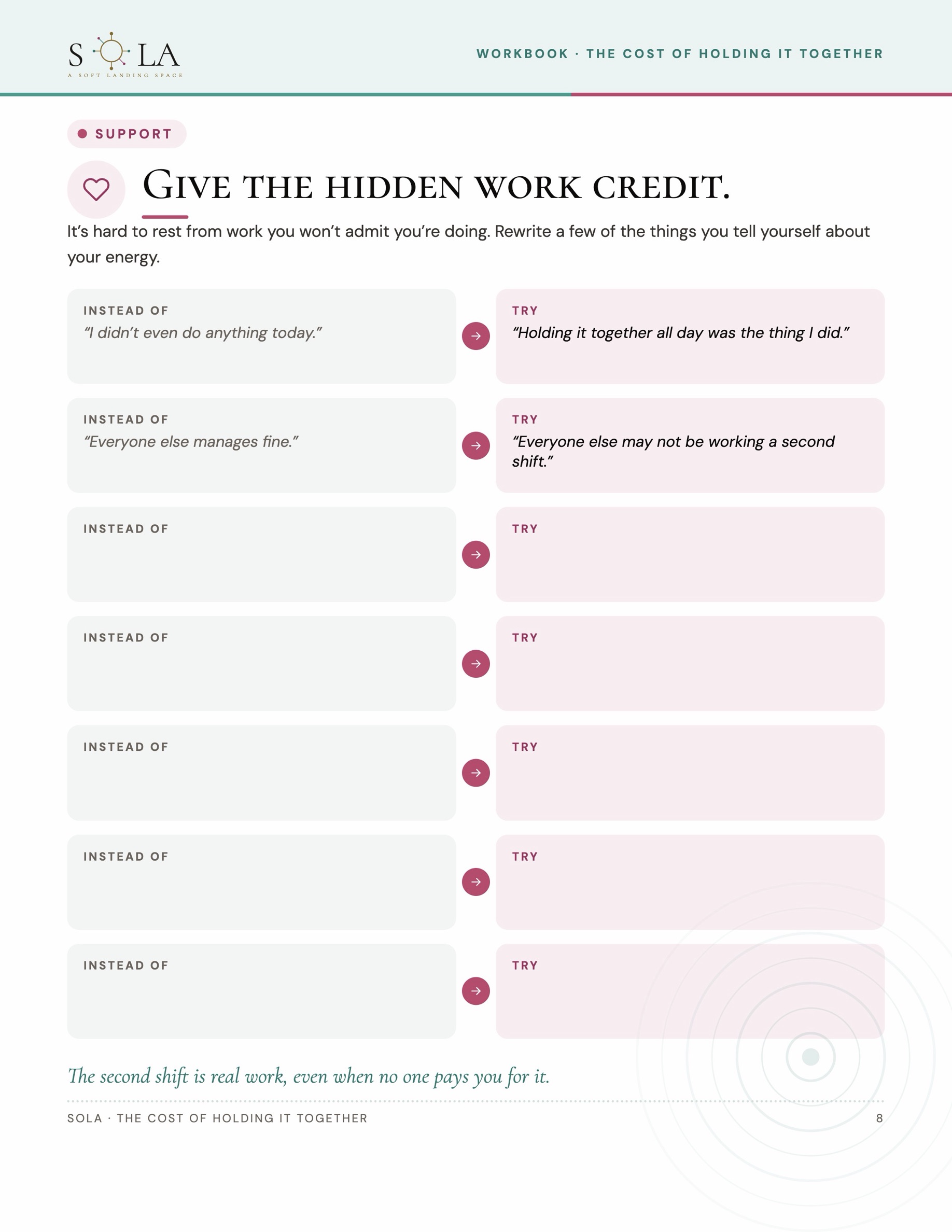
Give the hidden work credit.
It’s hard to rest from work you won’t admit you’re doing. Rewrite a few of the things you tell yourself about your energy.
INSTEAD OF “I didn’t even do anything today.” → TRY “Holding it together all day was the thing I did.”
INSTEAD OF “Everyone else manages fine.” → TRY “Everyone else may not be working a second shift.”
| INSTEAD OF | TRY |
|---|---|
The second shift is real work, even when no one pays you for it.
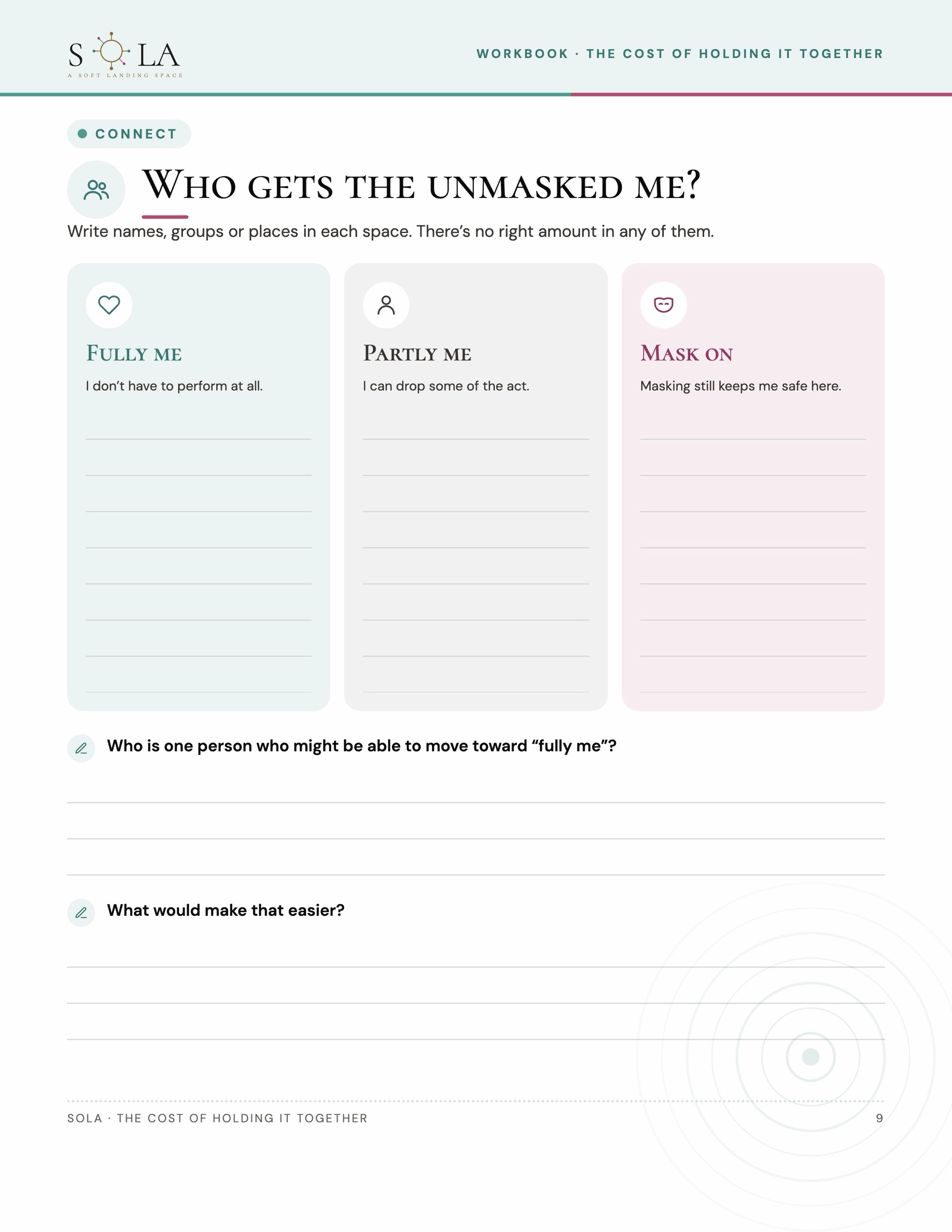
Who gets the unmasked me?
Write names, groups or places in each space. There’s no right amount in any of them.
Fully me
I don’t have to perform at all.Partly me
I can drop some of the act.Mask on
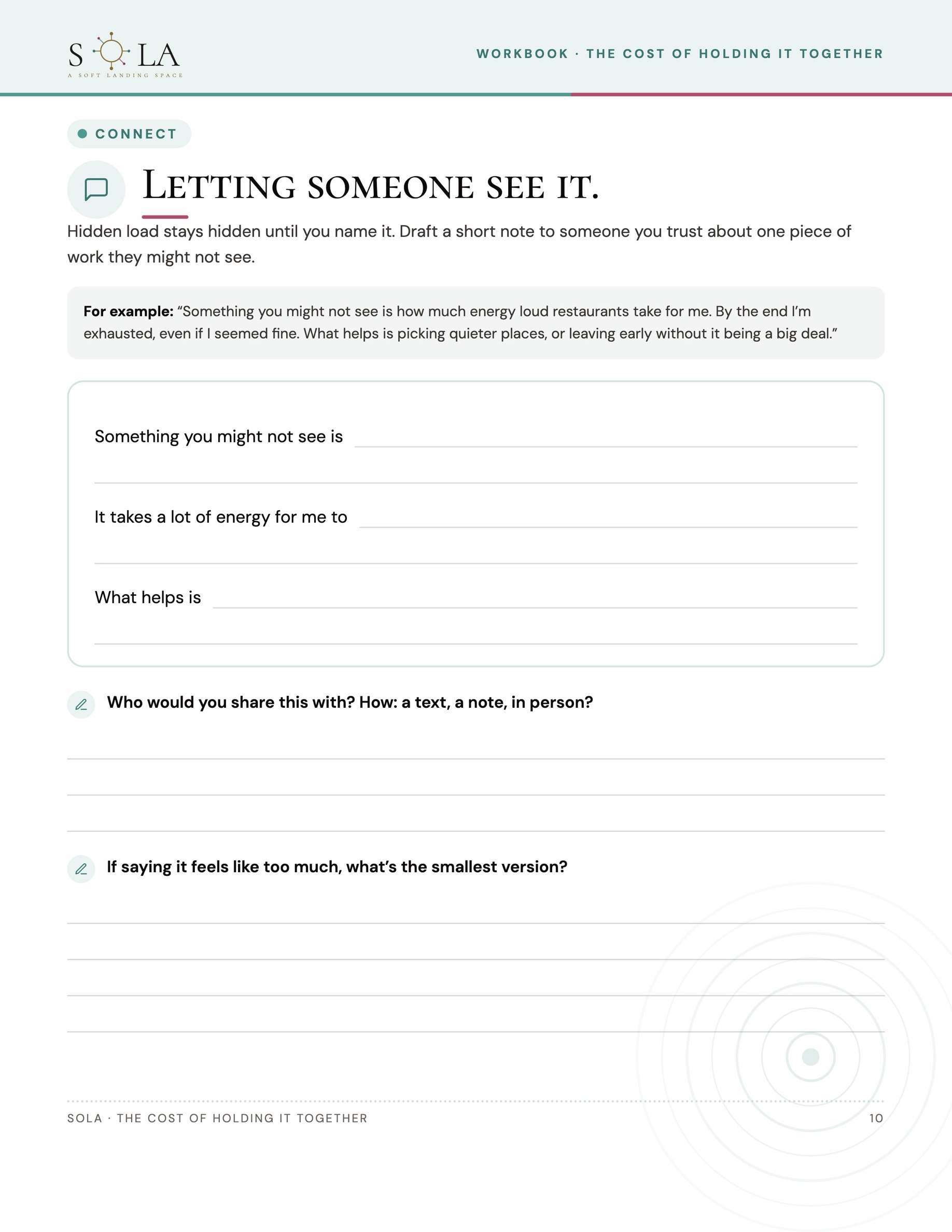
Masking still keeps me safe here.Letting someone see it.
Hidden load stays hidden until you name it. Draft a short note to someone you trust about one piece of work they might not see.
For example: “Something you might not see is how much energy loud restaurants take for me. By the end I’m exhausted, even if I seemed fine. What helps is picking quieter places, or leaving early without it being a big deal.”
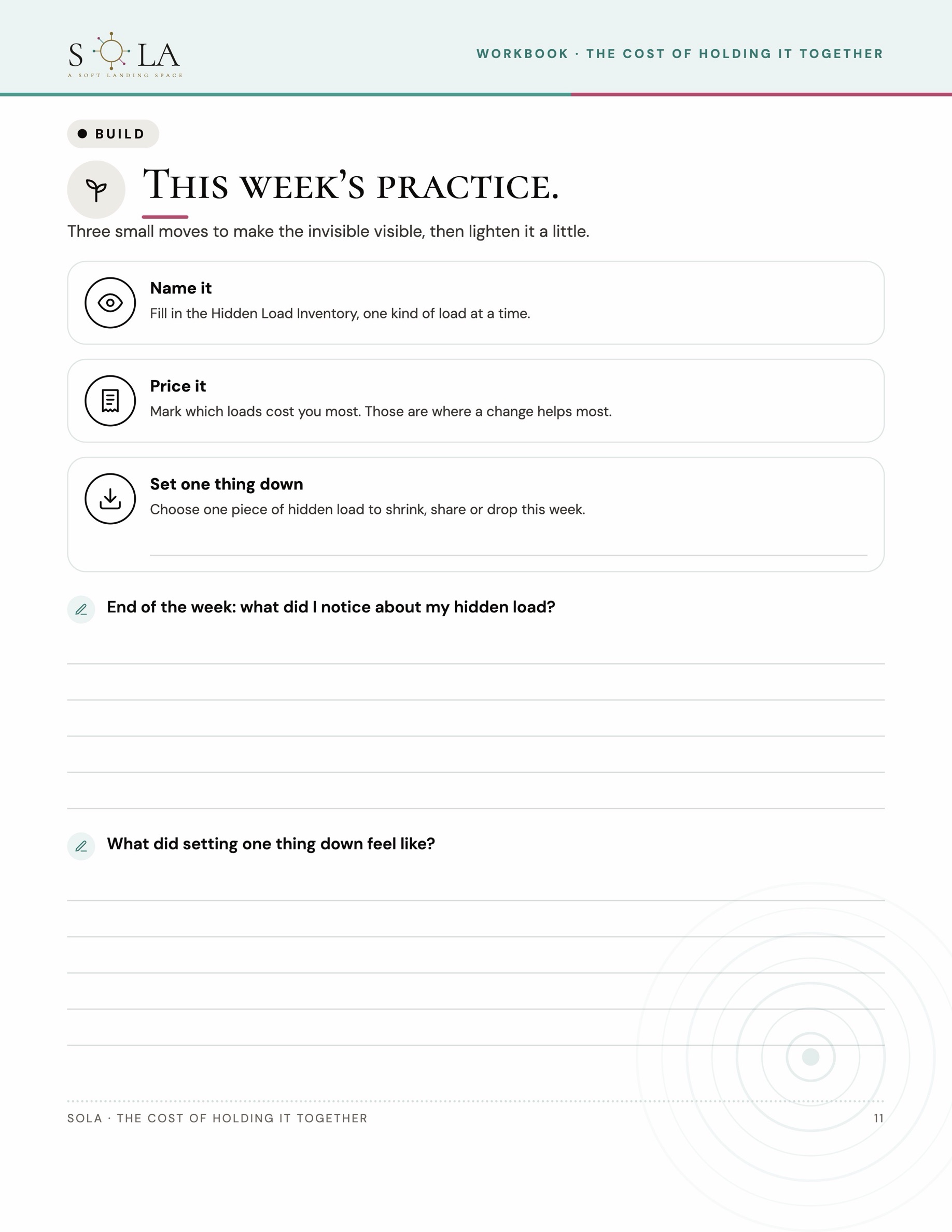
This week’s practice.
Three small moves to make the invisible visible, then lighten it a little.
Name it: Fill in the Hidden Load Inventory, one kind of load at a time.
Price it: Mark which loads cost you most. Those are where a change helps most.
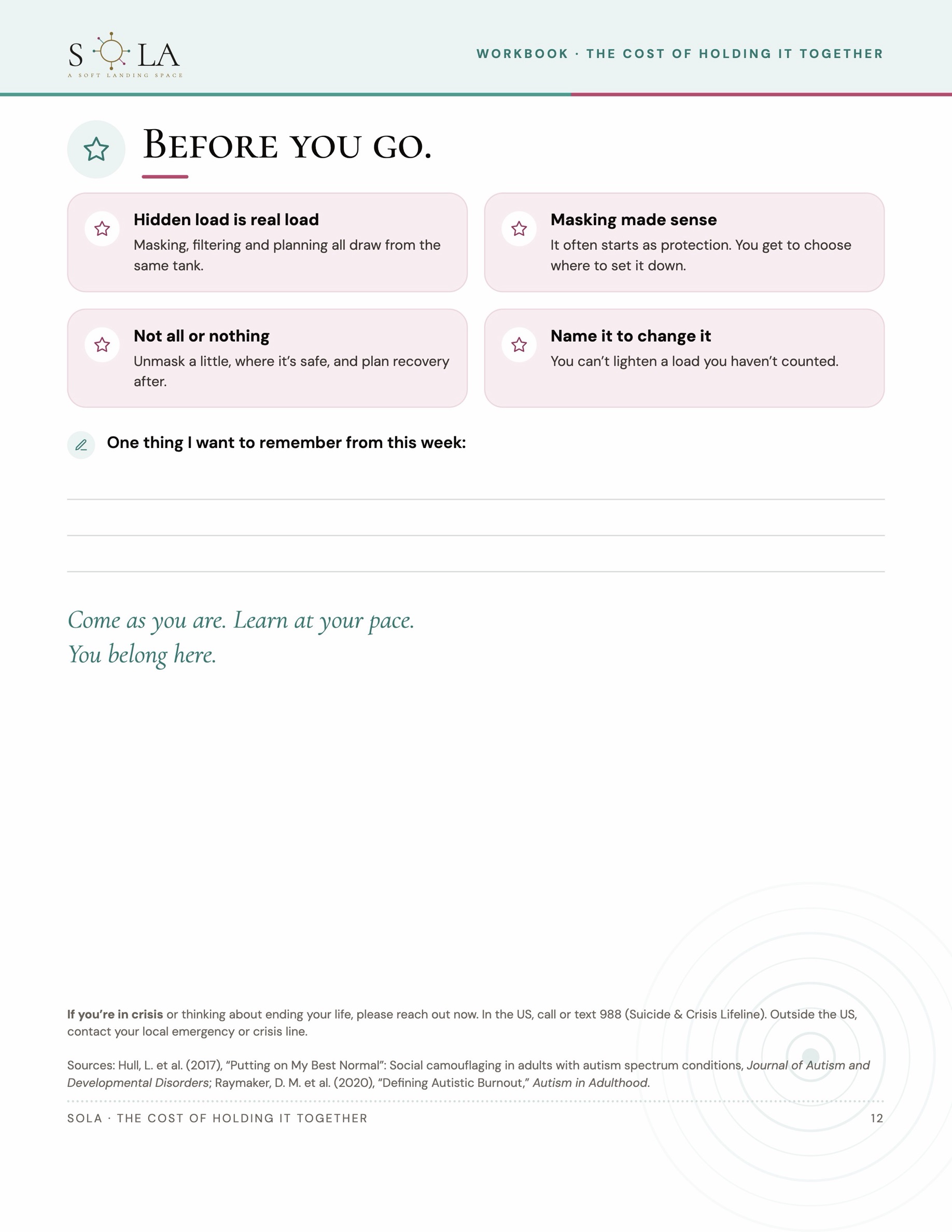
Before you go.
Hidden load is real load: Masking, filtering and planning all draw from the same tank.
Masking made sense: It often starts as protection. You get to choose where to set it down.
Not all or nothing: Unmask a little, where it’s safe, and plan recovery after.
Name it to change it: You can’t lighten a load you haven’t counted.
Come as you are. Learn at your pace. You belong here.
If you’re in crisis or thinking about ending your life, please reach out now. In the US, call or text 988 (Suicide & Crisis Lifeline). Outside the US, contact your local emergency or crisis line.
Sources and credits. Sources: Hull, L. et al. (2017), “Putting on My Best Normal”: Social camouflaging in adults with autism spectrum conditions, Journal of Autism and Developmental Disorders; Raymaker, D. M. et al. (2020), “Defining Autistic Burnout,” Autism in Adulthood.