Learn
Executive function, explained.
Executive Function 101
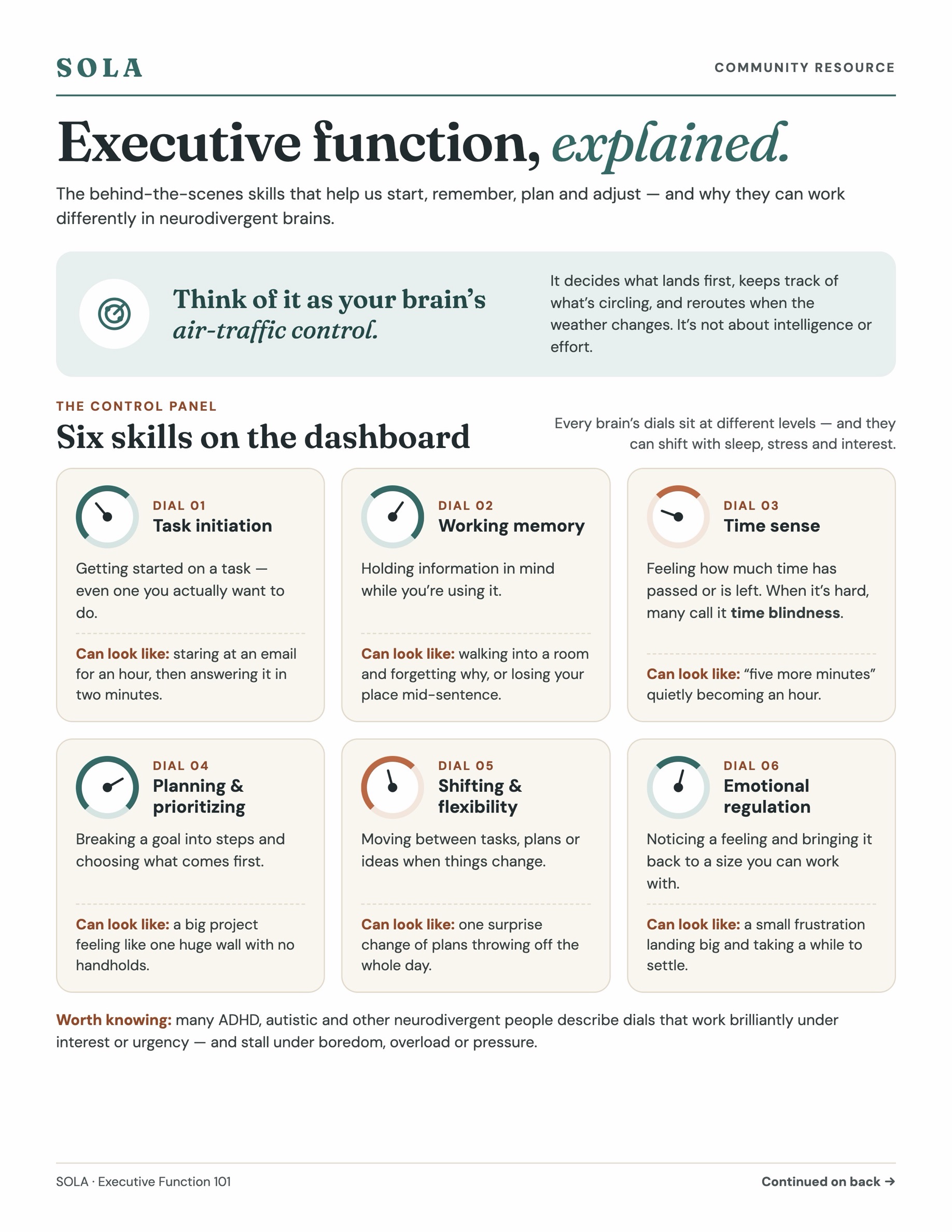
The behind-the-scenes skills that help us start, remember, plan and adjust — and why they can work differently in neurodivergent brains.
The guide, as designed. The same content is written out below.
See page 2
Think of it as your brain’s air-traffic control. It decides what lands first, keeps track of what’s circling, and reroutes when the weather changes. It’s not about intelligence or effort.
Six skills on the dashboard
The control panel. Every brain’s dials sit at different levels — and they can shift with sleep, stress and interest.
Getting started on a task — even one you actually want to do.
Can look like: staring at an email for an hour, then answering it in two minutes.
Holding information in mind while you’re using it.
Can look like: walking into a room and forgetting why, or losing your place mid-sentence.
Feeling how much time has passed or is left. When it’s hard, many call it time blindness.
Can look like: “five more minutes” quietly becoming an hour.
Breaking a goal into steps and choosing what comes first.
Can look like: a big project feeling like one huge wall with no handholds.
Moving between tasks, plans or ideas when things change.
Can look like: one surprise change of plans throwing off the whole day.
Noticing a feeling and bringing it back to a size you can work with.
Can look like: a small frustration landing big and taking a while to settle.
many ADHD, autistic and other neurodivergent people describe dials that work brilliantly under interest or urgency — and stall under boredom, overload or pressure.
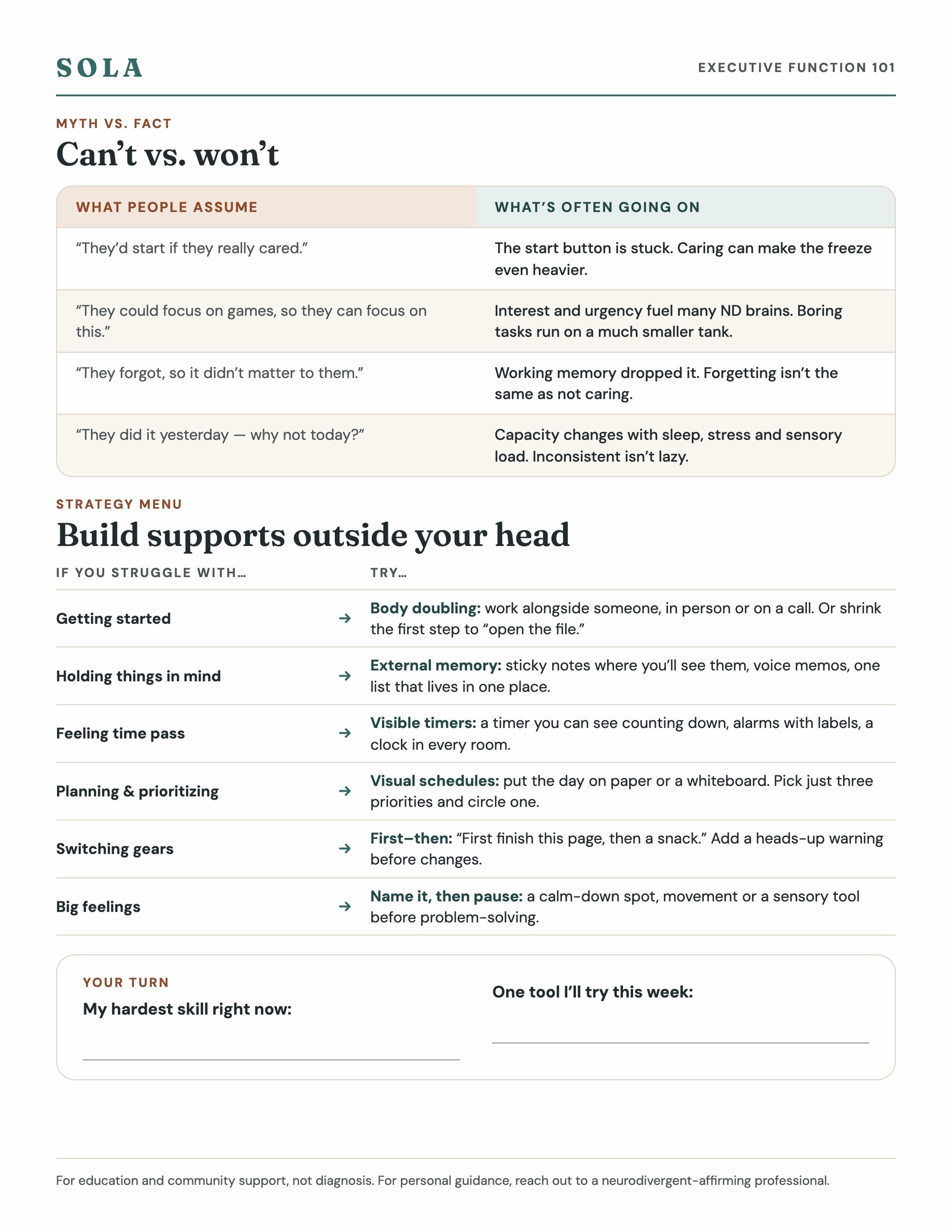
Can’t vs. won’t
Myth vs. fact
“They’d start if they really cared.”
What’s often going on: The start button is stuck. Caring can make the freeze even heavier.
“They could focus on games, so they can focus on this.”
What’s often going on: Interest and urgency fuel many ND brains. Boring tasks run on a much smaller tank.
“They forgot, so it didn’t matter to them.”
What’s often going on: Working memory dropped it. Forgetting isn’t the same as not caring.
“They did it yesterday — why not today?”
What’s often going on: Capacity changes with sleep, stress and sensory load. Inconsistent isn’t lazy.
Build supports outside your head
Strategy menu. If you struggle with… → try…
→ Body doubling: work alongside someone, in person or on a call. Or shrink the first step to “open the file.”
→ External memory: sticky notes where you’ll see them, voice memos, one list that lives in one place.
→ Visible timers: a timer you can see counting down, alarms with labels, a clock in every room.
→ Visual schedules: put the day on paper or a whiteboard. Pick just three priorities and circle one.
→ First–then: “First finish this page, then a snack.” Add a heads-up warning before changes.
→ Name it, then pause: a calm-down spot, movement or a sensory tool before problem-solving.
Your turn
For education and community support, not diagnosis. For personal guidance, reach out to a neurodivergent-affirming professional.
Sources and credits. SOLA · Community Resource · Executive Function 101