Learn
Deep focus, by design.
Monotropism & Special Interests
A neurodivergent-affirming look at monotropism — why some brains dive deep, why switching can be so hard, and why special interests matter.
The guide, as designed. The same content is written out below.
See page 2
What is monotropism?
The idea
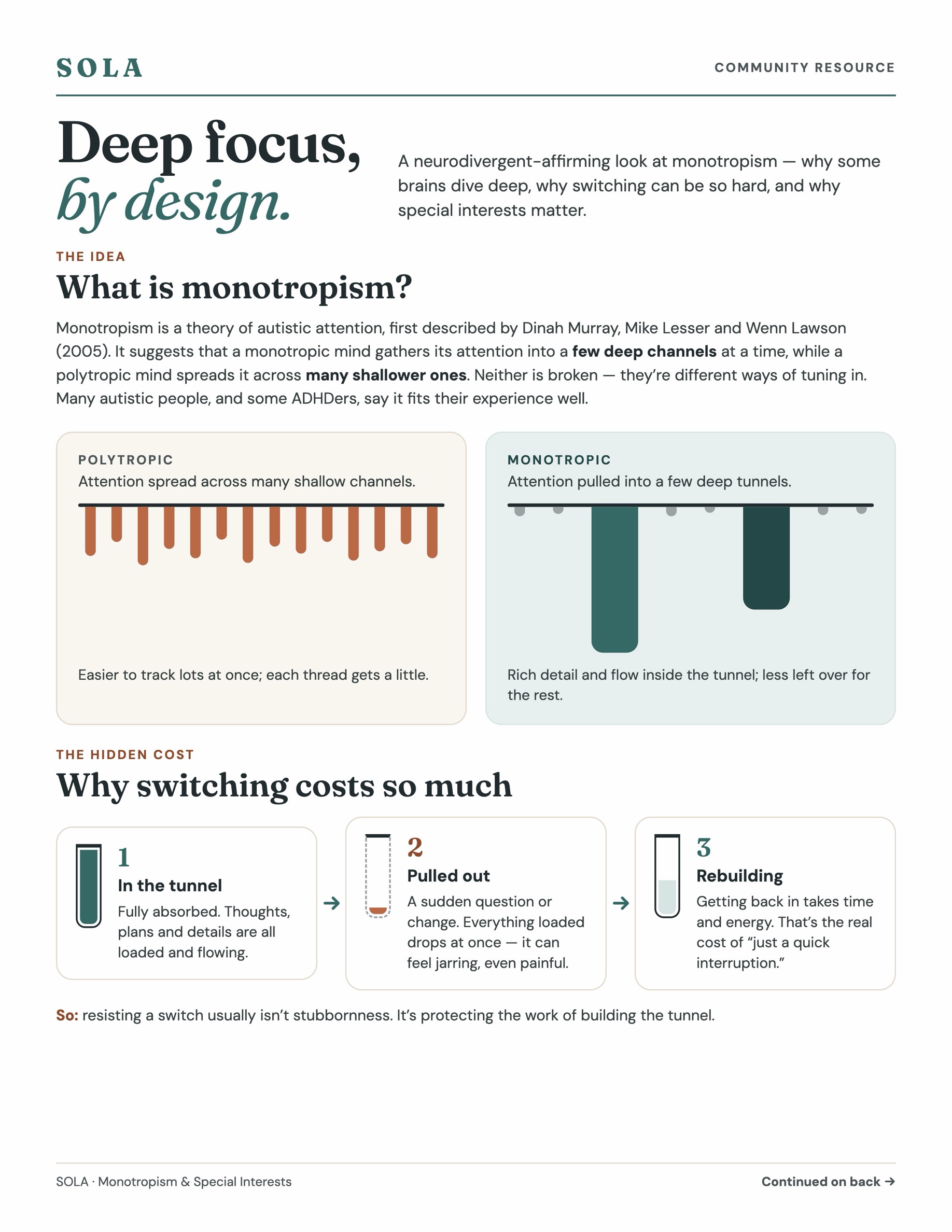
Monotropism is a theory of autistic attention, first described by Dinah Murray, Mike Lesser and Wenn Lawson (2005). It suggests that a monotropic mind gathers its attention into a few deep channels at a time, while a polytropic mind spreads it across many shallower ones. Neither is broken — they’re different ways of tuning in. Many autistic people, and some ADHDers, say it fits their experience well.
Attention spread across many shallow channels.
Easier to track lots at once; each thread gets a little.
Attention pulled into a few deep tunnels.
Rich detail and flow inside the tunnel; less left over for the rest.
Why switching costs so much
The hidden cost
Fully absorbed. Thoughts, plans and details are all loaded and flowing.
A sudden question or change. Everything loaded drops at once — it can feel jarring, even painful.
Getting back in takes time and energy. That’s the real cost of “just a quick interruption.”
resisting a switch usually isn’t stubbornness. It’s protecting the work of building the tunnel.
Special interests are…
Not “obsessions”
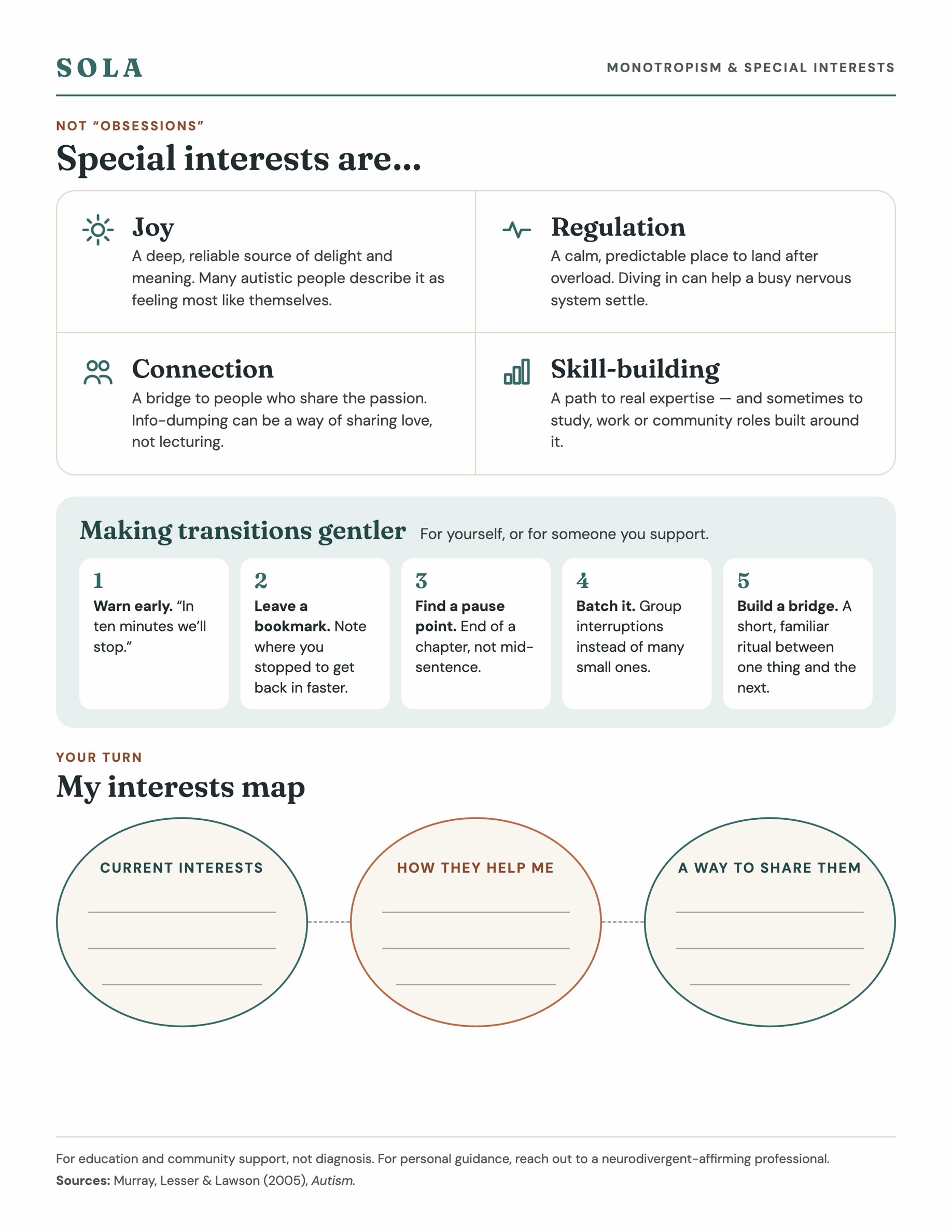
A deep, reliable source of delight and meaning. Many autistic people describe it as feeling most like themselves.
A calm, predictable place to land after overload. Diving in can help a busy nervous system settle.
A bridge to people who share the passion. Info-dumping can be a way of sharing love, not lecturing.
A path to real expertise — and sometimes to study, work or community roles built around it.
Making transitions gentler
For yourself, or for someone you support.
“In ten minutes we’ll stop.”
Note where you stopped to get back in faster.
End of a chapter, not mid-sentence.
Group interruptions instead of many small ones.
A short, familiar ritual between one thing and the next.
My interests map
Your turn
Current interests
How they help me
A way to share them
For education and community support, not diagnosis. For personal guidance, reach out to a neurodivergent-affirming professional.
Sources and credits. Sources: Murray, Lesser & Lawson (2005), Autism. SOLA · Community Resource · Monotropism & Special Interests