Learn
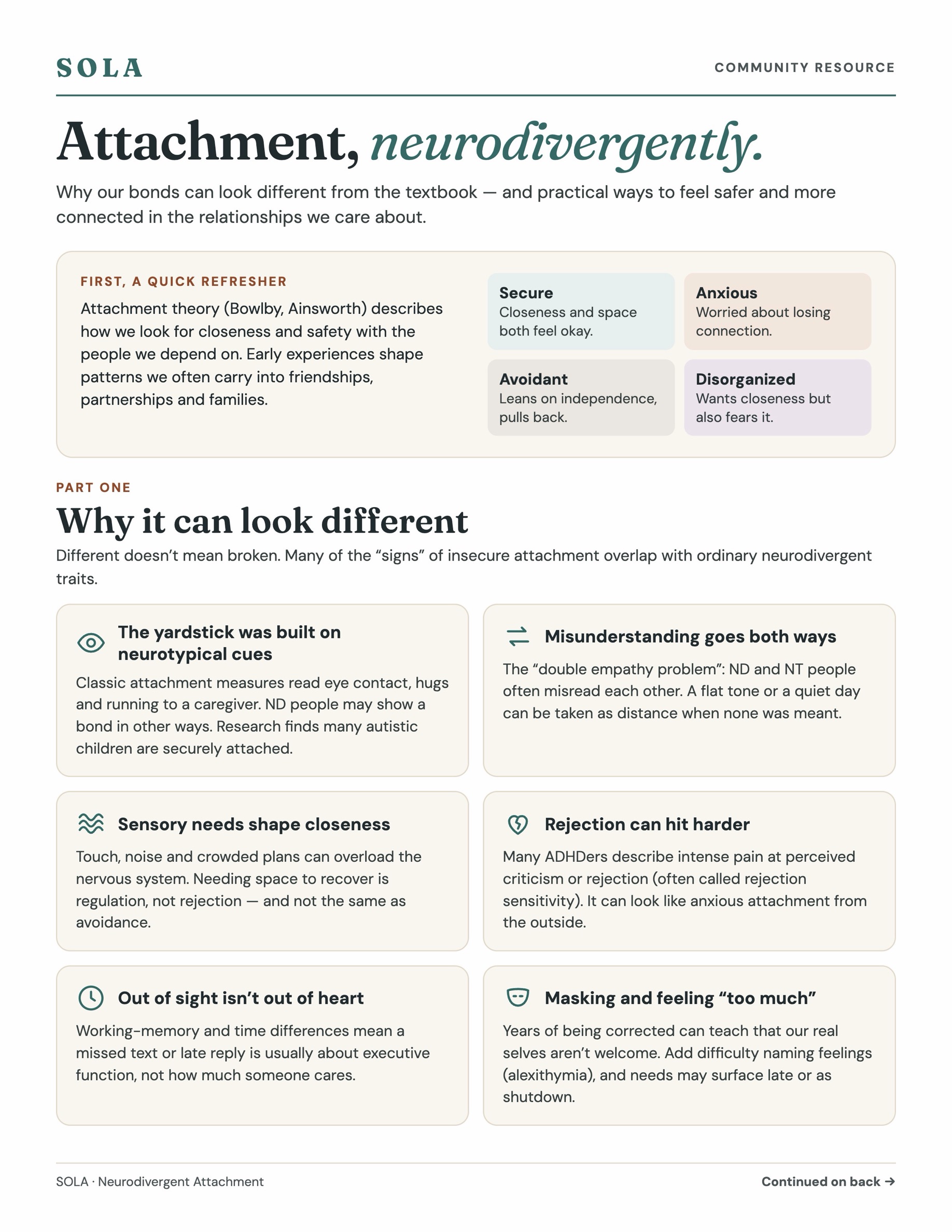
Attachment, neurodivergently.
Community Resource
Why our bonds can look different from the textbook — and practical ways to feel safer and more connected in the relationships we care about.
The guide, as designed. The same content is written out below.
See page 2
First, a quick refresher
Attachment theory (Bowlby, Ainsworth) describes how we look for closeness and safety with the people we depend on. Early experiences shape patterns we often carry into friendships, partnerships and families.
Closeness and space both feel okay.
Worried about losing connection.
Leans on independence, pulls back.
Wants closeness but also fears it.
Why it can look different
Part one. Different doesn’t mean broken. Many of the “signs” of insecure attachment overlap with ordinary neurodivergent traits.
Classic attachment measures read eye contact, hugs and running to a caregiver. ND people may show a bond in other ways. Research finds many autistic children are securely attached.
The “double empathy problem”: ND and NT people often misread each other. A flat tone or a quiet day can be taken as distance when none was meant.
Touch, noise and crowded plans can overload the nervous system. Needing space to recover is regulation, not rejection — and not the same as avoidance.
Many ADHDers describe intense pain at perceived criticism or rejection (often called rejection sensitivity). It can look like anxious attachment from the outside.
Working-memory and time differences mean a missed text or late reply is usually about executive function, not how much someone cares.
Years of being corrected can teach that our real selves aren’t welcome. Add difficulty naming feelings (alexithymia), and needs may surface late or as shutdown.
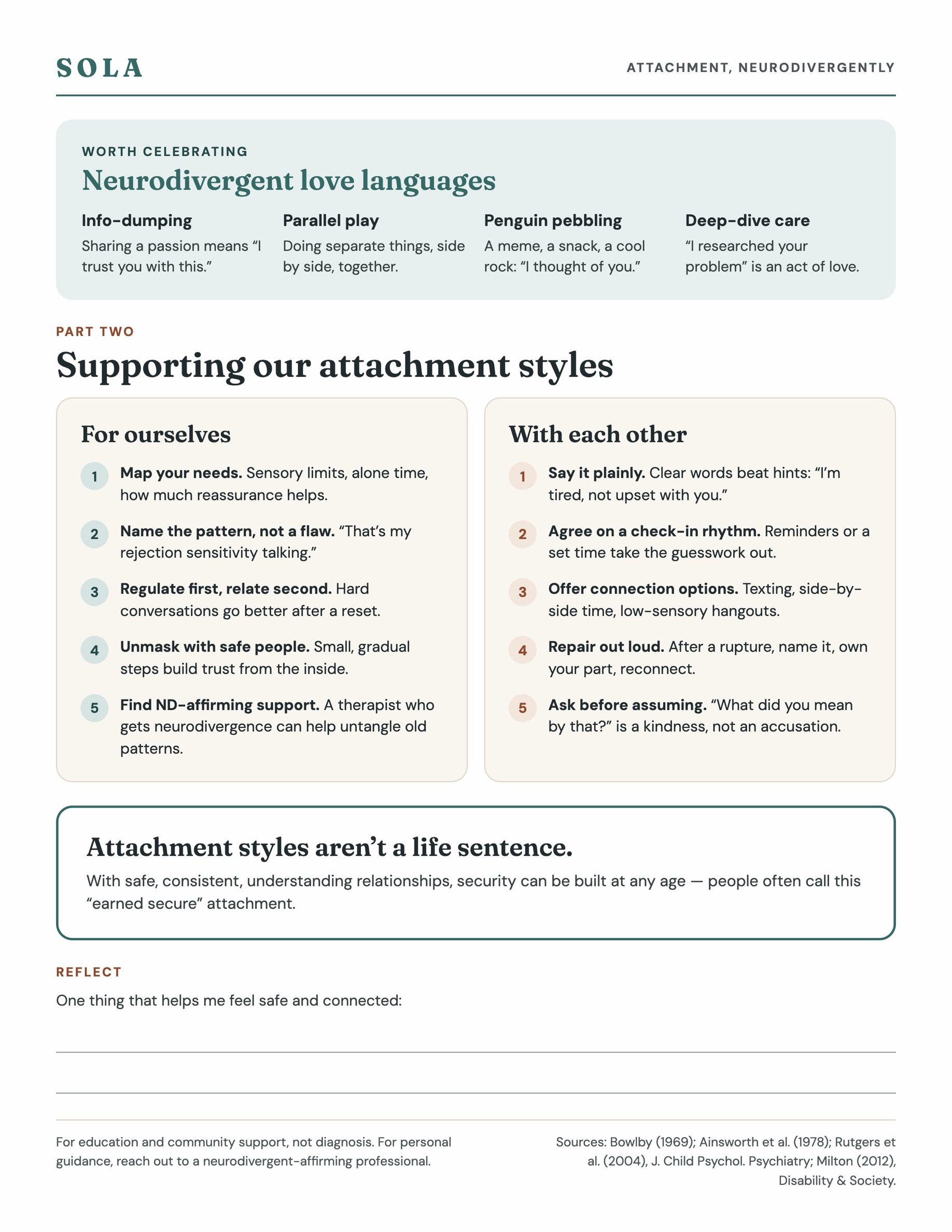
Neurodivergent love languages
Worth celebrating
Sharing a passion means “I trust you with this.”
Doing separate things, side by side, together.
A meme, a snack, a cool rock: “I thought of you.”
“I researched your problem” is an act of love.
Supporting our attachment styles
Part two
- Map your needs. Sensory limits, alone time, how much reassurance helps.
- Name the pattern, not a flaw. “That’s my rejection sensitivity talking.”
- Regulate first, relate second. Hard conversations go better after a reset.
- Unmask with safe people. Small, gradual steps build trust from the inside.
- Find ND-affirming support. A therapist who gets neurodivergence can help untangle old patterns.
- Say it plainly. Clear words beat hints: “I’m tired, not upset with you.”
- Agree on a check-in rhythm. Reminders or a set time take the guesswork out.
- Offer connection options. Texting, side-by-side time, low-sensory hangouts.
- Repair out loud. After a rupture, name it, own your part, reconnect.
- Ask before assuming. “What did you mean by that?” is a kindness, not an accusation.
With safe, consistent, understanding relationships, security can be built at any age — people often call this “earned secure” attachment.
Reflect
For education and community support, not diagnosis. For personal guidance, reach out to a neurodivergent-affirming professional.
Sources and credits. Sources: Bowlby (1969); Ainsworth et al. (1978); Rutgers et al. (2004), J. Child Psychol. Psychiatry; Milton (2012), Disability & Society.