Learn
How do I tell the difference between needs and wants?
Brain Library · Infographic
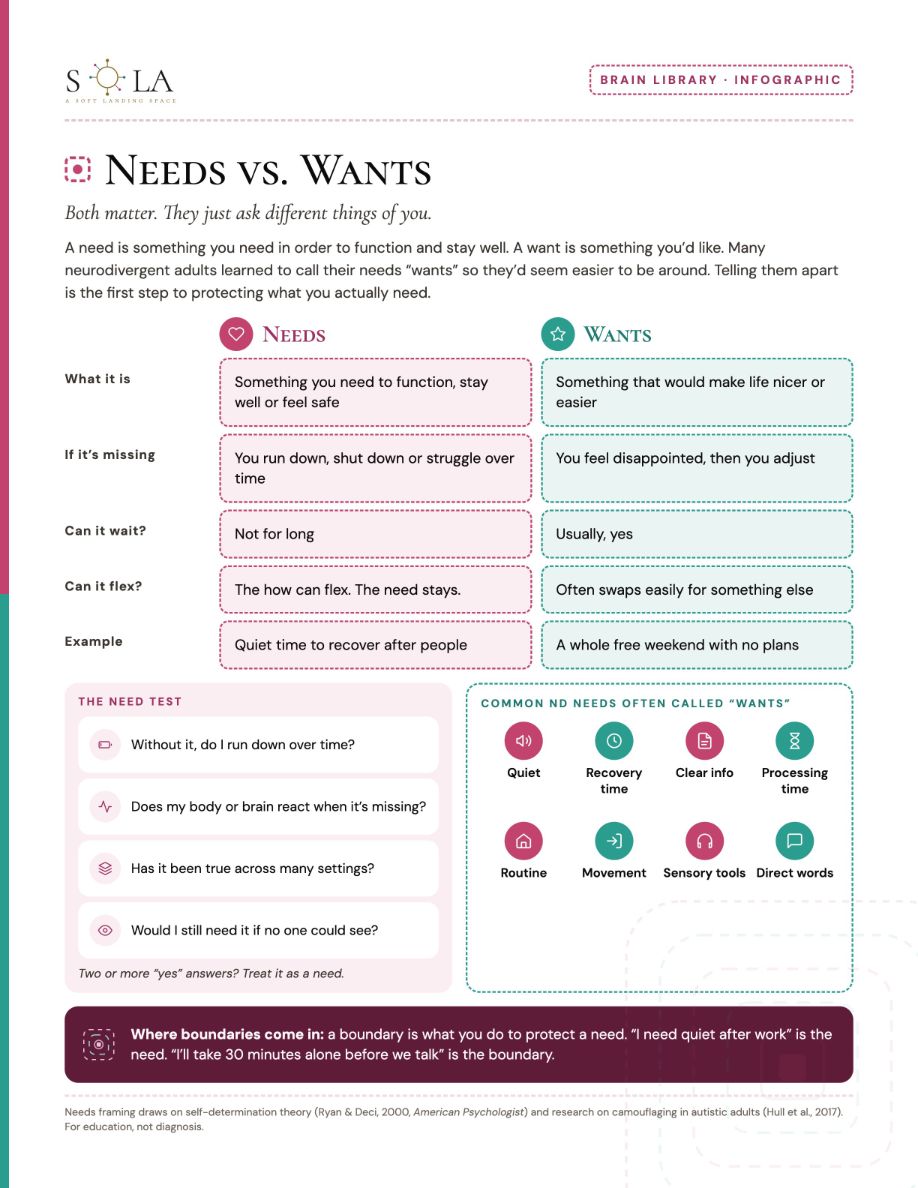
In short. A need is something you require to function, stay well or feel safe. A want is something that would make life nicer or easier. Many neurodivergent adults learned to call their needs wants so they would seem easier to be around. Telling them apart is the first step to protecting what you actually need.
The difference shows up in what happens when it is missing
A need and a want can look similar from the outside. Both are things you ask for or wish you had. The difference is in what happens when you do not get them. When a want is missing, you feel disappointed, then you adjust. When a need is missing, you run down, shut down or struggle over time. Your body or brain reacts. The cost builds up.
This matters because many neurodivergent adults were taught to minimize what they needed. Quiet after socializing became a preference. Processing time became a nice-to-have. Routine, movement, clear information and direct words all got downgraded to wants so they would seem less demanding. The result is a lifetime of treating essential things as optional, then wondering why everything feels so hard.
Needs and wants ask different things of you
A need cannot wait for long. You can delay it, push through without it, but the cost accumulates and eventually something gives. A want can usually wait. The how of a need can flex, but the need itself stays. You might need quiet to recover after people, and that could be thirty minutes alone or a walk with headphones, but the recovery itself is not negotiable. A want often swaps easily for something else. A whole free weekend with no plans would be lovely, but a quiet evening or a slow morning might do just fine.
Understanding this difference changes what you protect and what you let go. It also changes how you talk about what you need. When you know something is a need, you can say so plainly, without apology or the hope that someone will read between the lines and offer it anyway.
The need test helps you sort them
When you are not sure whether something is a need or a want, ask yourself four questions. Without it, do I run down over time? Does my body or brain react when it is missing? Has it been true across many settings? Would I still need it if no one could see? Two or more yes answers means you should treat it as a need.
The test is not about proving anything to anyone else. It is about giving yourself permission to take something seriously. Many neurodivergent adults have spent years second-guessing their own needs, waiting for external validation that never comes. This test is the validation. If your body says it is a need, it is a need.
Common neurodivergent needs often get called wants
Quiet is a need for many neurodivergent adults, not a luxury. So is recovery time after socializing or sensory input. Clear information, processing time, routine, movement, sensory tools and direct words all show up on the needs list far more often than the wants list, but they are frequently treated as preferences or requests for special treatment.
This happens because these needs are invisible to people who do not share them. Someone who recharges by being around people cannot see why you would need to be alone. Someone whose brain processes in real time cannot see why you would need a pause before answering. The need is real whether or not it is visible, and naming it as a need rather than a want is how you start protecting it.
Boundaries are what protect your needs
A boundary is what you do to protect a need. The need is the thing itself. The boundary is the action you take to make sure you get it. If you need quiet after work, that is the need. If you say I will take thirty minutes alone before we talk, that is the boundary. The need explains why. The boundary explains what.
Many people skip straight to the boundary without naming the need, which makes the boundary sound arbitrary or controlling. Other people name the need but never set a boundary, which means the need stays unmet and the resentment builds. Both parts matter. The need gives you the reason. The boundary gives you the method.
Sorting your own takes practice
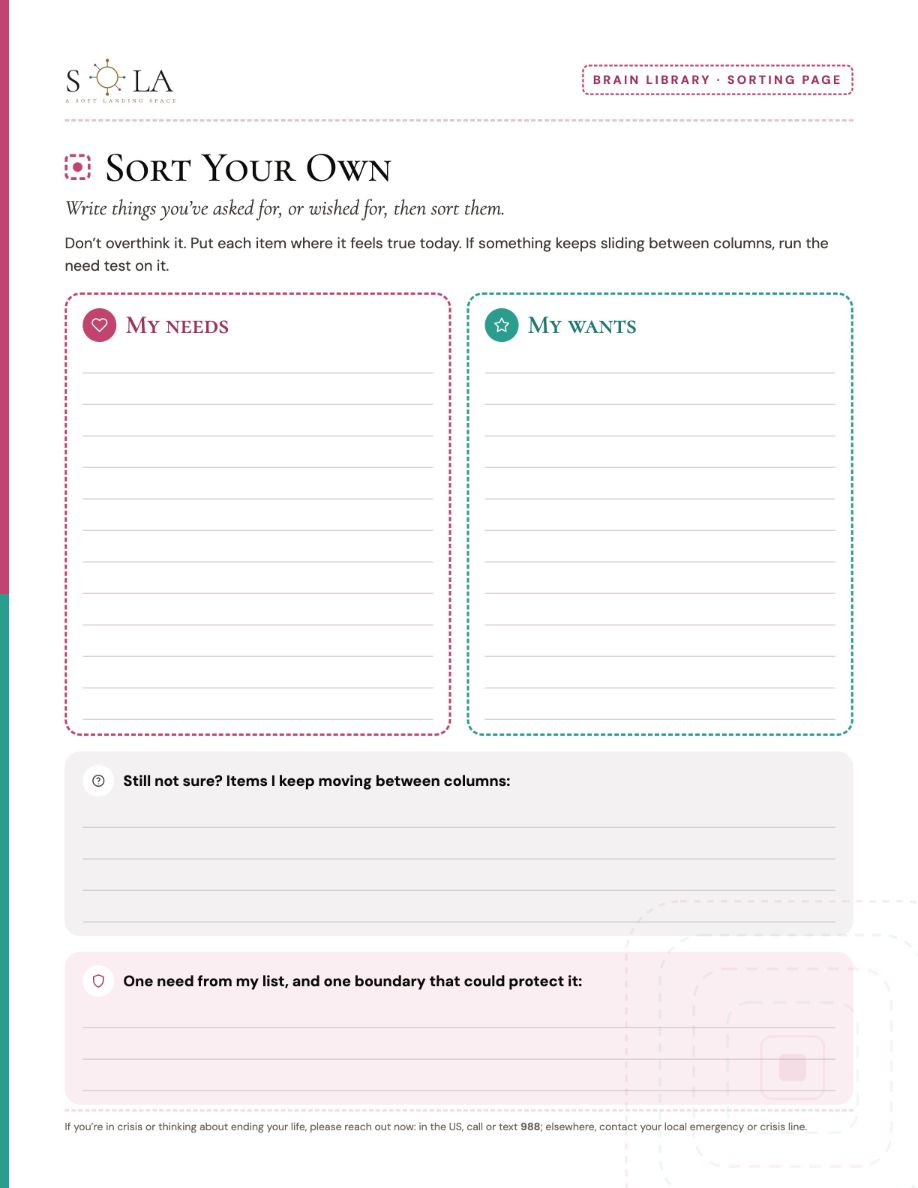
The guide includes a sorting page where you write things you have asked for or wished for, then put each one in the needs column or the wants column. Do not overthink it. Put each item where it feels true today. If something keeps sliding between columns, run the need test on it.
Some items will be obvious. Others will move back and forth as you think about them, and that is fine. The point is not to get it perfect. The point is to start noticing the difference, so you can protect what matters and let go of what does not. At the end, pick one need from your list and write one boundary that could protect it. That is where the work begins.
How to use this guide
The guide ends with a sorting page and three reflection prompts. You can work through them alone or with someone you trust.
- Write things you have asked for or wished for recently, without sorting them yet.
- Put each item in the needs column or the wants column, based on where it feels true today.
- If something keeps moving between columns, run the four-question need test on it.
- Write down the items you are still not sure about, so you can come back to them.
- Pick one need from your list and write one boundary that could protect it.
Questions people ask
What is the difference between a need and a want?
A need is something you require to function, stay well or feel safe. When it is missing, you run down or struggle over time. A want is something that would make life nicer or easier. When it is missing, you feel disappointed, then you adjust. Needs cannot wait long and the need itself does not flex, though the how might. Wants can usually wait and often swap for something else.
How do I know if something is really a need?
Ask yourself four questions. Without it, do I run down over time? Does my body or brain react when it is missing? Has it been true across many settings? Would I still need it if no one could see? Two or more yes answers means you should treat it as a need.
Why do neurodivergent adults call their needs wants?
Many neurodivergent adults learned to minimize what they needed so they would seem easier to be around. Quiet, processing time, routine and clear information all got downgraded to preferences or nice-to-haves. This often starts in childhood and continues into adulthood, which is why so many people spend years treating essential things as optional.
What is the connection between needs and boundaries?
A boundary is what you do to protect a need. The need is the thing itself, like quiet after work. The boundary is the action, like taking thirty minutes alone before talking. Many people name needs without setting boundaries, which leaves the need unmet. Others set boundaries without naming the need, which makes the boundary sound arbitrary. Both parts matter.
What are common neurodivergent needs that get mistaken for wants?
Quiet, recovery time after socializing, clear information, processing time, routine, movement, sensory tools and direct words are all common neurodivergent needs that are frequently treated as preferences. They are invisible to people who do not share them, which is why they get minimized, but they are needs nonetheless.
What if I am still not sure whether something is a need or a want?
Write it down in the uncertain column and come back to it. Run the need test on it. Notice what happens in your body when it is missing. Ask whether it has been true across different jobs, homes or relationships. Sorting takes practice, and some items will move between columns as you learn more about yourself.
The guide, as designed. The guide above is written from it.
See page 2