Before we get started
Neurodivergent Glossary
Words for our worlds.
A field guide to words the neurodivergent community uses. Borrow the ones that help; leave the rest. You decide which words fit you.
Your words, your choice.
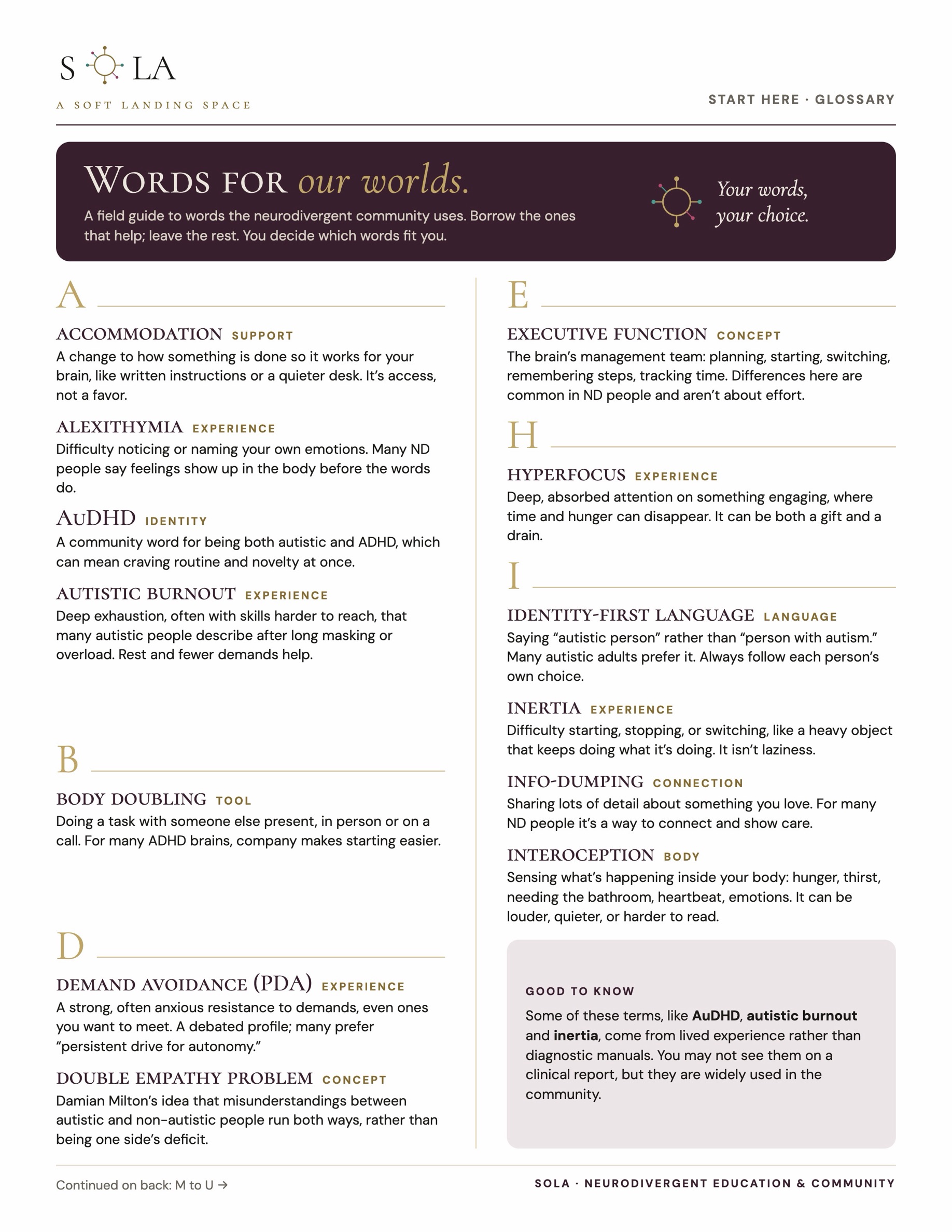
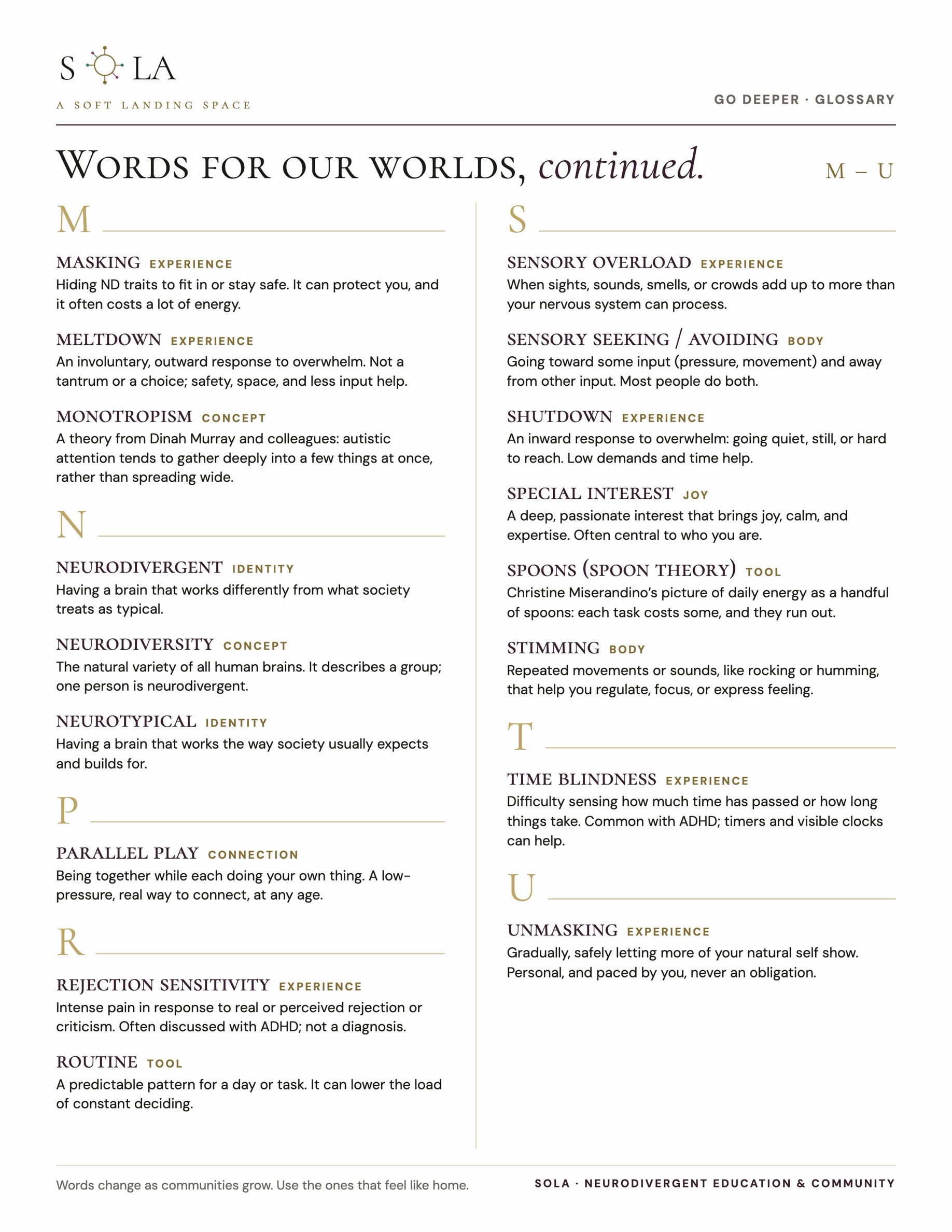
The guide, as designed. The same content is written out below.
See page 2
A
· Support
A change to how something is done so it works for your brain, like written instructions or a quieter desk. It's access, not a favor.
· Experience
Difficulty noticing or naming your own emotions. Many ND people say feelings show up in the body before the words do.
· Identity
A community word for being both autistic and ADHD, which can mean craving routine and novelty at once.
· Experience
Deep exhaustion, often with skills harder to reach, that many autistic people describe after long masking or overload. Rest and fewer demands help.
B
body doubling · Tool
Doing a task with someone else present, in person or on a call. For many ADHD brains, company makes starting easier.
D
· Experience
A strong, often anxious resistance to demands, even ones you want to meet. A debated profile; many prefer "persistent drive for autonomy."
· Concept
Damian Milton's idea that misunderstandings between autistic and non-autistic people run both ways, rather than being one side's deficit.
E
executive function · Concept
The brain's management team: planning, starting, switching, remembering steps, tracking time. Differences here are common in ND people and aren't about effort.
H
hyperfocus · Experience
Deep, absorbed attention on something engaging, where time and hunger can disappear. It can be both a gift and a drain.
I
· Language
Saying "autistic person" rather than "person with autism." Many autistic adults prefer it. Always follow each person's own choice.
· Experience
Difficulty starting, stopping, or switching, like a heavy object that keeps doing what it's doing. It isn't laziness.
· Connection
Sharing lots of detail about something you love. For many ND people it's a way to connect and show care.
· Body
Sensing what's happening inside your body: hunger, thirst, needing the bathroom, heartbeat, emotions. It can be louder, quieter, or harder to read.
Good to know
Some of these terms, like AuDHD, autistic burnout and inertia, come from lived experience rather than diagnostic manuals. You may not see them on a clinical report, but they are widely used in the community.
M
Words for our worlds, continued. M–U
· Experience
Hiding ND traits to fit in or stay safe. It can protect you, and it often costs a lot of energy.
· Experience
An involuntary, outward response to overwhelm. Not a tantrum or a choice; safety, space, and less input help.
· Concept
A theory from Dinah Murray and colleagues: autistic attention tends to gather deeply into a few things at once, rather than spreading wide.
N
· Identity
Having a brain that works differently from what society treats as typical.
· Concept
The natural variety of all human brains. It describes a group; one person is neurodivergent.
· Identity
Having a brain that works the way society usually expects and builds for.
P
parallel play · Connection
Being together while each doing your own thing. A low-pressure, real way to connect, at any age.
R
· Experience
Intense pain in response to real or perceived rejection or criticism. Often discussed with ADHD; not a diagnosis.
· Tool
A predictable pattern for a day or task. It can lower the load of constant deciding.
S
· Experience
When sights, sounds, smells, or crowds add up to more than your nervous system can process.
· Body
Going toward some input (pressure, movement) and away from other input. Most people do both.
· Experience
An inward response to overwhelm: going quiet, still, or hard to reach. Low demands and time help.
· Joy
A deep, passionate interest that brings joy, calm, and expertise. Often central to who you are.
· Tool
Christine Miserandino's picture of daily energy as a handful of spoons: each task costs some, and they run out.
· Body
Repeated movements or sounds, like rocking or humming, that help you regulate, focus, or express feeling.
T
time blindness · Experience
Difficulty sensing how much time has passed or how long things take. Common with ADHD; timers and visible clocks can help.
U
unmasking · Experience
Gradually, safely letting more of your natural self show. Personal, and paced by you, never an obligation.
Sources and credits. Words change as communities grow. Use the ones that feel like home.