Before we get started
What is Autism?
Autism, the basics.
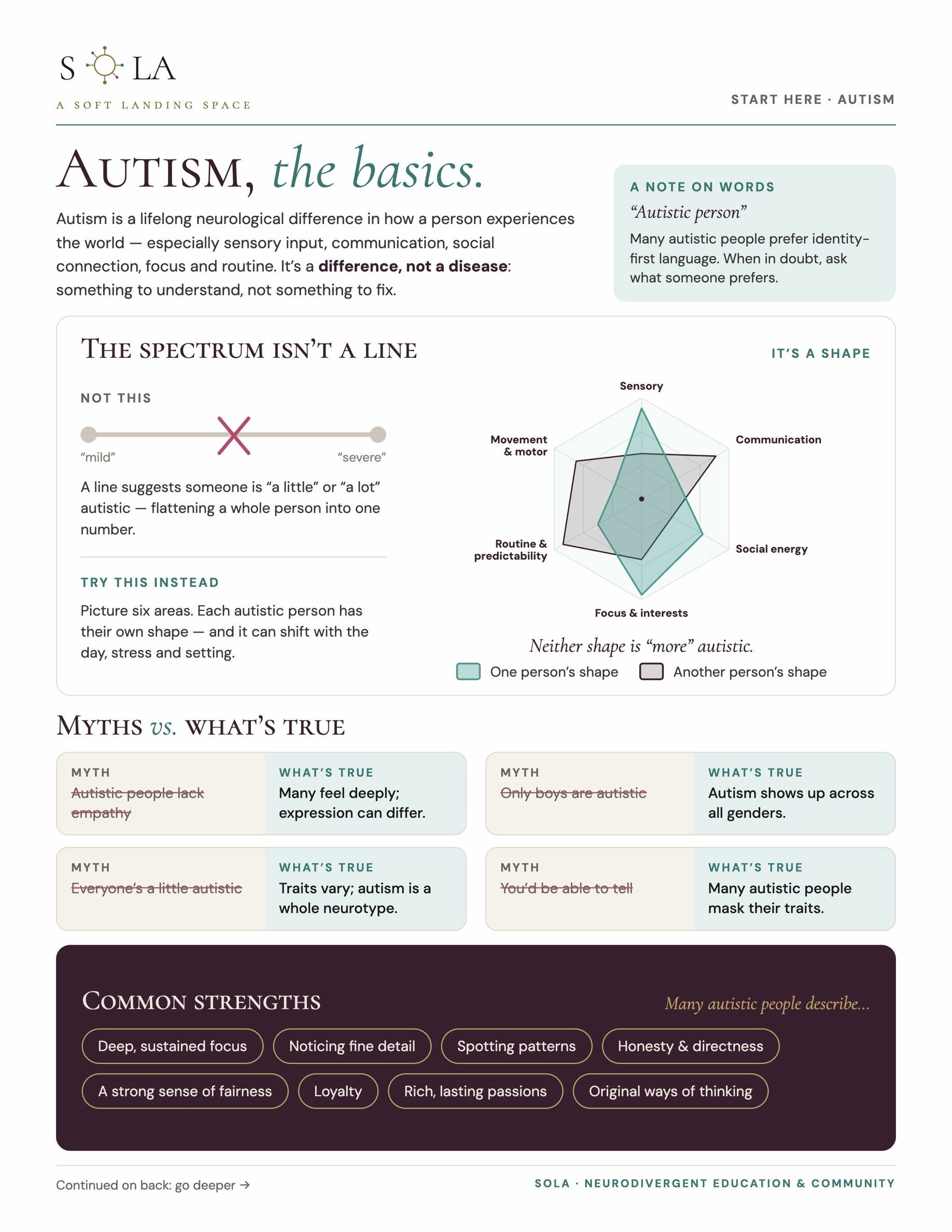
Autism is a lifelong neurological difference in how a person experiences the world — especially sensory input, communication, social connection, focus and routine. It's a difference, not a disease: something to understand, not something to fix.
The guide, as designed. The same content is written out below.
See page 2
A note on words
"Autistic person"
Many autistic people prefer identity-first language. When in doubt, ask what someone prefers.
The spectrum isn't a line
It's a shape
a line from "mild" to "severe".
A line suggests someone is "a little" or "a lot" autistic — flattening a whole person into one number.
Picture six areas. Each autistic person has their own shape — and it can shift with the day, stress and setting.
The six areas, drawn as a shape: Sensory · Communication · Social energy · Focus & interests · Routine & predictability · Movement & motor. The sheet shows one person's shape and another person's shape overlaid.
Neither shape is "more" autistic.
Myths vs. what's true
Autistic people lack empathy
What's true: Many feel deeply; expression can differ.
Only boys are autistic
What's true: Autism shows up across all genders.
Everyone's a little autistic
What's true: Traits vary; autism is a whole neurotype.
You'd be able to tell
What's true: Many autistic people mask their traits.
Common strengths
Many autistic people describe…
- Deep, sustained focus
- Noticing fine detail
- Spotting patterns
- Honesty & directness
- A strong sense of fairness
- Loyalty
- Rich, lasting passions
- Original ways of thinking
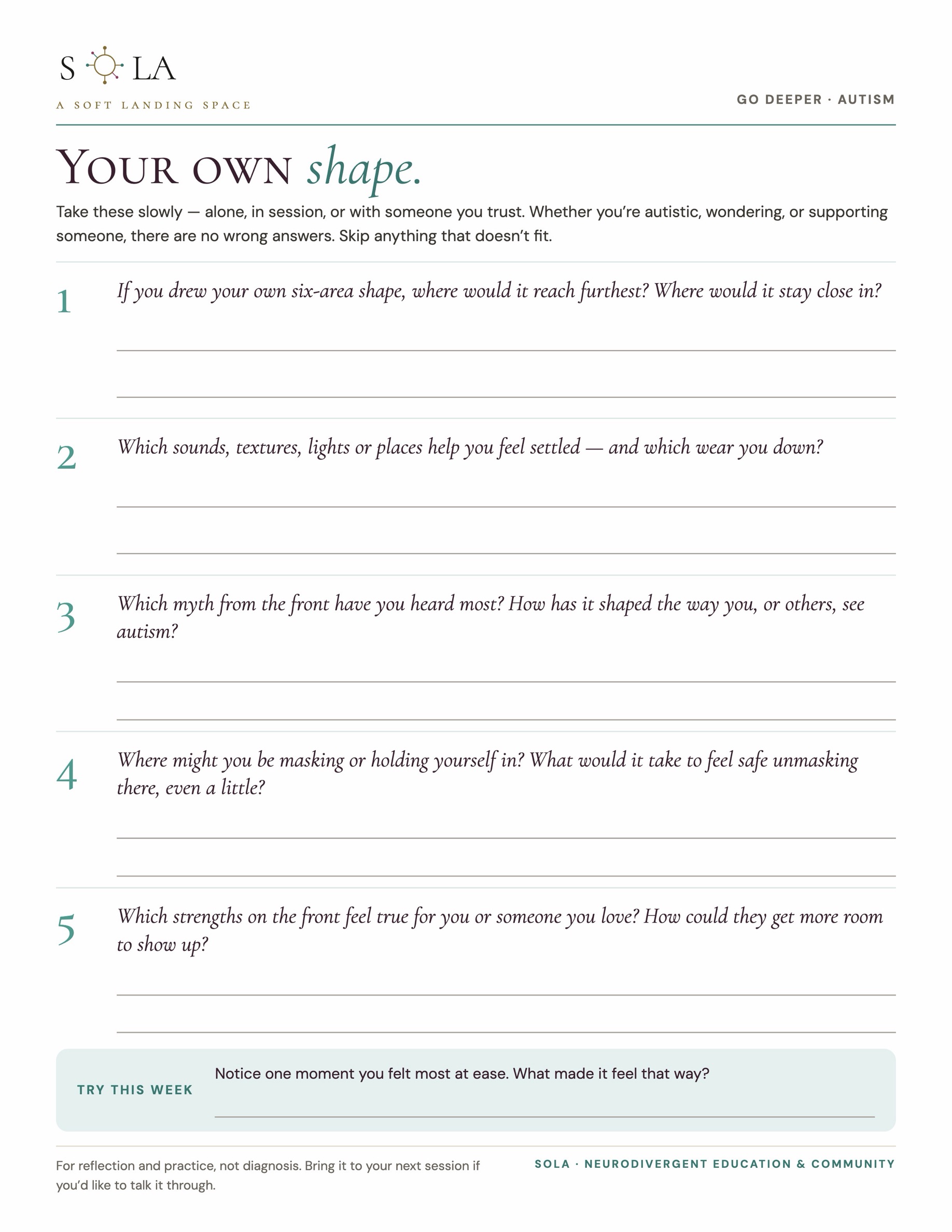
Your own shape.
Take these slowly — alone, in session, or with someone you trust. Whether you're autistic, wondering, or supporting someone, there are no wrong answers. Skip anything that doesn't fit.
Try this week
For reflection and practice, not diagnosis. Bring it to your next session if you'd like to talk it through.