Practice
How do I tell a need from a want and set a boundary?
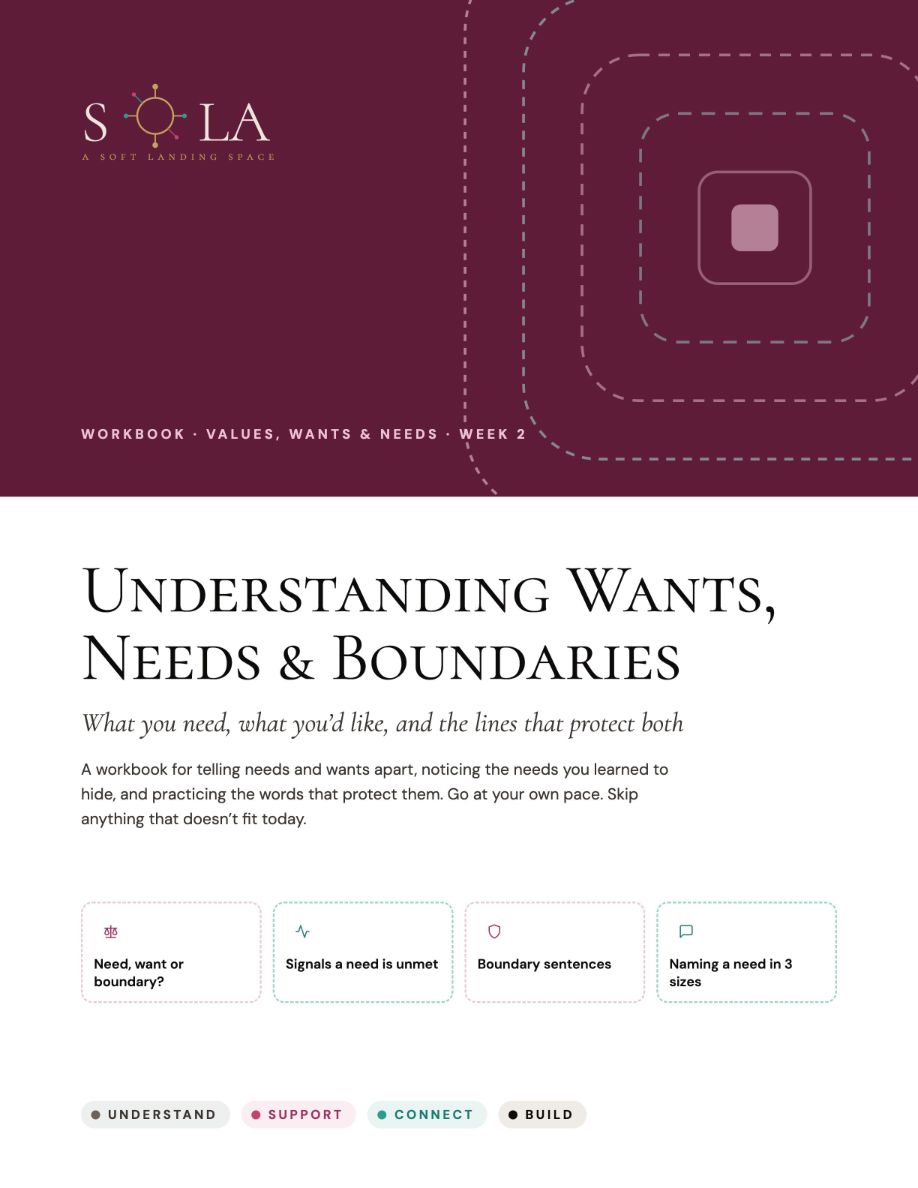
Workbook · Values, Wants & Needs · Week 2
In short. A need is something you function worse without. A want is something you would like. A boundary is what you will do to protect either one. Run the item through four questions, such as what happens if it goes unmet for a week, and sort it for you, not for people in general.
The same thing can be a need for one person and a want for another
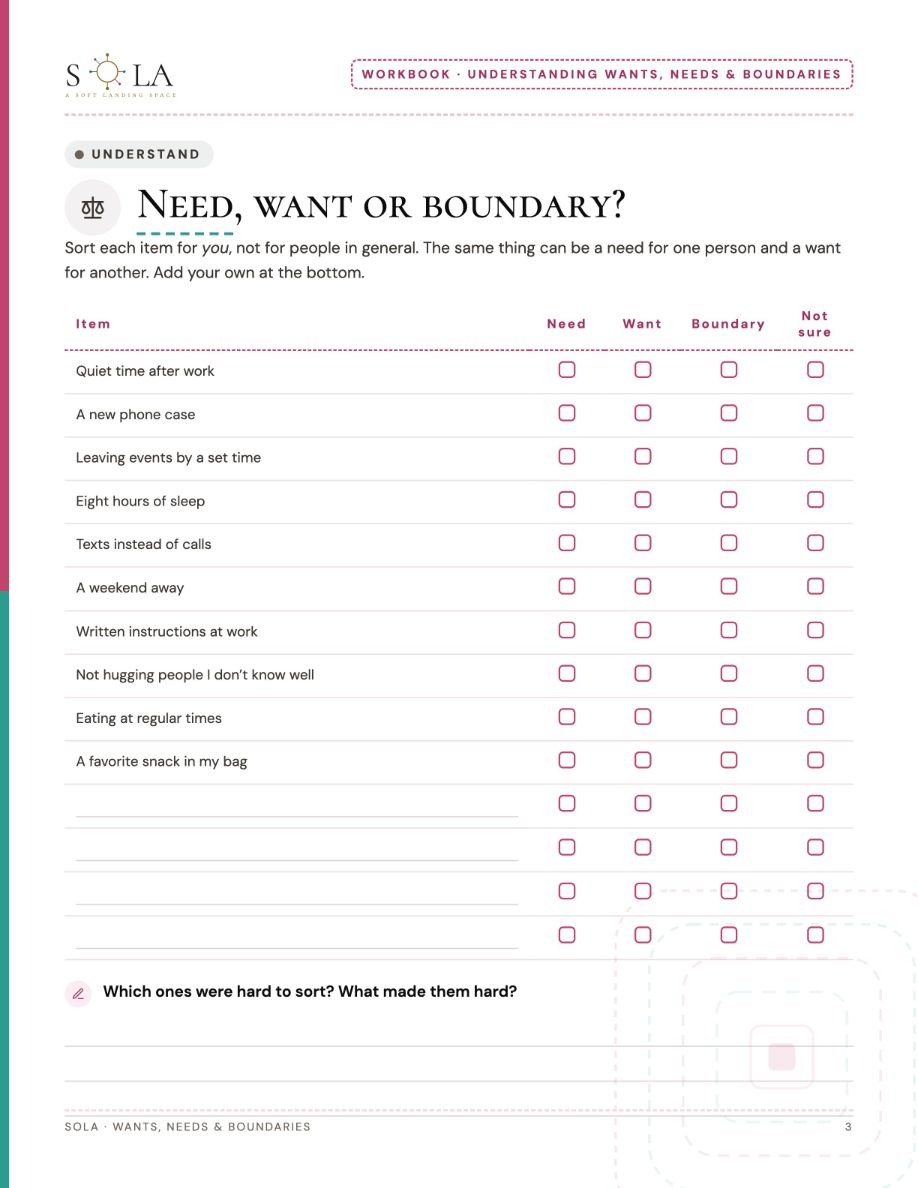
Quiet time after work, eight hours of sleep, texts instead of calls, written instructions at work. For one neurodivergent adult each of these is a nice extra. For another it is what keeps the day from falling apart. The workbook asks you to sort items like these for you, not for people in general, because there is no master list that settles it.
That is why the sorting starts with a plain rule of thumb: if it breaks down without it, it is probably a need. Leaving events by a set time or not hugging people you do not know well can also sit in a third box. Those are boundaries, which are about what you do rather than what you require.
Four questions can settle the ones you are unsure about
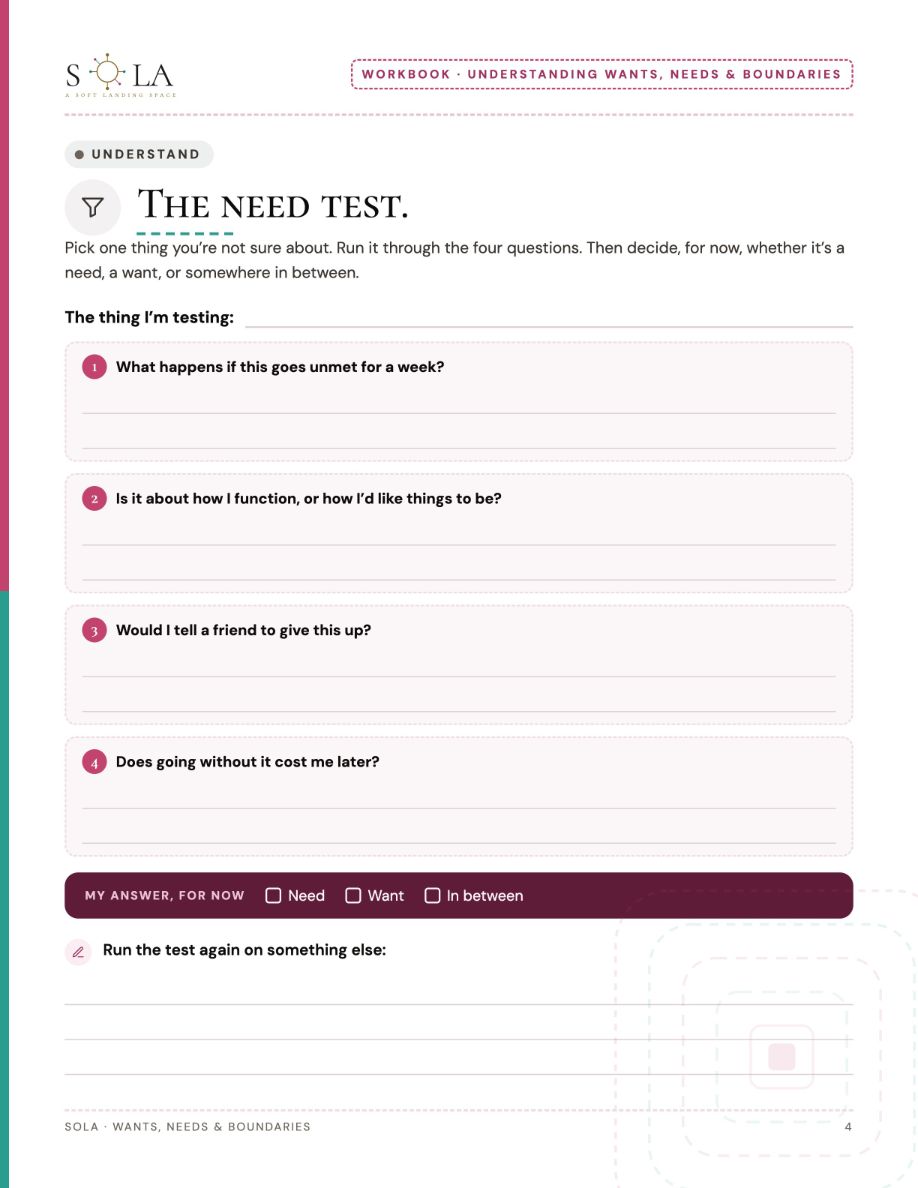
Pick one thing that is hard to sort. Ask what happens if it goes unmet for a week. Ask whether it is about how you function or how you would like things to be. Ask whether you would tell a friend to give it up. Ask whether going without it costs you later.
Your answer can be need, want or somewhere in between, and it only has to hold for now. If you would never tell a friend to skip their sleep or their quiet, that tells you something about how you are treating yourself. Notice that gap without judging it.
Many of us learned to hide what we need
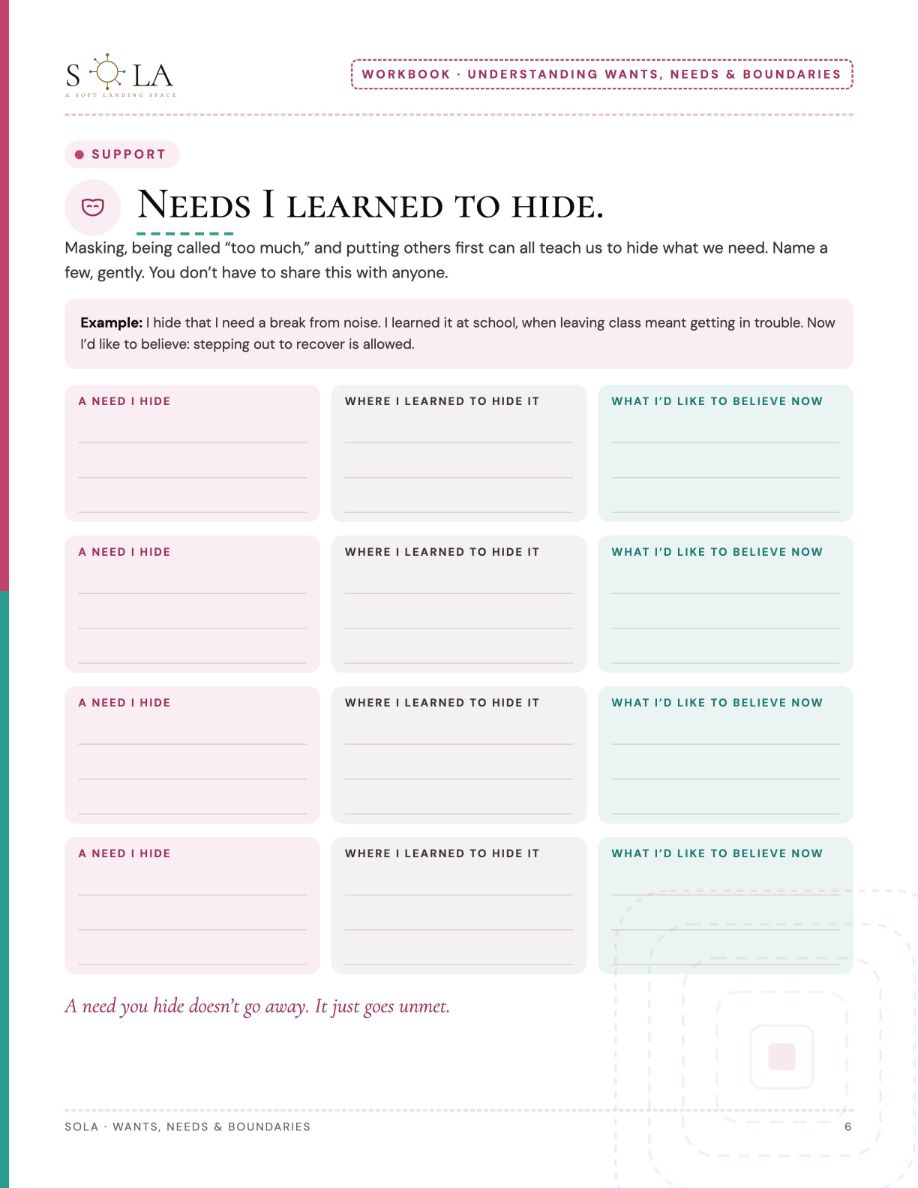
Masking, being called too much and putting other people first can all teach a person to bury a need. Picture a kid who needed a break from noise, and learned at school that leaving class meant getting in trouble. As an adult, that same person sits through a loud dinner and says nothing.
The workbook has you write the need you hide, where you learned to hide it, and what you would like to believe now. In the example, the new belief is that stepping out to recover is allowed. A need you hide does not go away. It just goes unmet.
Unmet needs often show up sideways
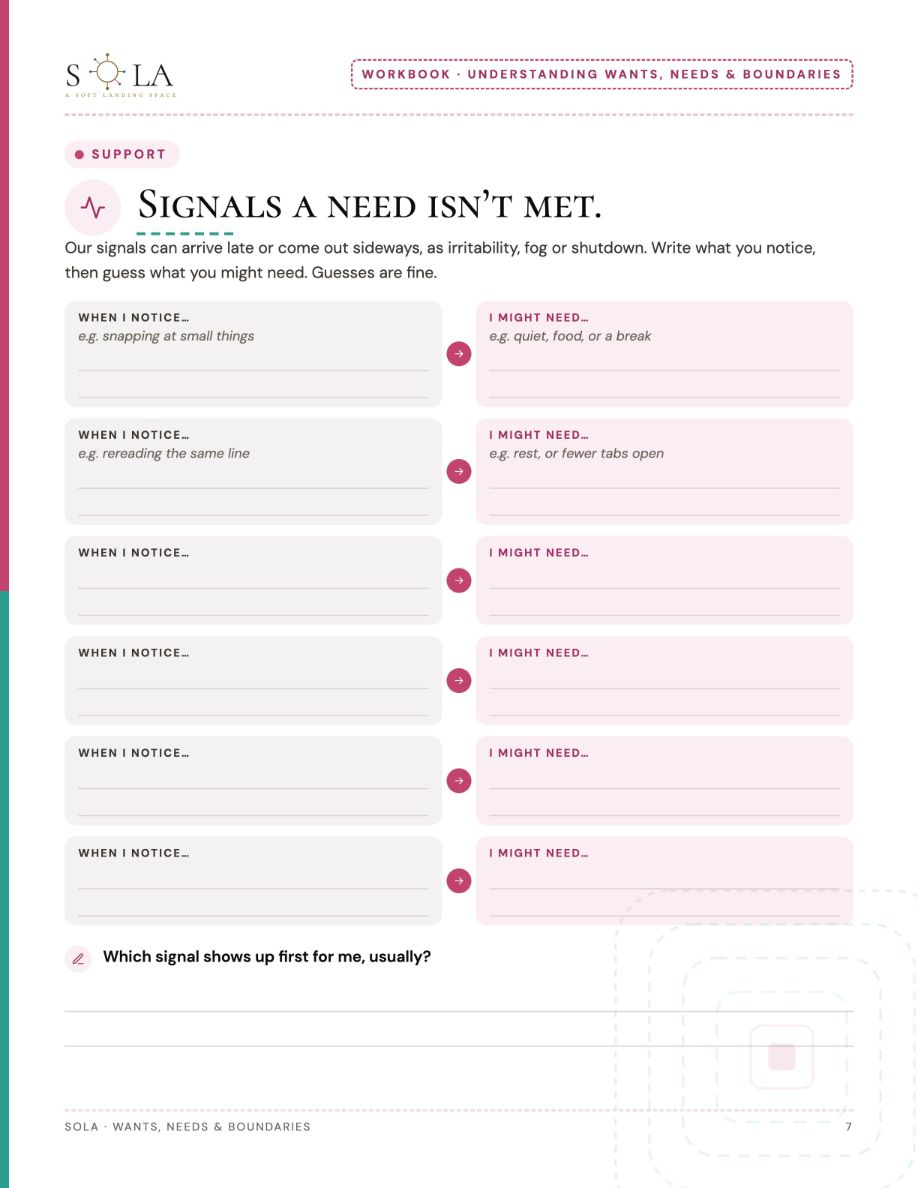
Signals can arrive late or come out as something else: irritability, fog or shutdown. You may not think I need a break. You may just notice you are snapping at small things, or rereading the same line over and over.
The practice is to write what you notice, then guess what it might mean. Snapping at small things might point to quiet, food or a break. Rereading the same line might point to rest, or fewer tabs open. Guesses are fine. It also helps to learn which signal shows up first for you, because that is your earliest warning.
- Snapping at small things
- Rereading the same line
- Quiet, food or a break
- Rest, or fewer tabs open
A request asks, a boundary acts
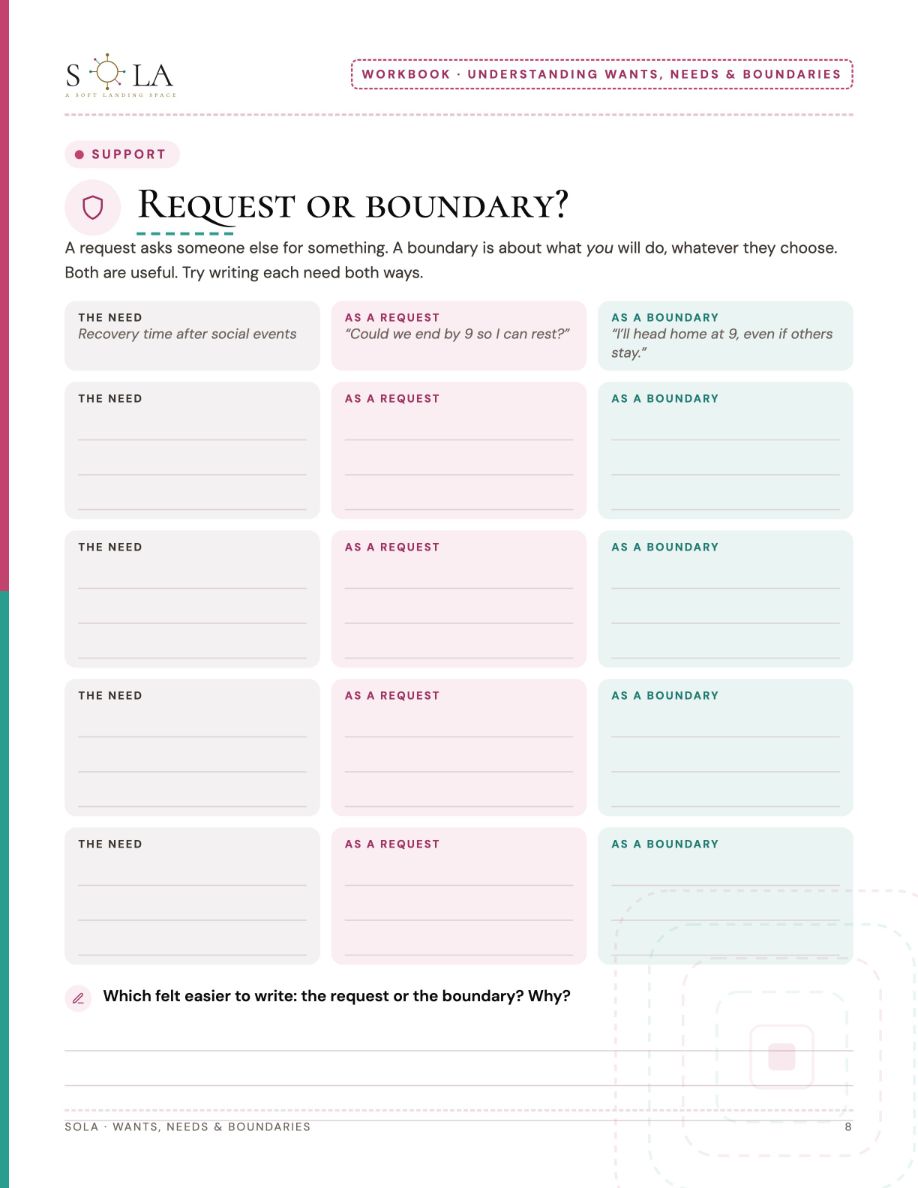
A request asks someone else for something. A boundary is about what you will do, whatever they choose. Both are useful, and the workbook has you write each need both ways. Take recovery time after social events. As a request: Could we end by 9 so I can rest? As a boundary: I'll head home at 9, even if others stay.
The request depends on a yes. The boundary does not. You may find one comes more easily than the other, and that is worth noticing too. You do not need anyone's permission to keep a boundary.
Boundary sentences have a simple shape
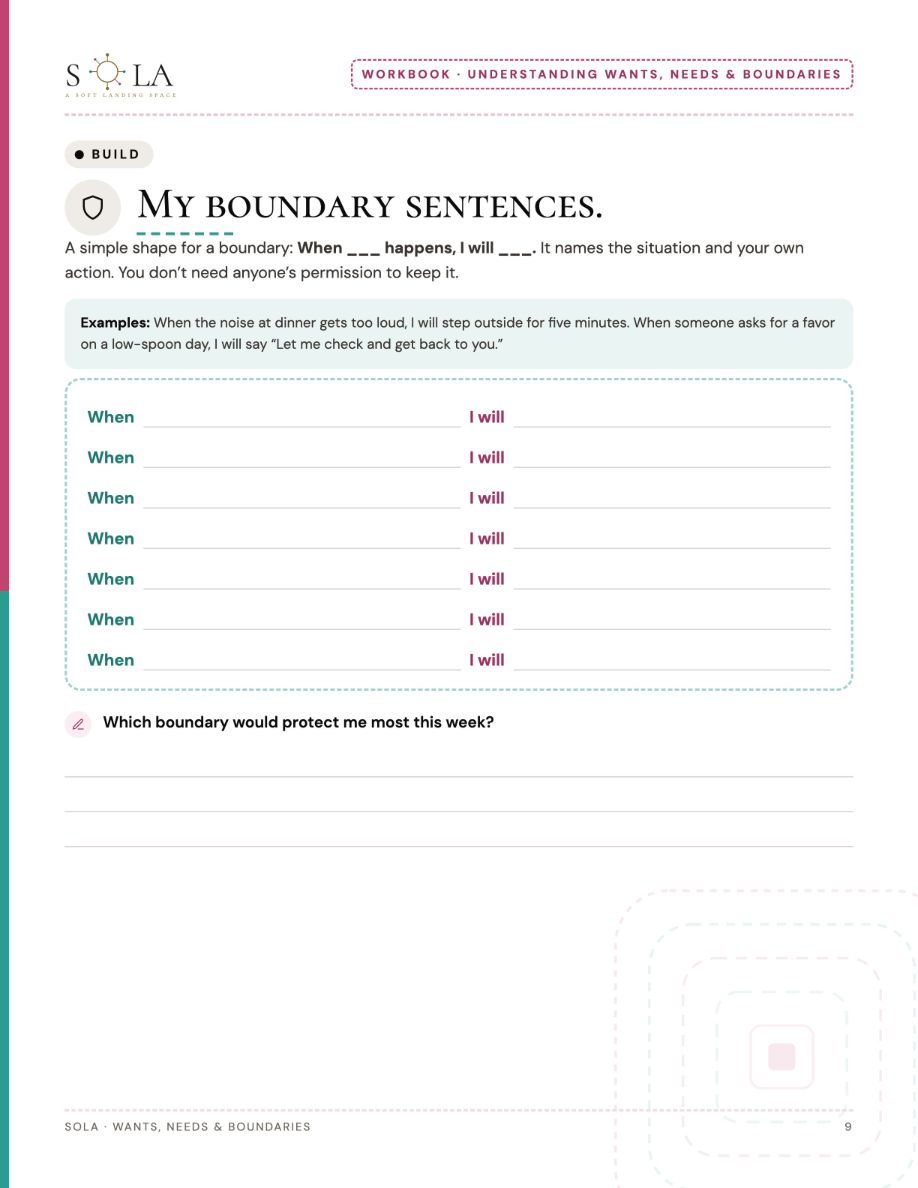
The shape is: when this happens, I will do this. It names the situation and your own action. When the noise at dinner gets too loud, I will step outside for five minutes. When someone asks for a favor on a low-spoon day, I will say, Let me check and get back to you.
Because the sentence is about your action, it is something you can actually carry out. Write a few, then pick the one that would protect you most this week.
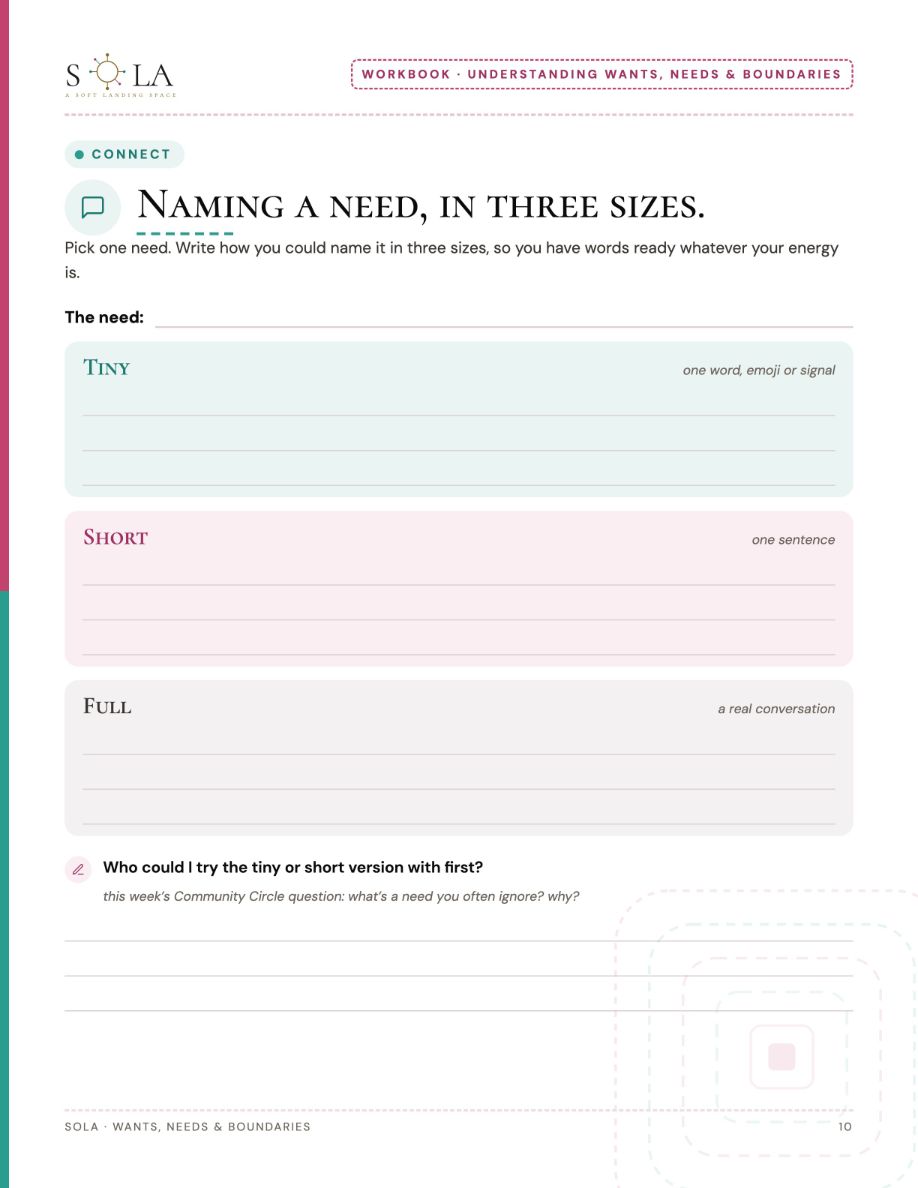
You can name a need in three sizes
Some days a real conversation is out of reach. So the workbook has you prepare three versions of the same need. Tiny is one word, an emoji or a signal. Short is one sentence. Full is a real conversation.
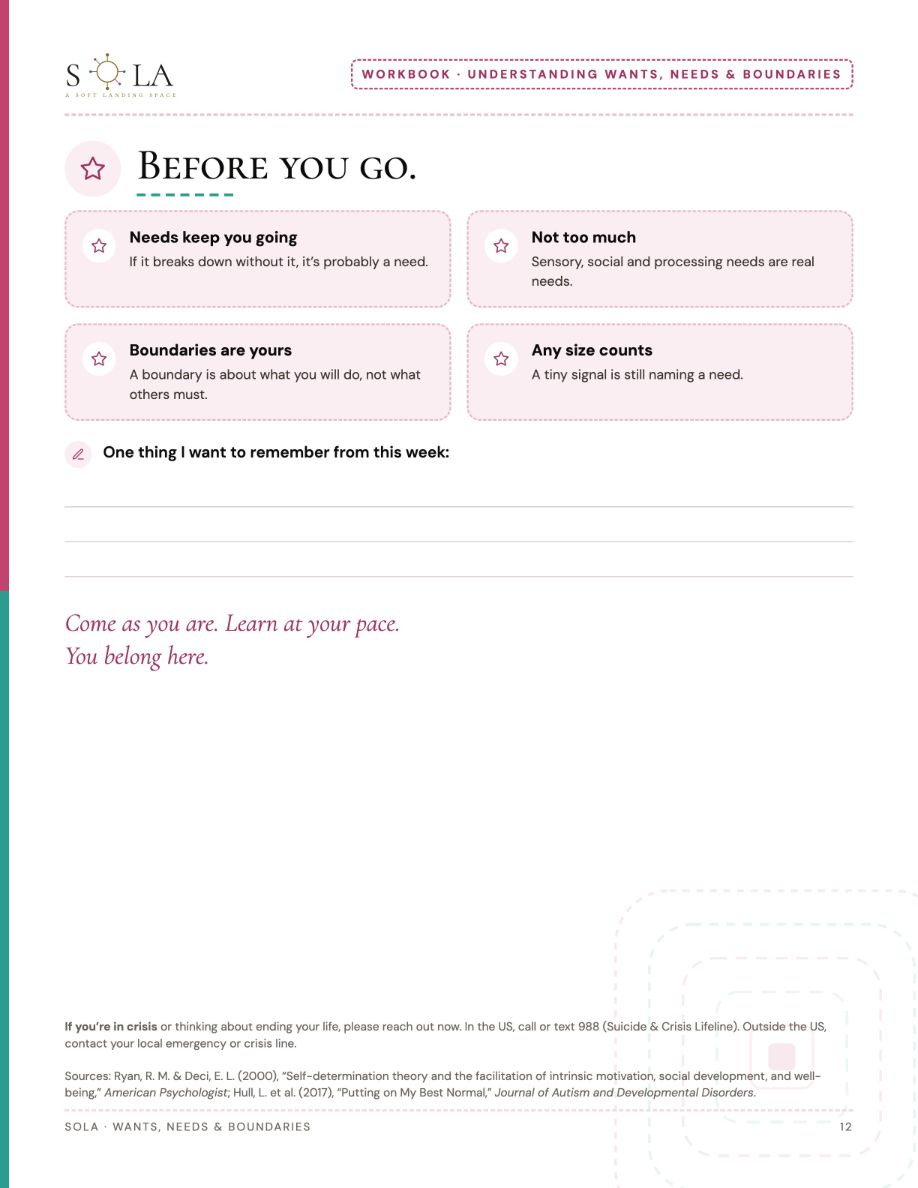
Having all three ready means your energy does not decide whether you get to say it. A tiny signal still counts as naming a need. Try the tiny or short version with someone safe first. Sensory, social and processing needs are real needs, and having them does not make you needy.
How to use this workbook
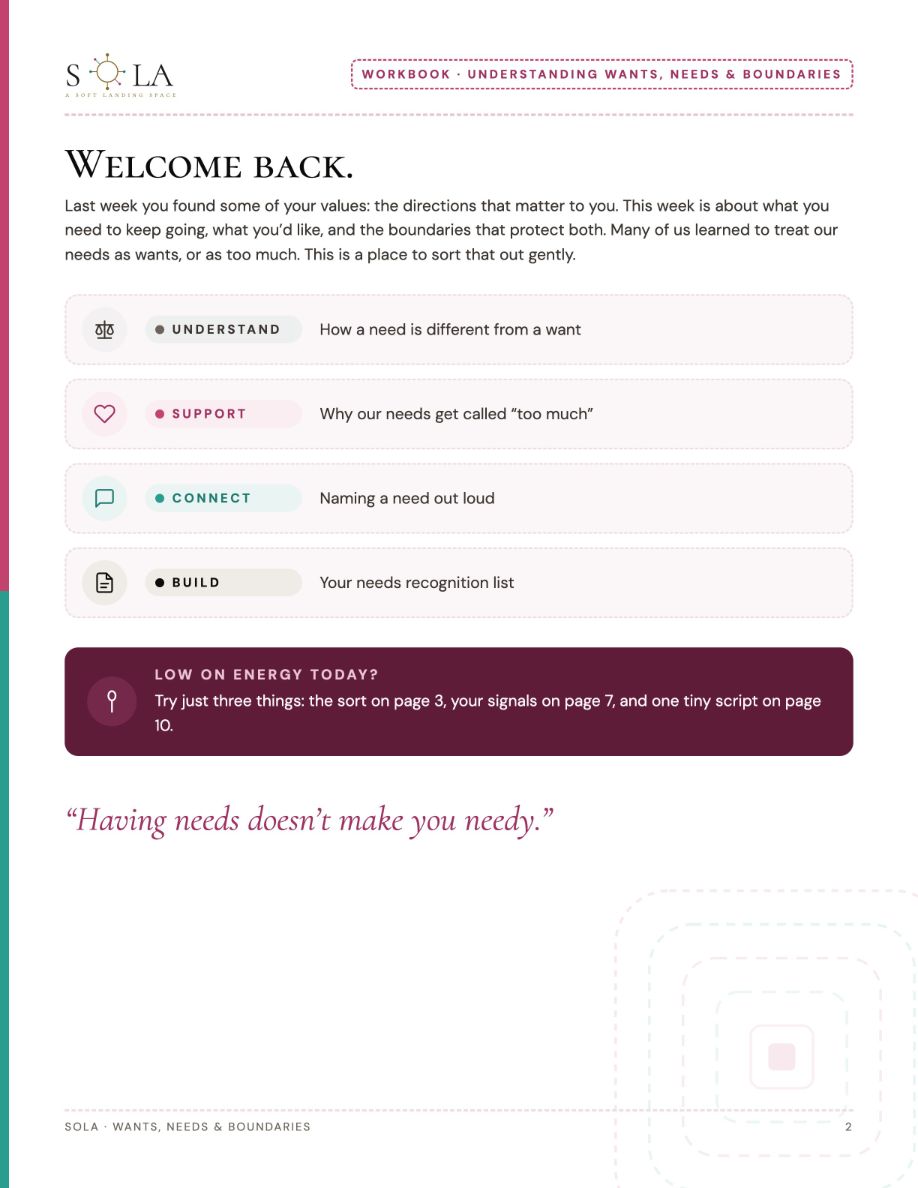
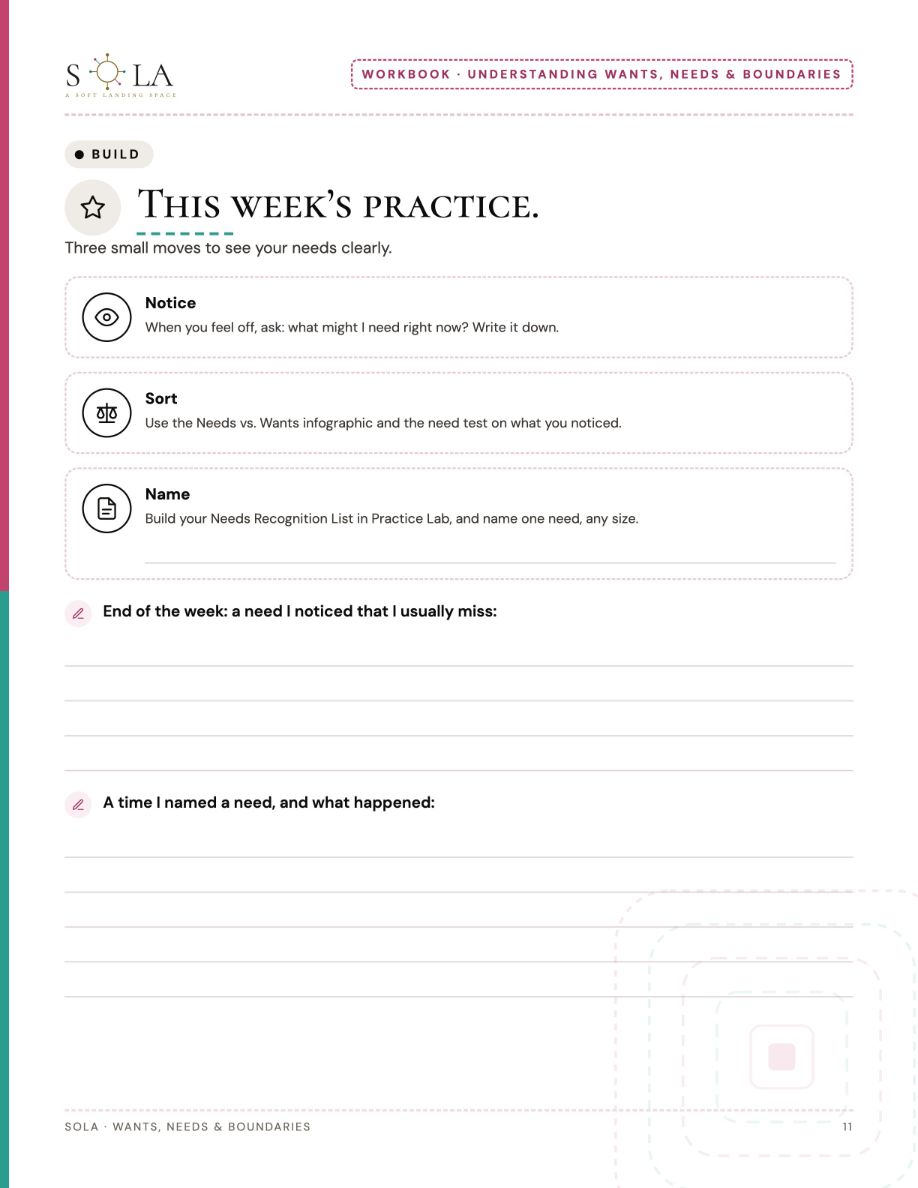
The workbook is built to be done at your own pace, and you can skip anything that does not fit today. On a low-energy day, do just the sort, your signals and one tiny script.
- Sort each listed item as a need, want, boundary or not sure, for you.
- Run one uncertain item through the four-question need test.
- Write what you notice when a need is unmet, then guess what you might need.
- Write one need as a request and as a boundary.
- Fill in a boundary sentence: when ___ happens, I will ___.
- Name one need in a tiny, short and full version.
Questions people ask
What is the difference between a need and a want?
A need is something you function worse without, while a want is something you would like. The line is personal: the same thing can be a need for one person and a want for another. If it breaks down without it, it is probably a need.
Is a boundary the same as a request?
No. A request asks someone else for something. A boundary is about what you will do, whatever they choose. For example, asking to end by 9 is a request, while saying you will head home at 9 is a boundary.
How do I write a boundary sentence?
Use the shape: when ___ happens, I will ___. It names the situation and your own action. For example, when the noise at dinner gets too loud, I will step outside for five minutes. You do not need anyone's permission to keep it.
Are sensory and processing needs real needs?
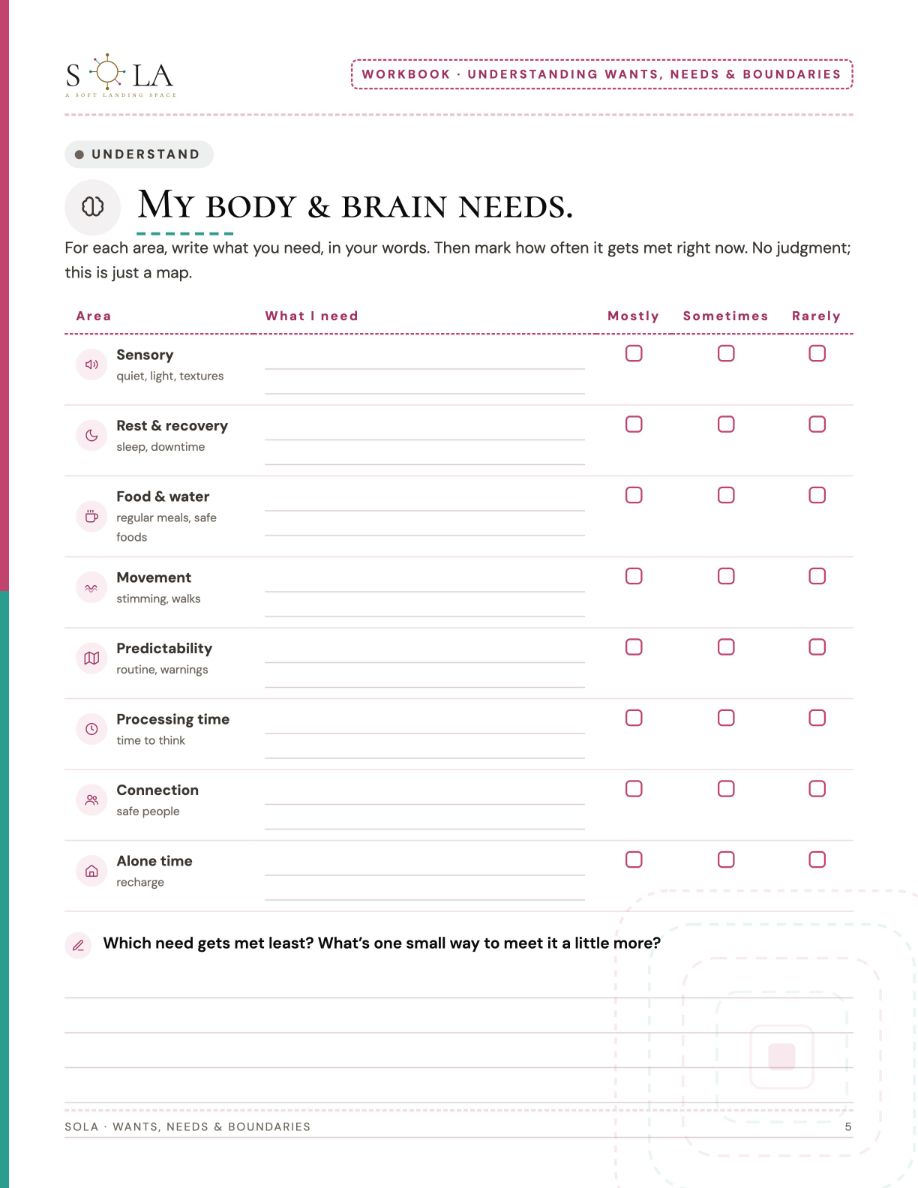
Yes. Sensory, social and processing needs are real needs, not too much. Having needs does not make you needy. The workbook maps areas like sensory quiet, rest, food, movement, predictability, processing time, connection and alone time.
What if I can only name a need in a tiny way?
That still counts. A tiny signal is still naming a need. The workbook suggests preparing a tiny version (a word, emoji or signal), a short sentence and a full conversation, so you have words ready whatever your energy is.
Does this workbook diagnose or treat anything?
No. SOLA is education and community, not therapy, assessment or diagnosis. The workbook is a gentle way to sort your own needs, wants and boundaries at your own pace. If you are in crisis, call or text 988 in the US.
The workbook, as designed. The guide above is written from it.
See the other 11 pages