Learn
Values & the Neurodivergent Brain
Values Series · Handout 2
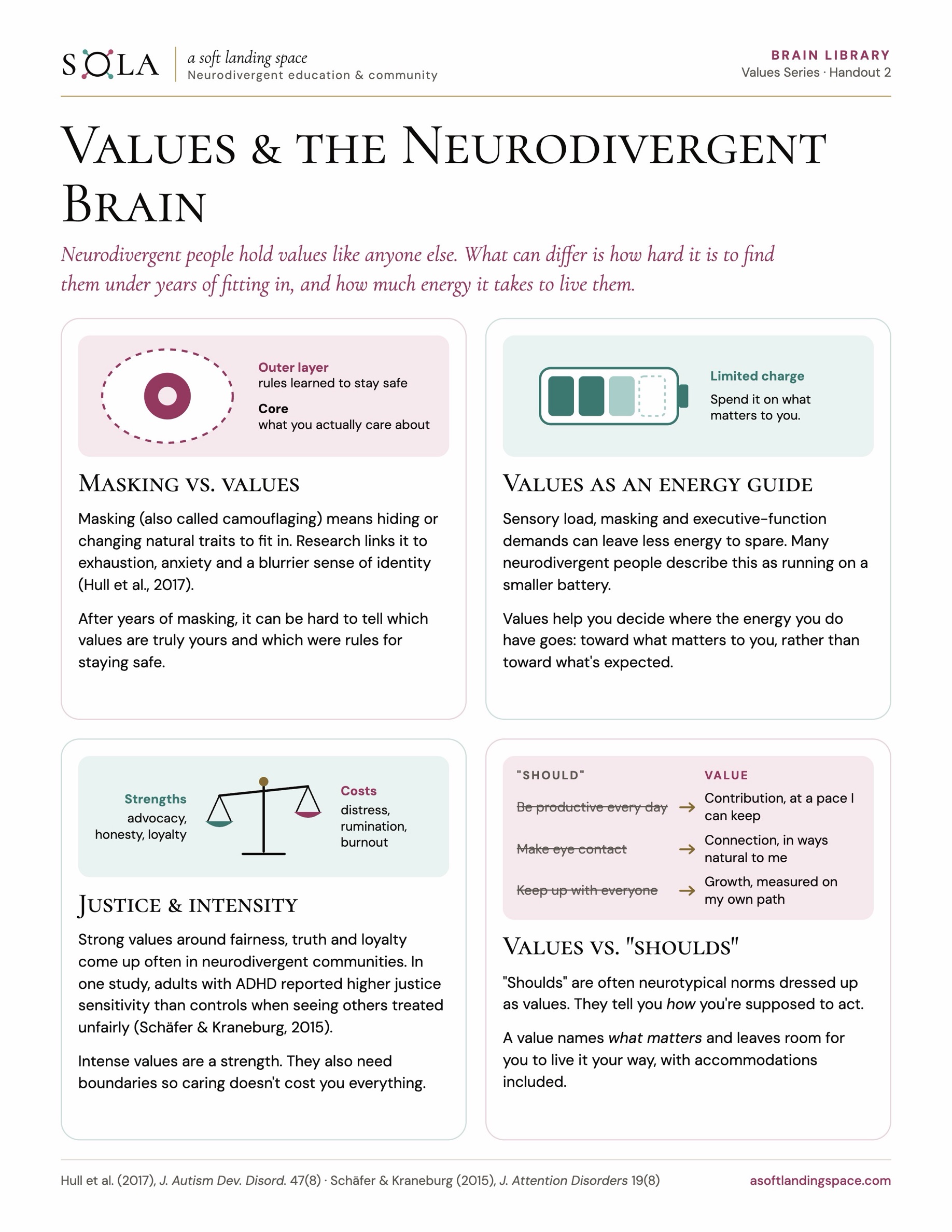
Neurodivergent people hold values like anyone else. What can differ is how hard it is to find them under years of fitting in, and how much energy it takes to live them.
The guide, as designed. The same content is written out below.
See page 2
Masking vs. values
A dotted outer ring around a solid core. Outer layer: rules learned to stay safe. Core: what you actually care about.
Masking (also called camouflaging) means hiding or changing natural traits to fit in. Research links it to exhaustion, anxiety and a blurrier sense of identity (Hull et al., 2017).
After years of masking, it can be hard to tell which values are truly yours and which were rules for staying safe.
Values as an energy guide
A battery with two of four bars full. Limited charge. Spend it on what matters to you.
Sensory load, masking and executive-function demands can leave less energy to spare. Many neurodivergent people describe this as running on a smaller battery.
Values help you decide where the energy you do have goes: toward what matters to you, rather than toward what's expected.
Justice & intensity
A balance scale. Strengths: advocacy, honesty, loyalty. Costs: distress, rumination, burnout.
Strong values around fairness, truth and loyalty come up often in neurodivergent communities. In one study, adults with ADHD reported higher justice sensitivity than controls when seeing others treated unfairly (Schäfer & Kraneburg, 2015).
Intense values are a strength. They also need boundaries so caring doesn't cost you everything.
Values vs. "shoulds"
"Should" → Value
- Be productive every day → Contribution, at a pace I can keep
- Make eye contact → Connection, in ways natural to me
- Keep up with everyone → Growth, measured on my own path
"Shoulds" are often neurotypical norms dressed up as values. They tell you how you're supposed to act.
A value names what matters and leaves room for you to live it your way, with accommodations included.
Reflect
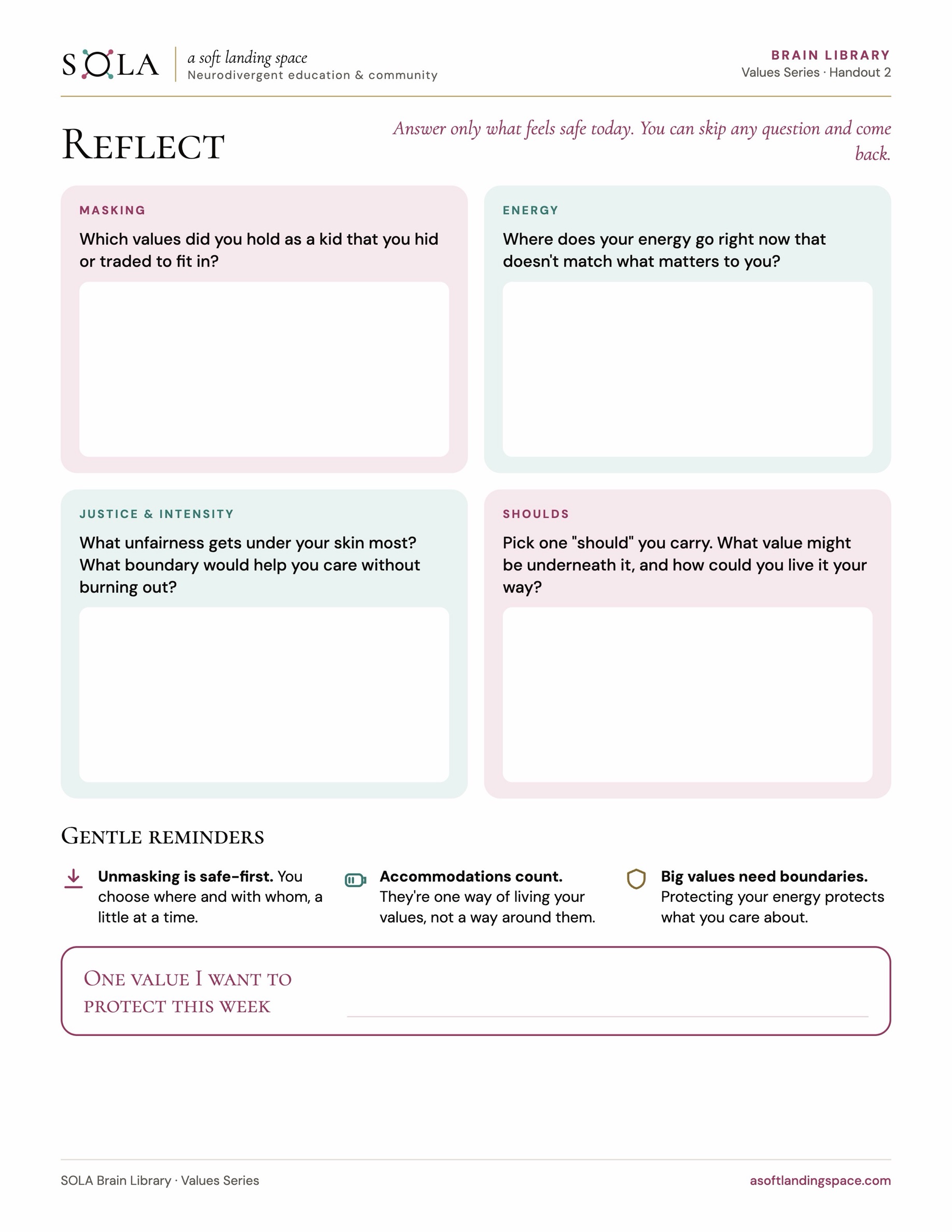
Answer only what feels safe today. You can skip any question and come back.
Gentle reminders
Unmasking is safe-first. You choose where and with whom, a little at a time.
Accommodations count. They're one way of living your values, not a way around them.
Big values need boundaries. Protecting your energy protects what you care about.
Sources and credits. SOLA Brain Library · Values Series · asoftlandingspace.com. Hull et al. (2017), J. Autism Dev. Disord. 47(8) · Schäfer & Kraneburg (2015), J. Attention Disorders 19(8)