Learn
Your 8 Senses & DBT
DBT Skills · 8-Sense Sensory Tool Kit
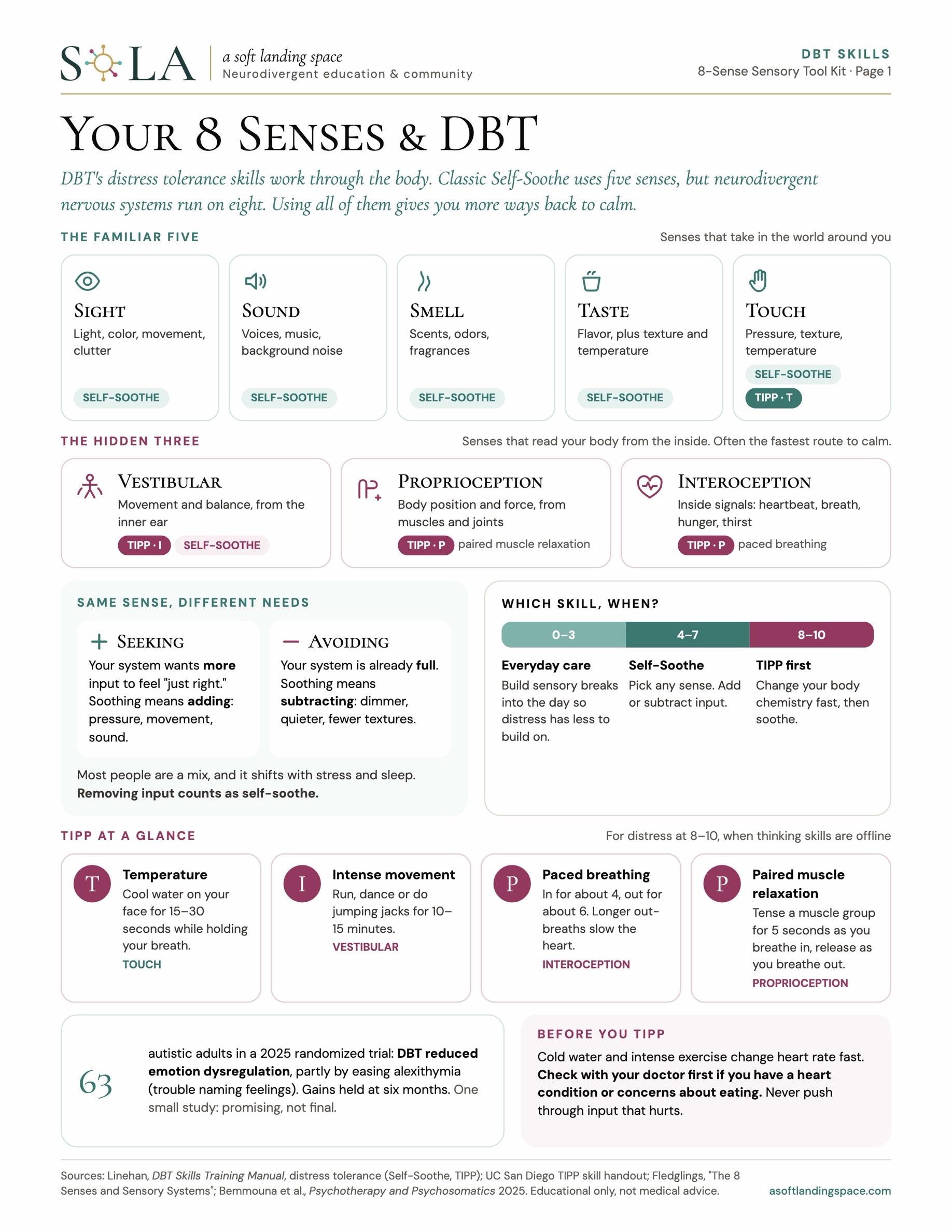
DBT's distress tolerance skills work through the body. Classic Self-Soothe uses five senses, but neurodivergent nervous systems run on eight. Using all of them gives you more ways back to calm.
The guide, as designed. The same content is written out below.
See the other 2 pages
The familiar five
Senses that take in the world around you
Sight Light, color, movement, clutter · Self-Soothe
Sound Voices, music, background noise · Self-Soothe
Smell Scents, odors, fragrances · Self-Soothe
Taste Flavor, plus texture and temperature · Self-Soothe
Touch Pressure, texture, temperature · Self-Soothe · TIPP · T
The hidden three
Senses that read your body from the inside. Often the fastest route to calm.
Vestibular Movement and balance, from the inner ear · TIPP · I · Self-Soothe
Proprioception Body position and force, from muscles and joints · TIPP · P · paired muscle relaxation
Interoception Inside signals: heartbeat, breath, hunger, thirst · TIPP · P · paced breathing
Same sense, different needs
+ Seeking Your system wants more input to feel "just right." Soothing means adding: pressure, movement, sound.
− Avoiding Your system is already full. Soothing means subtracting: dimmer, quieter, fewer textures.
Most people are a mix, and it shifts with stress and sleep. Removing input counts as self-soothe.
Which skill, when?
0–3 · Everyday care Build sensory breaks into the day so distress has less to build on.
4–7 · Self-Soothe Pick any sense. Add or subtract input.
8–10 · TIPP first Change your body chemistry fast, then soothe.
TIPP at a glance
For distress at 8–10, when thinking skills are offline
Cool water on your face for 15–30 seconds while holding your breath. (Touch)
I · Intense movement Run, dance or do jumping jacks for 10–15 minutes. (Vestibular)
P · Paced breathing In for about 4, out for about 6. Longer out-breaths slow the heart. (Interoception)
P · Paired muscle relaxation Tense a muscle group for 5 seconds as you breathe in, release as you breathe out. (Proprioception)
autistic adults in a 2025 randomized trial: DBT reduced emotion dysregulation, partly by easing alexithymia (trouble naming feelings). Gains held at six months. One small study: promising, not final.
Cold water and intense exercise change heart rate fast. Check with your doctor first if you have a heart condition or concerns about eating. Never push through input that hurts.
The 8-Sense Menu
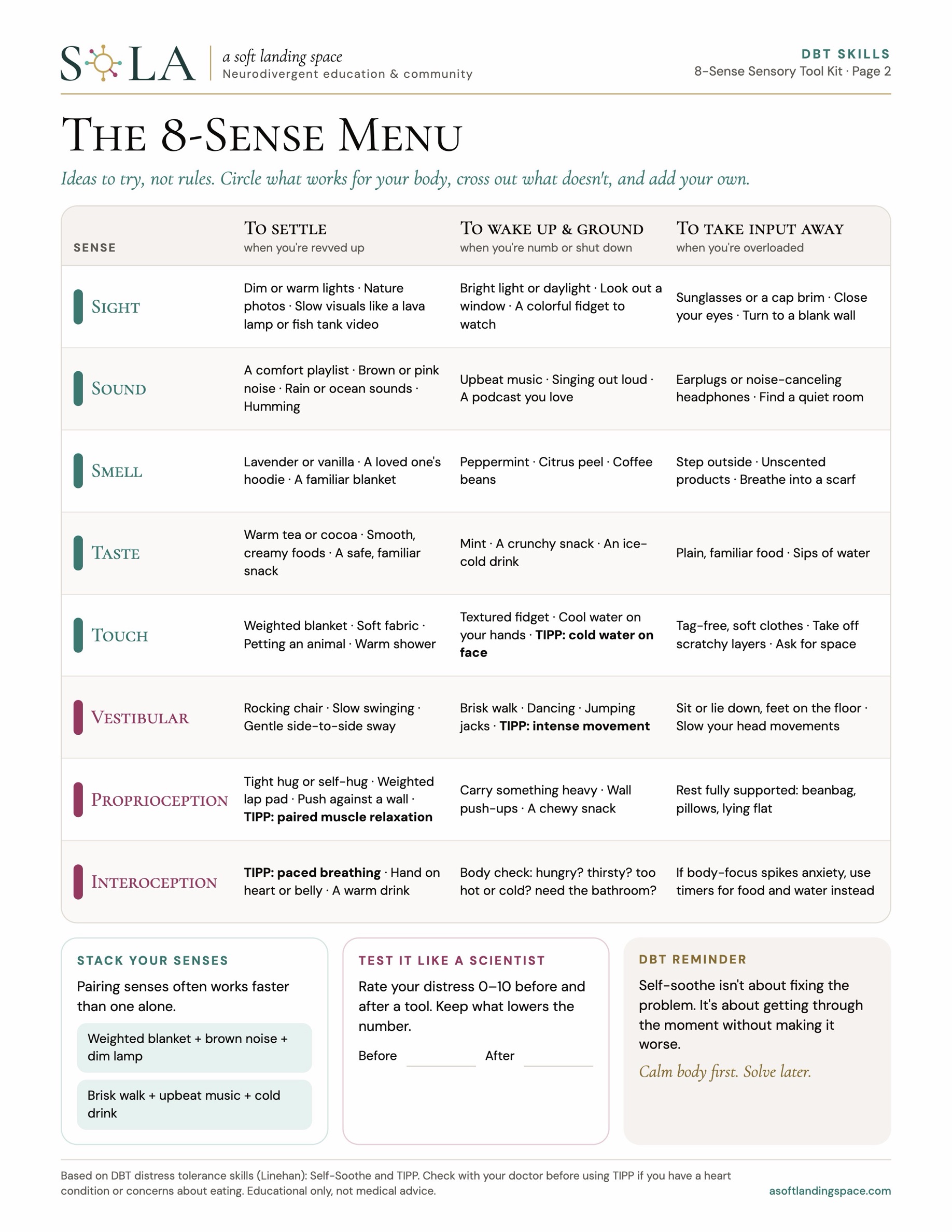
Ideas to try, not rules. Circle what works for your body, cross out what doesn't, and add your own.
Three columns for each sense: To settle (when you're revved up) · To wake up & ground (when you're numb or shut down) · To take input away (when you're overloaded)
- To settle: Dim or warm lights · Nature photos · Slow visuals like a lava lamp or fish tank video
- To wake up & ground: Bright light or daylight · Look out a window · A colorful fidget to watch
- To take input away: Sunglasses or a cap brim · Close your eyes · Turn to a blank wall
- To settle: A comfort playlist · Brown or pink noise · Rain or ocean sounds · Humming
- To wake up & ground: Upbeat music · Singing out loud · A podcast you love
- To take input away: Earplugs or noise-canceling headphones · Find a quiet room
- To settle: Lavender or vanilla · A loved one's hoodie · A familiar blanket
- To wake up & ground: Peppermint · Citrus peel · Coffee beans
- To take input away: Step outside · Unscented products · Breathe into a scarf
- To settle: Warm tea or cocoa · Smooth, creamy foods · A safe, familiar snack
- To wake up & ground: Mint · A crunchy snack · An ice-cold drink
- To take input away: Plain, familiar food · Sips of water
- To settle: Weighted blanket · Soft fabric · Petting an animal · Warm shower
- To wake up & ground: Textured fidget · Cool water on your hands · TIPP: cold water on face
- To take input away: Tag-free, soft clothes · Take off scratchy layers · Ask for space
- To settle: Rocking chair · Slow swinging · Gentle side-to-side sway
- To wake up & ground: Brisk walk · Dancing · Jumping jacks · TIPP: intense movement
- To take input away: Sit or lie down, feet on the floor · Slow your head movements
- To settle: Tight hug or self-hug · Weighted lap pad · Push against a wall · TIPP: paired muscle relaxation
- To wake up & ground: Carry something heavy · Wall push-ups · A chewy snack
- To take input away: Rest fully supported: beanbag, pillows, lying flat
- To settle: TIPP: paced breathing · Hand on heart or belly · A warm drink
- To wake up & ground: Body check: hungry? thirsty? too hot or cold? need the bathroom?
- To take input away: If body-focus spikes anxiety, use timers for food and water instead
Stack your senses
Pairing senses often works faster than one alone.
- Weighted blanket + brown noise + dim lamp
- Brisk walk + upbeat music + cold drink
Test it like a scientist
Rate your distress 0–10 before and after a tool. Keep what lowers the number.
Before
After
DBT reminder
Self-soothe isn't about fixing the problem. It's about getting through the moment without making it worse.
Calm body first. Solve later.
Build My Sensory Kit
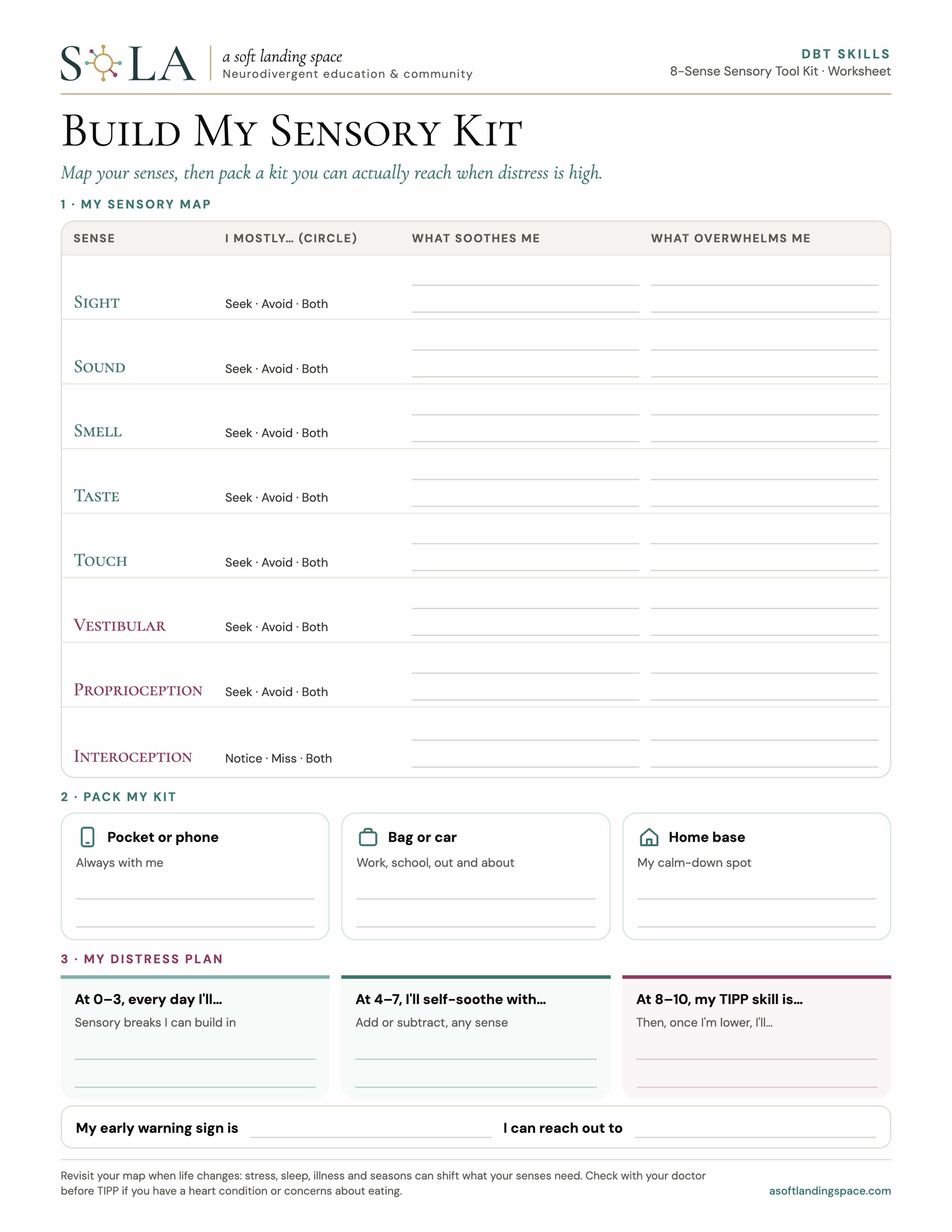
Map your senses, then pack a kit you can actually reach when distress is high.
1 · My sensory map
| I mostly… (circle) | What soothes me | What overwhelms me | |
|---|---|---|---|
| Sight | |||
| Sound | |||
| Smell | |||
| Taste | |||
| Touch | |||
| Vestibular | |||
| Proprioception |
| I mostly… (circle) | What soothes me | What overwhelms me | |
|---|---|---|---|
| Interoception |
Pack my kit
My distress plan
Revisit your map when life changes: stress, sleep, illness and seasons can shift what your senses need. Check with your doctor before TIPP if you have a heart condition or concerns about eating.
Cold water and intense exercise change heart rate fast. Check with your doctor first if you have a heart condition or concerns about eating. Never push through input that hurts. Educational only, not medical advice.
Sources and credits. Sources: Linehan, DBT Skills Training Manual, distress tolerance (Self-Soothe, TIPP); UC San Diego TIPP skill handout; Fledglings, "The 8 Senses and Sensory Systems"; Bemmouna et al., Psychotherapy and Psychosomatics 2025. Based on DBT distress tolerance skills (Linehan): Self-Soothe and TIPP. Check with your doctor before using TIPP if you have a heart condition or concerns about eating. Educational only, not medical advice.