Learn
It all makes sense now.
Late Diagnosis & Self-Discovery
Finding out you’re neurodivergent later in life can shift how you see your whole story. Whatever you’re feeling about it, you’re in good company.
Many people only recognize they’re autistic, ADHD or otherwise neurodivergent as teens or adults — often after years of quietly feeling out of step, working twice as hard to keep up, or being told they were “a lot.” Plenty of people were simply missed, especially if they learned early to mask. However you got here, your path counts.
The guide, as designed. The same content is written out below.
See page 2
Every path in is valid
- A formal assessment
- Self-identification
- Seeing yourself in a child or relative
- Still wondering
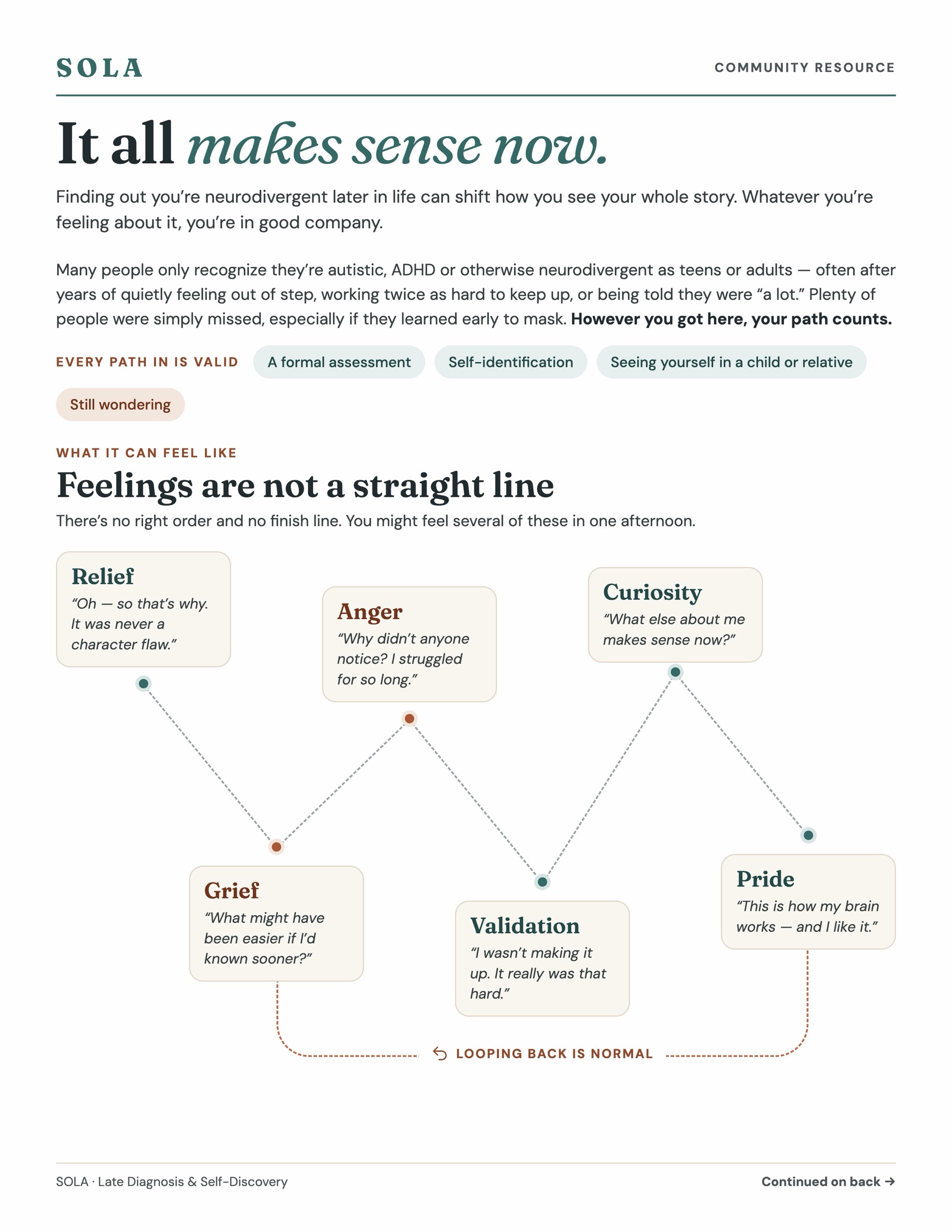
Feelings are not a straight line
What it can feel like. There’s no right order and no finish line. You might feel several of these in one afternoon.
“Oh — so that’s why. It was never a character flaw.”
“What might have been easier if I’d known sooner?”
“Why didn’t anyone notice? I struggled for so long.”
“I wasn’t making it up. It really was that hard.”
“What else about me makes sense now?”
“This is how my brain works — and I like it.”
Looping back is normal
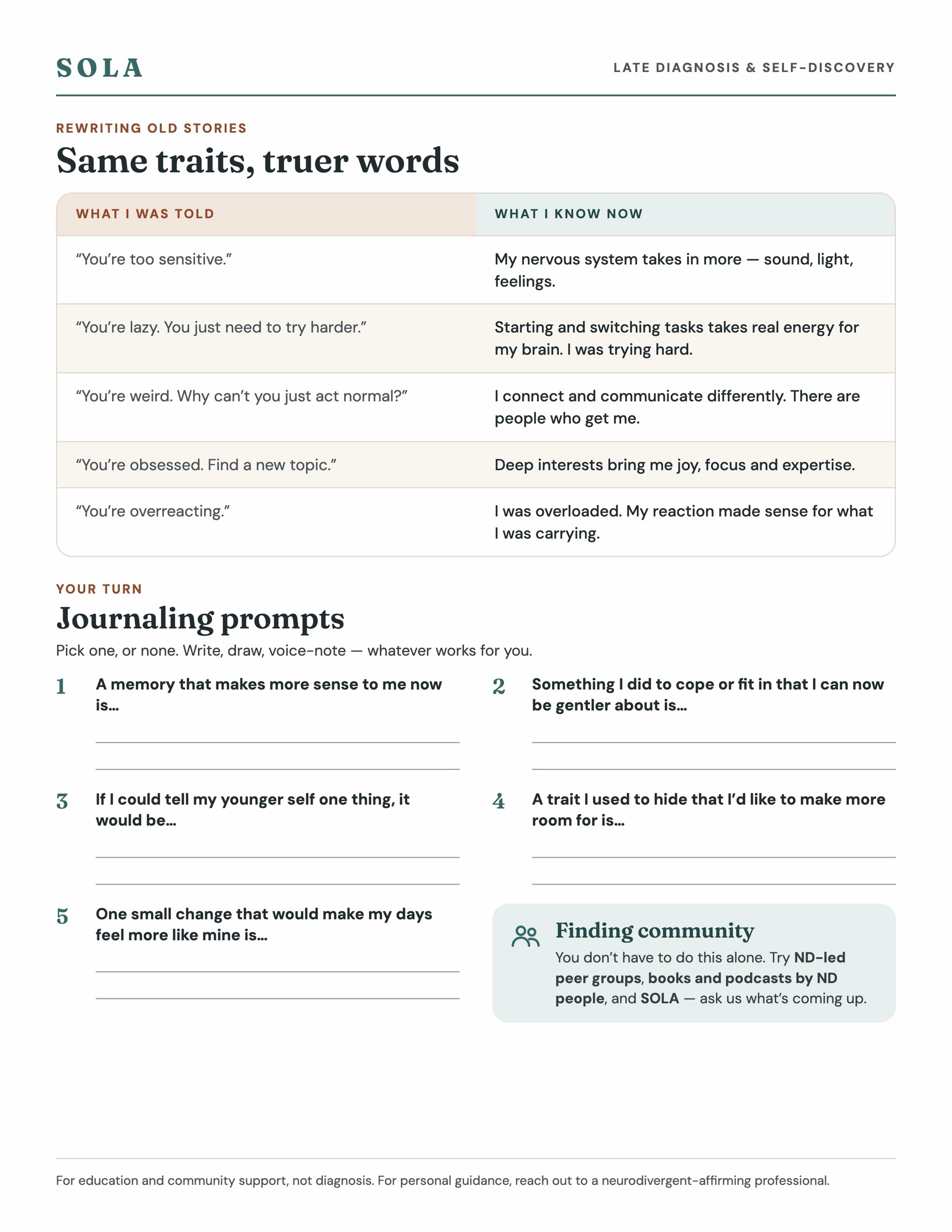
Same traits, truer words
Rewriting old stories
/ What I know now
My nervous system takes in more — sound, light, feelings.
Starting and switching tasks takes real energy for my brain. I was trying hard.
I connect and communicate differently. There are people who get me.
Deep interests bring me joy, focus and expertise.
I was overloaded. My reaction made sense for what I was carrying.
Journaling prompts
Your turn. Pick one, or none. Write, draw, voice-note — whatever works for you.
Finding community
You don’t have to do this alone. Try ND-led peer groups, books and podcasts by ND people, and SOLA — ask us what’s coming up.
For education and community support, not diagnosis. For personal guidance, reach out to a neurodivergent-affirming professional.
Sources and credits. SOLA · Community Resource · Late Diagnosis & Self-Discovery