Learn
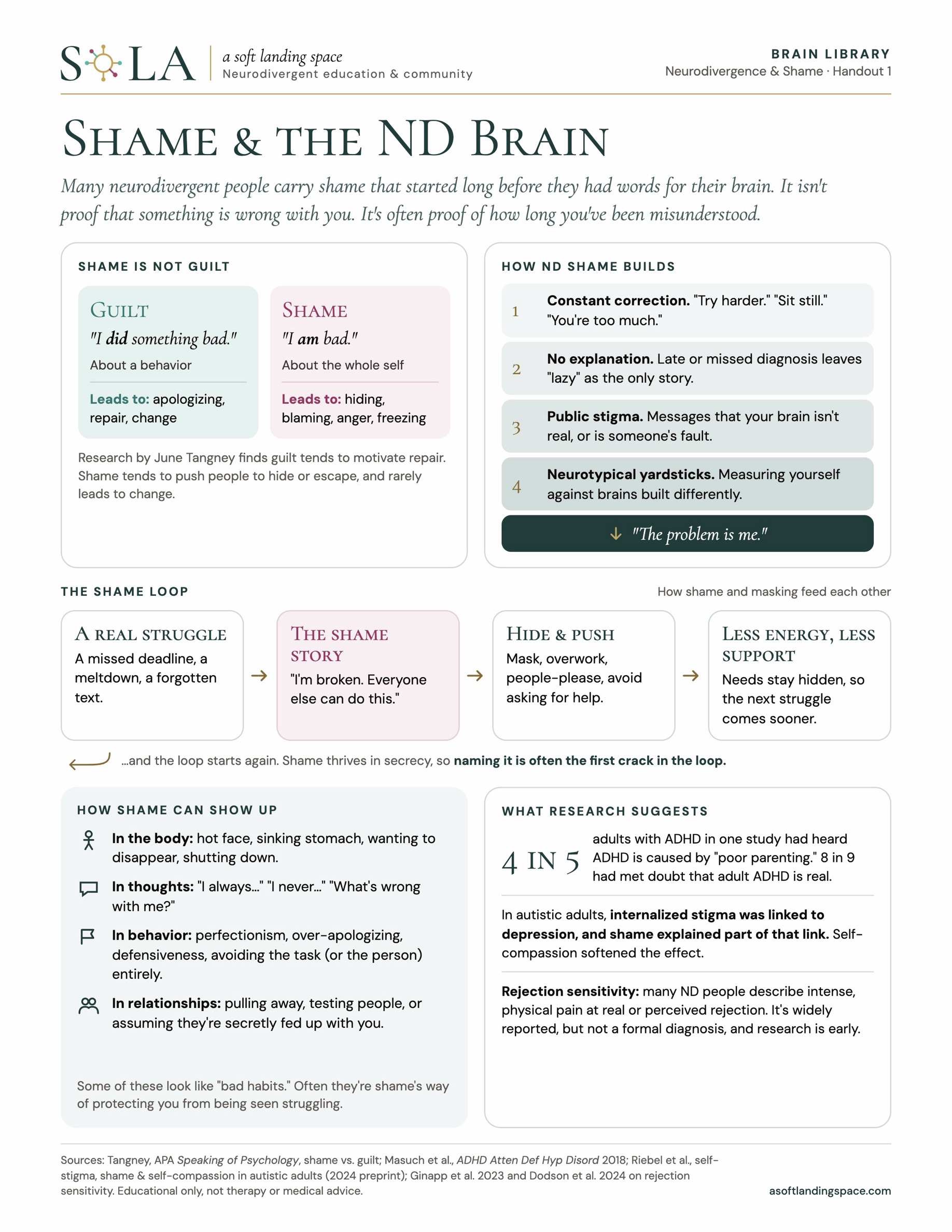
Shame & the ND Brain
Neurodivergence & Shame · Handout 1
Many neurodivergent people carry shame that started long before they had words for their brain. It isn't proof that something is wrong with you. It's often proof of how long you've been misunderstood.
The guide, as designed. The same content is written out below.
See page 2
Shame is not guilt
"I did something bad."
About a behavior
Leads to: apologizing, repair, change
"I am bad."
About the whole self
Leads to: hiding, blaming, anger, freezing
Research by June Tangney finds guilt tends to motivate repair. Shame tends to push people to hide or escape, and rarely leads to change.
How ND shame builds
- 1. Constant correction. "Try harder." "Sit still." "You're too much."
- 2. No explanation. Late or missed diagnosis leaves "lazy" as the only story.
- 3. Public stigma. Messages that your brain isn't real, or is someone's fault.
- 4. Neurotypical yardsticks. Measuring yourself against brains built differently.
↓ "The problem is me."
The shame loop
How shame and masking feed each other
A real struggle
A missed deadline, a meltdown, a forgotten text.
→ The shame story
"I'm broken. Everyone else can do this."
→ Hide & push
Mask, overwork, people-please, avoid asking for help.
→ Less energy, less support
Needs stay hidden, so the next struggle comes sooner.
…and the loop starts again. Shame thrives in secrecy, so naming it is often the first crack in the loop.
How shame can show up
- In the body: hot face, sinking stomach, wanting to disappear, shutting down.
- In thoughts: "I always…" "I never…" "What's wrong with me?"
- In behavior: perfectionism, over-apologizing, defensiveness, avoiding the task (or the person) entirely.
- In relationships: pulling away, testing people, or assuming they're secretly fed up with you.
Some of these look like "bad habits." Often they're shame's way of protecting you from being seen struggling.
What research suggests
4 in 5 adults with ADHD in one study had heard ADHD is caused by "poor parenting." 8 in 9 had met doubt that adult ADHD is real.
In autistic adults, internalized stigma was linked to depression, and shame explained part of that link. Self-compassion softened the effect.
Rejection sensitivity: many ND people describe intense, physical pain at real or perceived rejection. It's widely reported, but not a formal diagnosis, and research is early.
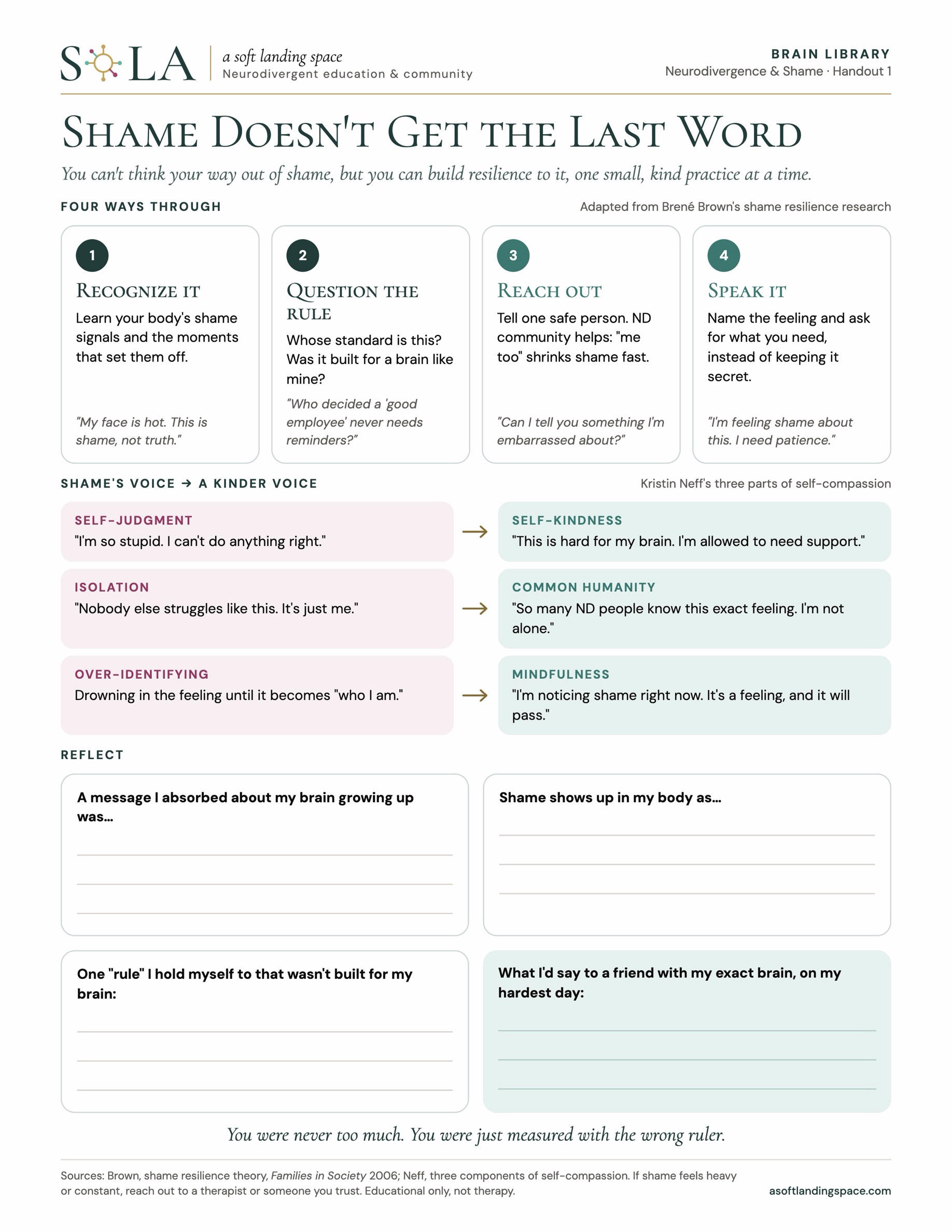
Shame Doesn't Get the Last Word
You can't think your way out of shame, but you can build resilience to it, one small, kind practice at a time.
Four ways through
Adapted from Brené Brown's shame resilience research
Learn your body's shame signals and the moments that set them off.
"My face is hot. This is shame, not truth."
Whose standard is this? Was it built for a brain like mine?
"Who decided a 'good employee' never needs reminders?"
Tell one safe person. ND community helps: "me too" shrinks shame fast.
"Can I tell you something I'm embarrassed about?"
Name the feeling and ask for what you need, instead of keeping it secret.
"I'm feeling shame about this. I need patience."
Shame's voice → a kinder voice
Kristin Neff's three parts of self-compassion
"I'm so stupid. I can't do anything right."
→ Self-kindness
"This is hard for my brain. I'm allowed to need support."
"Nobody else struggles like this. It's just me."
→ Common humanity
"So many ND people know this exact feeling. I'm not alone."
Drowning in the feeling until it becomes "who I am."
→ Mindfulness
"I'm noticing shame right now. It's a feeling, and it will pass."
Reflect
You were never too much. You were just measured with the wrong ruler.
If shame feels heavy or constant, reach out to a therapist or someone you trust. Educational only, not therapy or medical advice.
Sources and credits. Sources: Tangney, APA Speaking of Psychology, shame vs. guilt; Masuch et al., ADHD Atten Def Hyp Disord 2018; Riebel et al., self-stigma, shame & self-compassion in autistic adults (2024 preprint); Ginapp et al. 2023 and Dodson et al. 2024 on rejection sensitivity. Brown, shame resilience theory, Families in Society 2006; Neff, three components of self-compassion.