Understand
Hidden in Plain Sight
How ADHD and autism can show up in women and girls
Much of the early research on ADHD and autism was done with boys. Girls and women who meet the same criteria are more likely to be missed, misread or recognised years later.
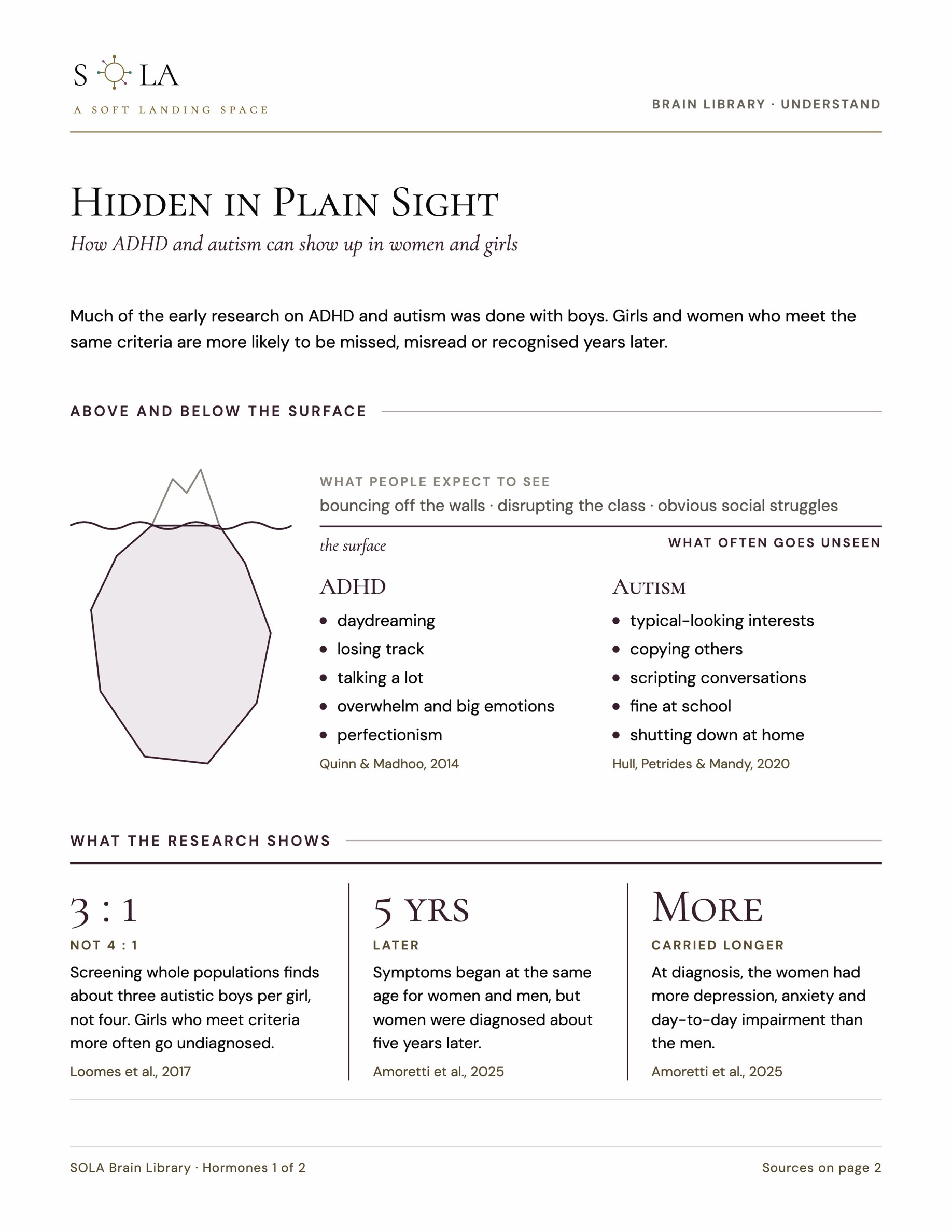
The guide, as designed. The same content is written out below.
See page 2
Above and below the surface
An iceberg: a small tip above the waterline, a much larger body below it.
What people expect to see (the surface): bouncing off the walls · disrupting the class · obvious social struggles
ADHD
- daydreaming
- losing track
- talking a lot
- overwhelm and big emotions
- perfectionism
Quinn & Madhoo, 2014
- typical-looking interests
- copying others
- scripting conversations
- fine at school
- shutting down at home
Hull, Petrides & Mandy, 2020
What the research shows
Screening whole populations finds about three autistic boys per girl, not four. Girls who meet criteria more often go undiagnosed. Loomes et al., 2017
Symptoms began at the same age for women and men, but women were diagnosed about five years later. Amoretti et al., 2025
At diagnosis, the women had more depression, anxiety and day-to-day impairment than the men. Amoretti et al., 2025
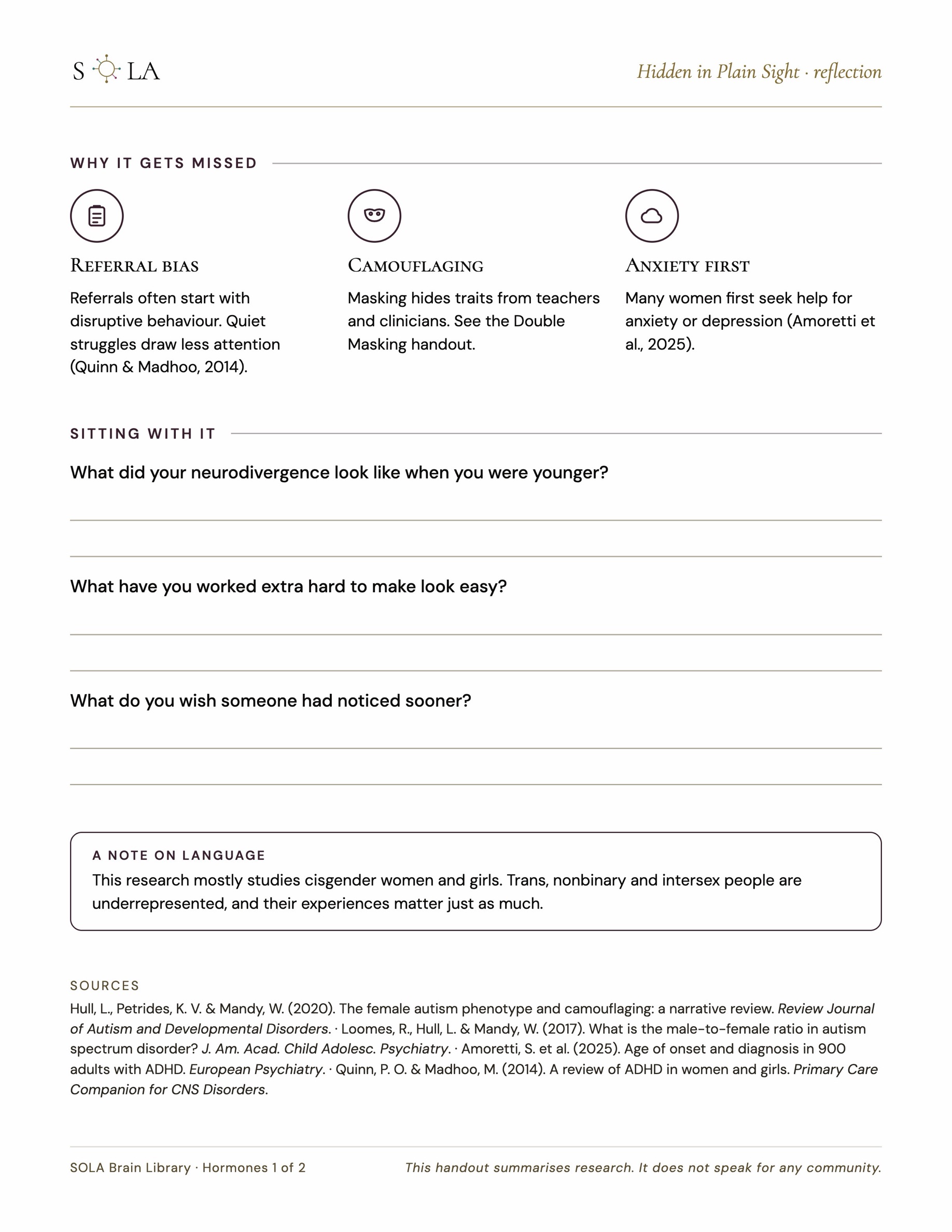
Why it gets missed
Referrals often start with disruptive behaviour. Quiet struggles draw less attention (Quinn & Madhoo, 2014).
Masking hides traits from teachers and clinicians. See the Double Masking handout.
Many women first seek help for anxiety or depression (Amoretti et al., 2025).
Sitting with it
A note on language
This research mostly studies cisgender women and girls. Trans, nonbinary and intersex people are underrepresented, and their experiences matter just as much.
Sources and credits. SOLA Brain Library · Hormones 1 of 2. This handout summarises research. It does not speak for any community. Sources: Hull, L., Petrides, K. V. & Mandy, W. (2020). The female autism phenotype and camouflaging: a narrative review. Review Journal of Autism and Developmental Disorders. · Loomes, R., Hull, L. & Mandy, W. (2017). What is the male-to-female ratio in autism spectrum disorder? J. Am. Acad. Child Adolesc. Psychiatry. · Amoretti, S. et al. (2025). Age of onset and diagnosis in 900 adults with ADHD. European Psychiatry. · Quinn, P. O. & Madhoo, M. (2014). A review of ADHD in women and girls. Primary Care Companion for CNS Disorders.