Learn
How do I figure out what I need when I feel off?
A one-page reference for the days it's hard to know what you need.
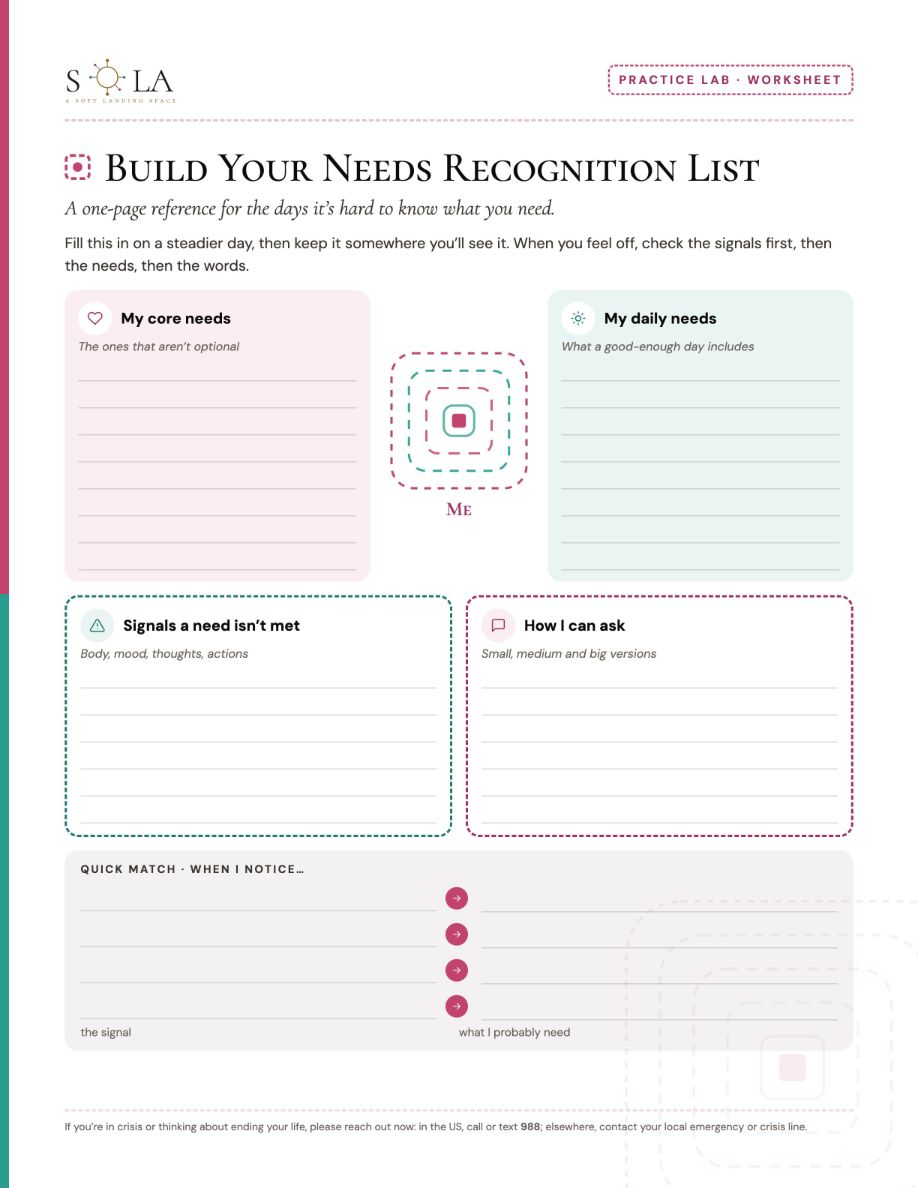
In short. Check your signals first, then your needs, then the words. When you feel off, look at what your body, mood, thoughts and actions are doing, match that to a need you have already written down, and pick a small way to ask. Build the list on a steadier day so it is ready when you are not.
Feeling off often arrives before you know why
Many neurodivergent adults can tell something is wrong long before they can say what. The body is tense, the mood has dipped, the day has gone sideways, and the question of what would actually help has no answer. On those days, thinking your way to a need is the hardest possible task, because the part of you that would do the thinking is already stretched.
This worksheet is a reference you build ahead of time. It holds what you know about yourself on a steadier day, so you do not have to work it out from scratch in the middle of a rough one. It is one page, and it is meant to be used, not perfected.
Start with the needs that are not optional
The first box is for your core needs. Leah's label for them is the ones that aren't optional. These are the things that, when they are missing, everything else gets harder. Sleep, food, quiet, movement, time alone or time with someone are the kinds of things people write here, though your list is yours alone.
Writing them down matters because core needs are easy to treat as negotiable. Many adults learned to push past them, or were told they were asking for too much. Seeing them on paper, in your own words, makes them harder to argue with at 4 p.m. when you are running on fumes.
Describe what a good-enough day includes
The second box is your daily needs: what a good-enough day includes. The phrase good-enough is doing real work. This is not a picture of a perfect day or a productive one. It is the short list of things that keep an ordinary day livable.
Maybe that is a proper meal, a stretch with no demands, a walk, a message to someone who feels safe. When a day is going badly, you can look at this box and see what is missing. Often the gap is small and fixable, and just being able to see it changes how the day feels.
Learn the signals that a need is not being met
The third box asks for your signals across four areas: body, mood, thoughts and actions. Needs rarely announce themselves by name. They show up as a tight jaw, a short temper, a loop of harsh thoughts, or a sudden urge to scroll, cancel plans or clean the kitchen at midnight.
Your signals are specific to you, which is why the list is worth writing down. Two people can feel the same unmet need in completely different ways. Once you know your own pattern, the signal stops being a mystery and starts being information.
- Body: a clenched jaw, a heavy chest, a headache that arrives out of nowhere
- Actions: snapping at people, avoiding messages, doing everything except the one thing
- Rest, food, water or a break from noise
- Space, reassurance, or help with the thing you keep avoiding
Plan small, medium and big ways to ask
Knowing what you need is only half of it. The fourth box, How I can ask, has small, medium and big versions. A small ask might be a short text or a single sentence. A medium ask might be a direct request for an hour or a favor. A big ask is the conversation that changes something longer term.
Having versions ready means you do not have to find the words while overwhelmed. On a low-energy day you can reach for the small one. On a steadier day you might try the medium one. Nothing here requires you to ask for everything at once.
Use the quick match when you have no energy to think
The bottom of the page is a quick match. On the left, you write a signal you notice. On the right, you write what you probably need. The word probably is honest: you are making a good guess, not issuing a verdict, and you can adjust the guess as you learn.
Fill in a few pairs that come up often. When you feel off, you can scan the left side, find the one that fits, and read across to a likely need. Keep the page somewhere you will see it. A reference you cannot find on a hard day does not help.
How to use this worksheet
The sheet is built to be filled in on a steadier day and read on a harder one. Work through the boxes in this order.
- Write your core needs, the ones that aren't optional, in the first box.
- List what a good-enough day includes under My daily needs.
- Note the signals a need isn't met, across body, mood, thoughts and actions.
- Write small, medium and big versions of how you can ask.
- Fill in the quick match with the signal on one side and what you probably need on the other.
- Keep the page somewhere you will see it, and check signals first, then needs, then words.
Questions people ask
What is a needs recognition list?
It is a one-page reference you fill in yourself. It holds your core needs, daily needs, the signals that show a need is unmet, and ways to ask for help. You use it on days when it is hard to know what you need.
When should I fill in the worksheet?
On a steadier day. The sheet is meant to be written when you can think clearly, then used when you cannot. Keep it where you will see it, so it is within reach when you feel off.
What if I do not know my signals yet?
Start with one or two, or leave boxes blank and come back. Notice what your body, mood, thoughts and actions do on a hard day, and add to the page as you learn. It does not need to be complete.
What is the difference between core needs and daily needs?
Core needs are the ones that are not optional, the things everything else depends on. Daily needs describe what a good-enough day includes. Core needs are the foundation; daily needs are what keeps an ordinary day workable.
Is this worksheet therapy?
No. SOLA is education and community, not therapy, assessment or crisis care. The worksheet is a self-reflection tool. If you are in crisis or thinking about ending your life, call or text 988 in the US, or contact your local crisis line.
Practice this with other people
Reading about a skill is the start. Using it on a hard day is the part most of us need company for. SOLA's live sessions are a safe space to practice what you've learned, with people whose brains work like yours.
The first Monday Learning Session of every month is free and open to everyone. No card, no membership, no diagnosis required.
Start with a free sessionNot ready for a session? Get Leah's essays by email, free.
The worksheet, as designed. The guide above is written from it.