Practice
How do I figure out what my needs are as a neurodivergent adult?
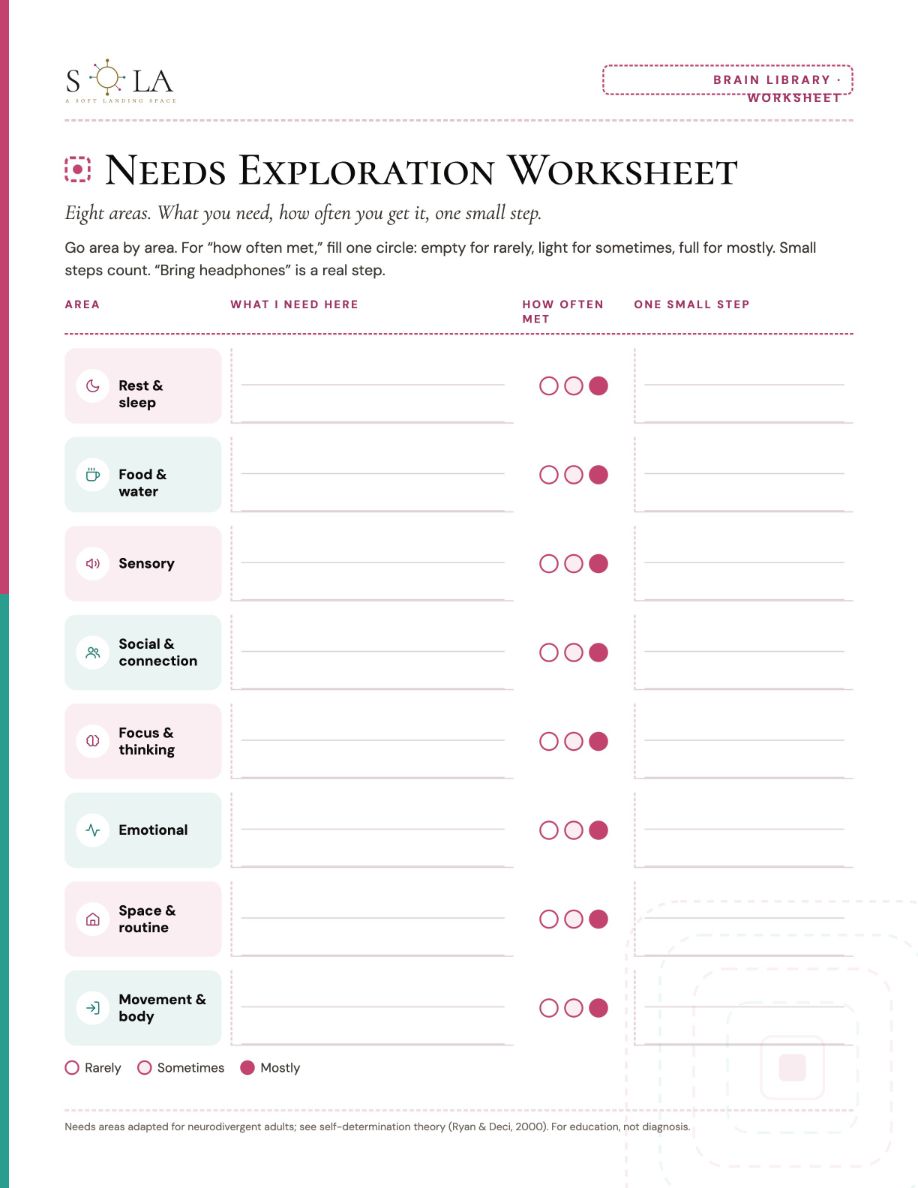
Eight areas. What you need, how often you get it, one small step.
In short. Go through eight areas of daily life one at a time: rest, food, sensory, social, focus, emotional, space and routine, and movement. For each one, write what you need, how often you get it, and one small step. Then learn your early signs of an unmet need, so you can ask for help sooner.
Needs are easy to miss when you are busy coping
Many neurodivergent adults spend years pushing through. You get used to the noise, the skipped meal, the plan you did not have energy for. After a while, it gets hard to tell what you need, because the need has been overridden so many times that it stops sending clear messages.
The Needs Exploration Worksheet is a slow, practical way back to those messages. It does not ask you to fix anything. It asks you to look at eight ordinary areas of life and write down what is true. The aim is information you can use, on a day when your head is too full to work it out from scratch.
Eight areas cover most of daily life
The first page lists eight areas: rest and sleep, food and water, sensory, social and connection, focus and thinking, emotional, space and routine, and movement and body. Each one has three parts. You write what you need here, you mark how often that need gets met, and you pick one small step.
The areas are adapted for neurodivergent adults and draw on self-determination theory (Ryan and Deci, 2000). In plain terms, that is a well-known body of work about the basic things people need in order to do well. Sensory is on the list because noise, light, texture and crowding can change a whole day. Space and routine is there because where you are and what your day looks like can matter as much as what you do.
How often a need is met tells you where to look
For each area, you fill in one circle. Empty means rarely. Light means sometimes. Full means mostly. There is no right pattern and no score. The circles are a quick picture of where things feel steady and where they feel thin.
You might find that food and water is mostly met, while rest is rarely met. Or that your social needs are fine, but your sensory needs are almost never considered. Seeing that on one page can be a relief. It turns a general sense of being worn out into something specific you can point at.
Small steps count, and they can be very small
The last column asks for one small step per area. The worksheet is clear about the size: small steps count, and "bring headphones" is a real step. A step does not have to change your routine or your life. It only has to make one need a little more likely to be met.
A small step could be a water bottle on your desk, a text to a friend, a fifteen-minute walk after lunch, or a lamp you switch on instead of the overhead light. Because the step is small, you can actually do it. That matters more than a big plan you never start.
Your early signs can speak up before things get hard
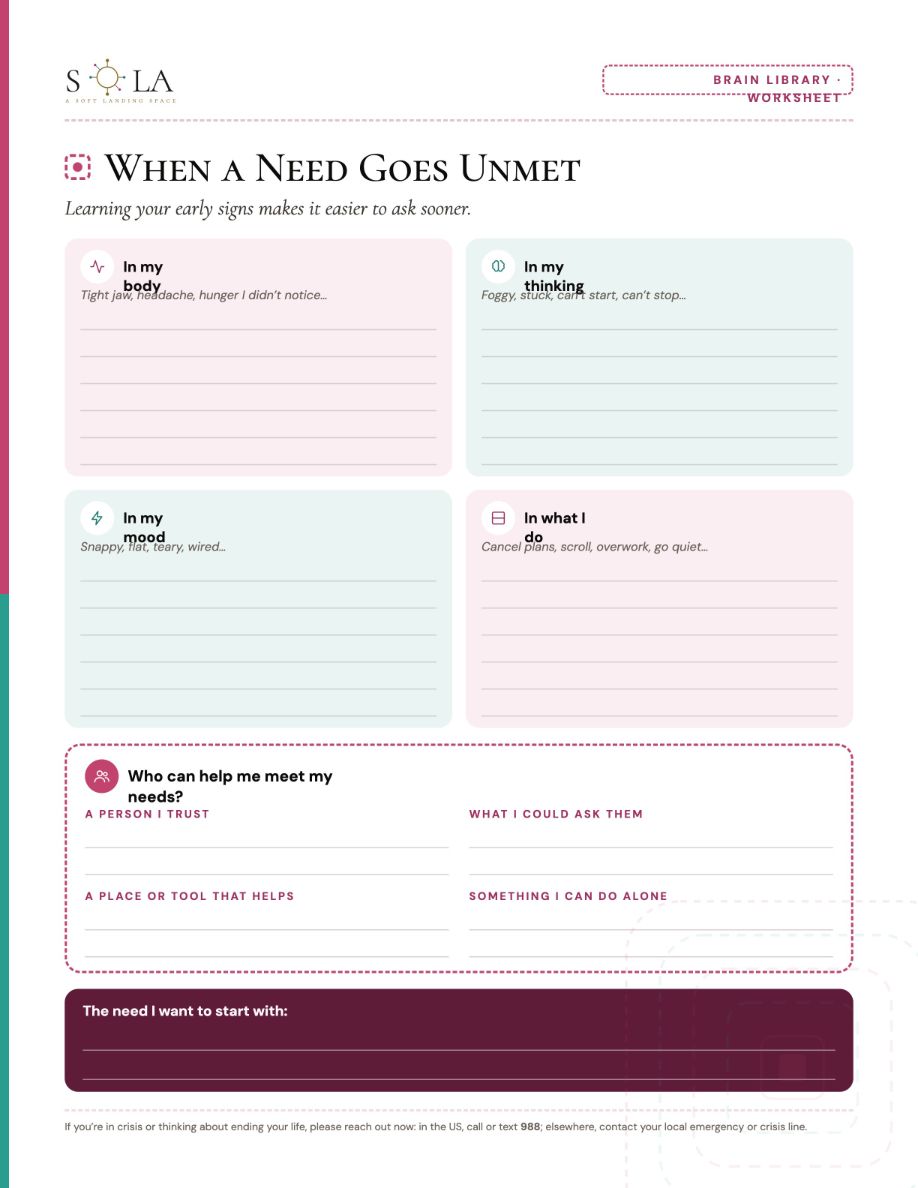
Page two is called When a Need Goes Unmet. Its idea is simple: learning your early signs makes it easier to ask sooner. It splits those signs into four places you might notice them, and each has space for your own words.
In your body, it might be a tight jaw, a headache, or hunger you did not notice. In your thinking, it might be foggy, stuck, can't start, can't stop. In your mood, snappy, flat, teary or wired. In what you do, canceling plans, scrolling, overworking or going quiet. Your list will be your own. Once you have it, you have a signal to act on earlier.
- Tight jaw, headache, hunger I didn't notice
- Foggy, stuck, can't start, can't stop
- Snappy, flat, teary, wired
- Cancel plans, scroll, overwork, go quiet
Asking for help is part of meeting a need
Not every need can be met alone, and the worksheet makes room for that. A box asks who can help you meet your needs. You fill in a person you trust and what you could ask them. Then you add a place or tool that helps, and something you can do alone.
Writing the ask down ahead of time takes some of the pressure off. When you are tired or overwhelmed, finding the words is hard. Having a sentence already on paper, like a request for a quiet hour or a check-in text, makes it far easier to send.
Start with one need, not all eight
The worksheet ends with a single line: the need you want to start with. After filling in eight areas, it is tempting to try to fix everything. Choosing one keeps the work doable.
Pick the one that feels most pressing, or the one that is easiest to improve, whichever you prefer. You can come back and fill the sheet in again later, because needs shift with seasons, stress and energy. Recognizing yourself in these areas is a starting point for curiosity, not a diagnosis. SOLA is education and community, not therapy or crisis care.
How to use this worksheet
The worksheet has two pages. You can fill it in alone, with someone you trust, or in a session with someone you work with.
- Go area by area on page one and write what you need in each one.
- Fill one circle for how often that need is met: empty for rarely, light for sometimes, full for mostly.
- Write one small step for each area. Remember that "bring headphones" is a real step.
- On page two, list your early signs in your body, thinking, mood and what you do.
- Fill in who can help you: a person you trust, what you could ask them, a place or tool, and something you can do alone.
- Write the one need you want to start with.
Questions people ask
What are the eight areas of needs on this worksheet?
They are rest and sleep, food and water, sensory, social and connection, focus and thinking, emotional, space and routine, and movement and body. For each area you write what you need, how often it is met, and one small step.
What counts as a small step for a need?
Anything that makes a need a little more likely to be met. The worksheet says small steps count, and that "bring headphones" is a real step. It only needs to be something you can actually do.
How do I know when a need is going unmet?
Look for early signs in four places: your body, your thinking, your mood, and what you do. Examples include a tight jaw, feeling foggy, feeling snappy, or canceling plans. The worksheet gives you space to list your own.
Does this worksheet diagnose anything?
No. It is for education, not diagnosis. Recognizing yourself in these areas is a starting point for curiosity. SOLA is education and community, not assessment, therapy or crisis care.
What should I do if I am in crisis?
Reach out now. In the US, call or text 988. Elsewhere, contact your local emergency or crisis line. This worksheet is not crisis care and cannot replace immediate help.
Practice this with other people
Reading about a skill is the start. Using it on a hard day is the part most of us need company for. SOLA's live sessions are a safe space to practice what you've learned, with people whose brains work like yours.
The first Monday Learning Session of every month is free and open to everyone. No card, no membership, no diagnosis required.
Start with a free sessionNot ready for a session? Get Leah's essays by email, free.
The worksheet, as designed. The guide above is written from it.
See page 2