Learn
What's Underneath Anger
Neurodivergence & Anger · Handout and Worksheet
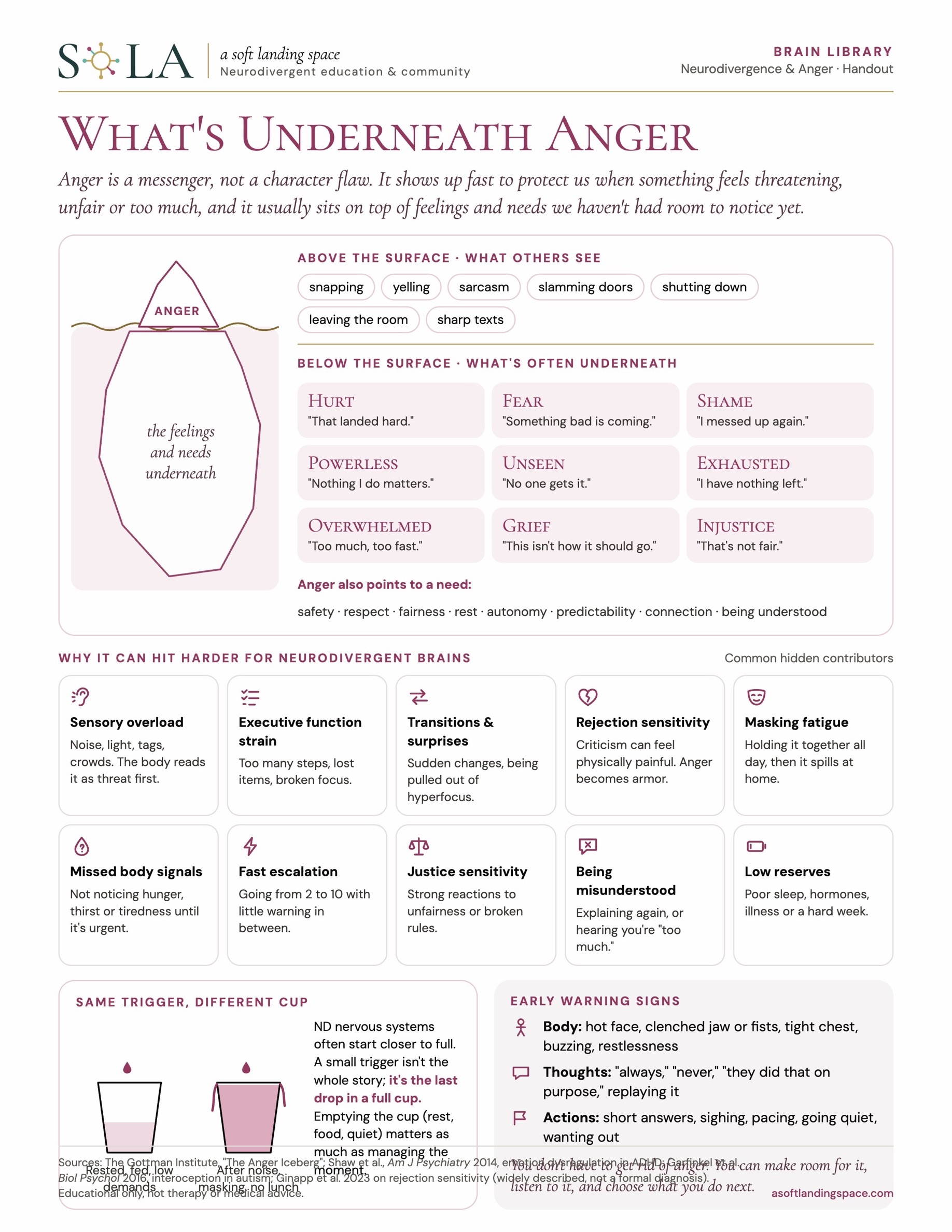
Anger is a messenger, not a character flaw. It shows up fast to protect us when something feels threatening, unfair or too much, and it usually sits on top of feelings and needs we haven't had room to notice yet.
The guide, as designed. The same content is written out below.
See page 2
Above the surface · what others see
The iceberg: anger is the tip above the water. Below it, the feelings and needs underneath.
snapping · yelling · sarcasm · slamming doors · shutting down · leaving the room · sharp texts
Below the surface · what's often underneath
- Hurt "That landed hard."
- Fear "Something bad is coming."
- Shame "I messed up again."
- Powerless "Nothing I do matters."
- Unseen "No one gets it."
- Exhausted "I have nothing left."
- Overwhelmed "Too much, too fast."
- Grief "This isn't how it should go."
- Injustice "That's not fair."
Anger also points to a need:
safety · respect · fairness · rest · autonomy · predictability · connection · being understood
Why it can hit harder for neurodivergent brains
Common hidden contributors
- Sensory overload. Noise, light, tags, crowds. The body reads it as threat first.
- Executive function strain. Too many steps, lost items, broken focus.
- Transitions & surprises. Sudden changes, being pulled out of hyperfocus.
- Rejection sensitivity. Criticism can feel physically painful. Anger becomes armor.
- Masking fatigue. Holding it together all day, then it spills at home.
- Missed body signals. Not noticing hunger, thirst or tiredness until it's urgent.
- Fast escalation. Going from 2 to 10 with little warning in between.
- Justice sensitivity. Strong reactions to unfairness or broken rules.
- Being misunderstood. Explaining again, or hearing you're "too much."
- Low reserves. Poor sleep, hormones, illness or a hard week.
Same trigger, different cup
Two cups, each getting the same drop. One is nearly empty: rested, fed, low demands. One is nearly full: after noise, masking, no lunch.
ND nervous systems often start closer to full. A small trigger isn't the whole story; it's the last drop in a full cup. Emptying the cup (rest, food, quiet) matters as much as managing the moment.
Early warning signs
- Body: hot face, clenched jaw or fists, tight chest, buzzing, restlessness
- Thoughts: "always," "never," "they did that on purpose," replaying it
- Actions: short answers, sighing, pacing, going quiet, wanting out
You don't have to get rid of anger. You can make room for it, listen to it, and choose what you do next.
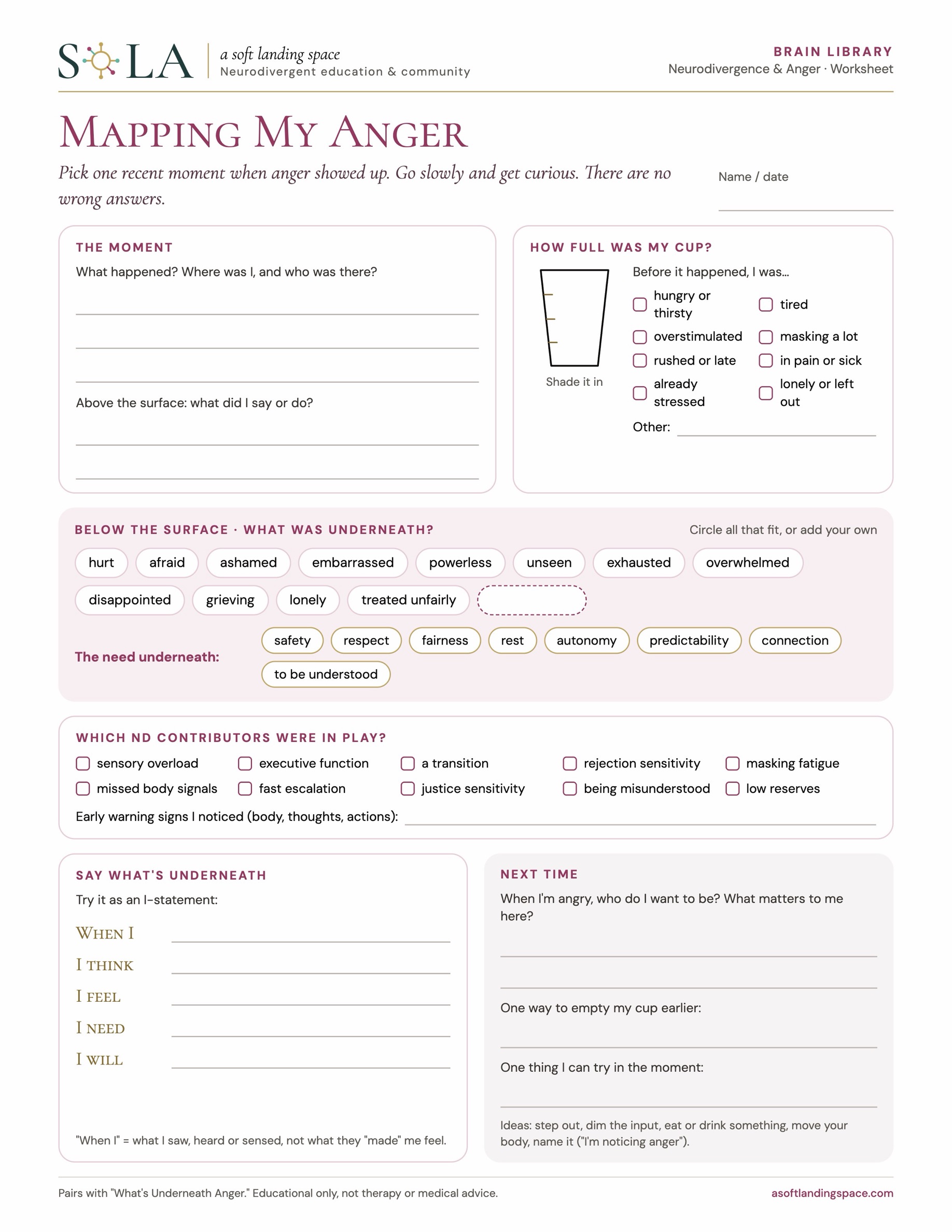
Mapping My Anger
Pick one recent moment when anger showed up. Go slowly and get curious. There are no wrong answers.
The moment
How full was my cup?
A cup to shade in: how full it was before this moment.
Before it happened, I was… Tick all that apply
- hungry or thirsty
- tired
- overstimulated
- masking a lot
- rushed or late
- in pain or sick
- already stressed
- lonely or left out
- Other:
Below the surface · what was underneath?
Circle all that fit, or add your own
What was underneath? Tick all that apply
- hurt
- afraid
- ashamed
- embarrassed
- powerless
- unseen
- exhausted
- overwhelmed
- disappointed
- grieving
- lonely
- treated unfairly
- Other:
The need underneath: Tick all that apply
- safety
- respect
- fairness
- rest
- autonomy
- predictability
- connection
- to be understood
Which ND contributors were in play?
Which ND contributors were in play? Tick all that apply
- sensory overload
- executive function
- a transition
- rejection sensitivity
- masking fatigue
- missed body signals
- fast escalation
- justice sensitivity
- being misunderstood
- low reserves
Say what's underneath
Try it as an I-statement:
"When I" = what I saw, heard or sensed, not what they "made" me feel.
Next time
Ideas: step out, dim the input, eat or drink something, move your body, name it ("I'm noticing anger").
Educational only, not therapy or medical advice.
Sources and credits. Sources: The Gottman Institute, "The Anger Iceberg"; Shaw et al., Am J Psychiatry 2014, emotion dysregulation in ADHD; Garfinkel et al., Biol Psychol 2016, interoception in autism; Ginapp et al. 2023 on rejection sensitivity (widely described, not a formal diagnosis). The worksheet pairs with "What's Underneath Anger."