Support
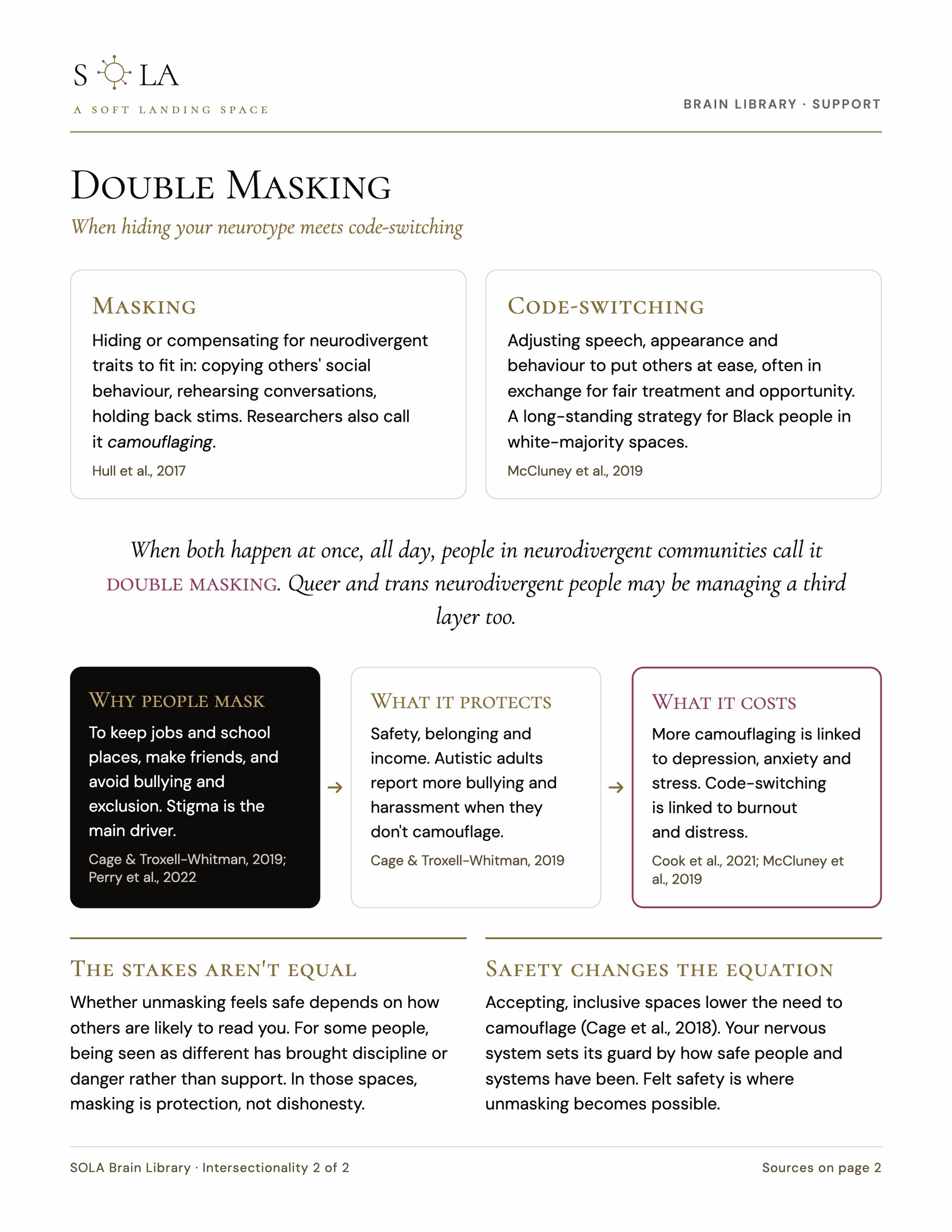
Double Masking
When hiding your neurotype meets code-switching
The guide, as designed. The same content is written out below.
See page 2
Masking
Hiding or compensating for neurodivergent traits to fit in: copying others' social behaviour, rehearsing conversations, holding back stims. Researchers also call it camouflaging.
Hull et al., 2017
Code-switching
Adjusting speech, appearance and behaviour to put others at ease, often in exchange for fair treatment and opportunity. A long-standing strategy for Black people in white-majority spaces.
McCluney et al., 2019
When both happen at once, all day, people in neurodivergent communities call it double masking. Queer and trans neurodivergent people may be managing a third layer too.
Why people mask
To keep jobs and school places, make friends, and avoid bullying and exclusion. Stigma is the main driver.
Cage & Troxell-Whitman, 2019; Perry et al., 2022
What it protects
Safety, belonging and income. Autistic adults report more bullying and harassment when they don't camouflage.
Cage & Troxell-Whitman, 2019
What it costs
More camouflaging is linked to depression, anxiety and stress. Code-switching is linked to burnout and distress.
Cook et al., 2021; McCluney et al., 2019
The stakes aren't equal
Whether unmasking feels safe depends on how others are likely to read you. For some people, being seen as different has brought discipline or danger rather than support. In those spaces, masking is protection, not dishonesty.
Safety changes the equation
Accepting, inclusive spaces lower the need to camouflage (Cage et al., 2018). Your nervous system sets its guard by how safe people and systems have been. Felt safety is where unmasking becomes possible.
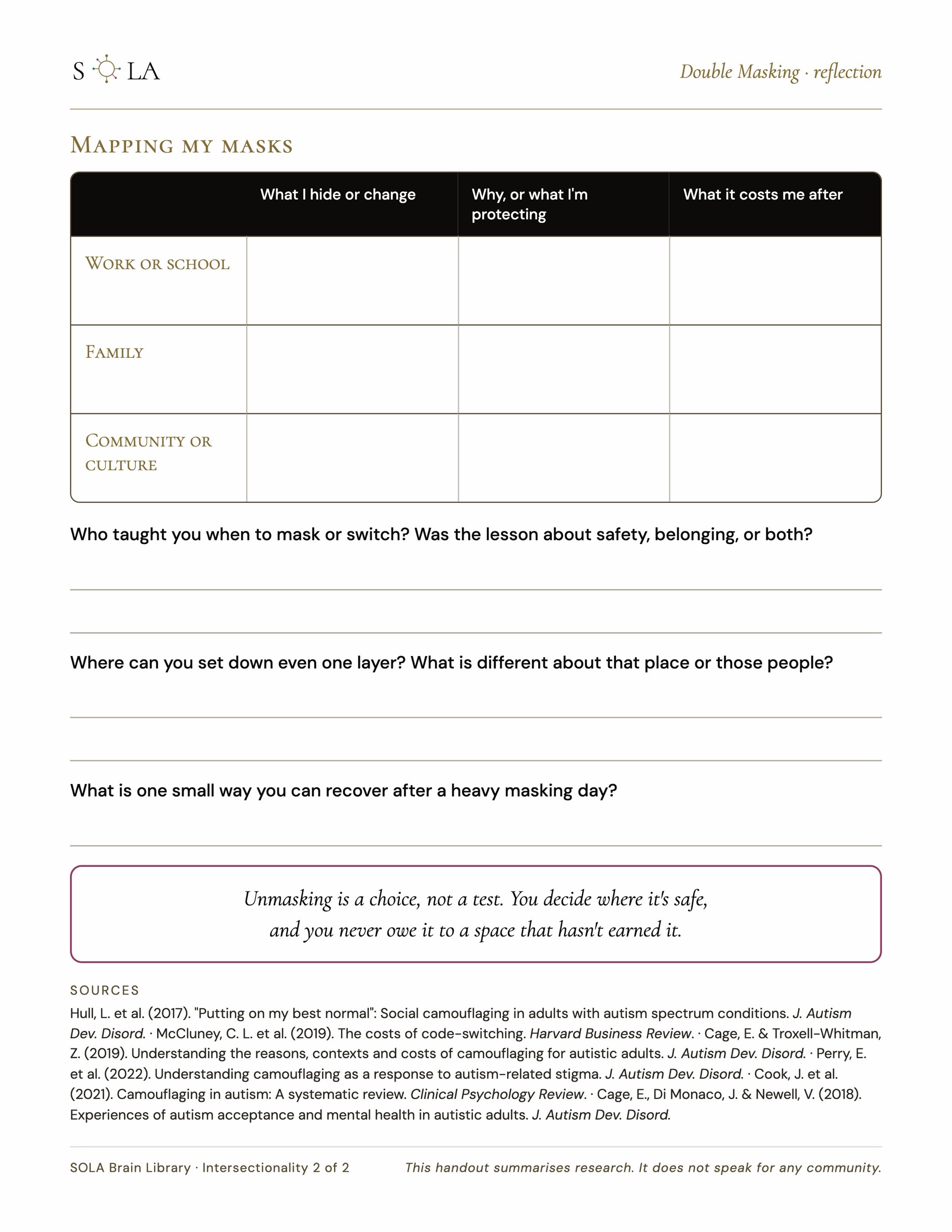
Mapping my masks
| What I hide or change | Why, or what I'm protecting | What it costs me after | |
|---|---|---|---|
| Work or school | |||
| Family | |||
| Community or culture |
Unmasking is a choice, not a test. You decide where it's safe, and you never owe it to a space that hasn't earned it.
Sources and credits. SOLA Brain Library · Intersectionality 2 of 2. This handout summarises research. It does not speak for any community. Sources: Hull, L. et al. (2017). "Putting on my best normal": Social camouflaging in adults with autism spectrum conditions. J. Autism Dev. Disord. · McCluney, C. L. et al. (2019). The costs of code-switching. Harvard Business Review. · Cage, E. & Troxell-Whitman, Z. (2019). Understanding the reasons, contexts and costs of camouflaging for autistic adults. J. Autism Dev. Disord. · Perry, E. et al. (2022). Understanding camouflaging as a response to autism-related stigma. J. Autism Dev. Disord. · Cook, J. et al. (2021). Camouflaging in autism: A systematic review. Clinical Psychology Review. · Cage, E., Di Monaco, J. & Newell, V. (2018). Experiences of autism acceptance and mental health in autistic adults. J. Autism Dev. Disord.