Learn
Radical Acceptance & the Mask
Radical Acceptance & Unmasking · Handout
Unmasking rarely starts with a big reveal. It starts quietly, with accepting how your brain actually works, instead of fighting it to look like everyone else's.
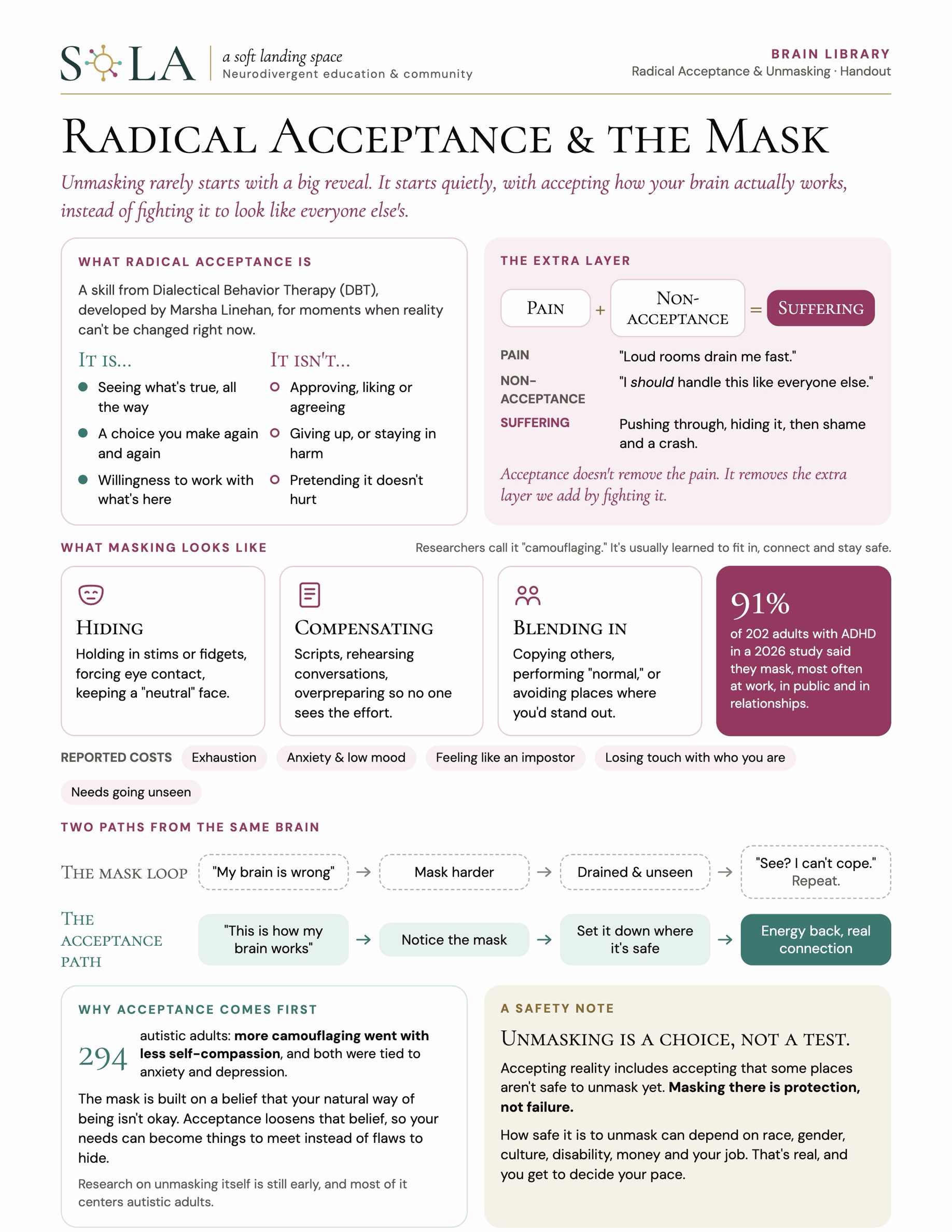
The guide, as designed. The same content is written out below.
See page 2
What radical acceptance is
A skill from Dialectical Behavior Therapy (DBT), developed by Marsha Linehan, for moments when reality can't be changed right now.
- Seeing what's true, all the way
- A choice you make again and again
- Willingness to work with what's here
- Approving, liking or agreeing
- Giving up, or staying in harm
- Pretending it doesn't hurt
The extra layer
Pain + Non-acceptance = Suffering
Pain "Loud rooms drain me fast."
Non-acceptance "I *should* handle this like everyone else."
Suffering Pushing through, hiding it, then shame and a crash.
Acceptance doesn't remove the pain. It removes the extra layer we add by fighting it.
What masking looks like
Researchers call it "camouflaging." It's usually learned to fit in, connect and stay safe.
Holding in stims or fidgets, forcing eye contact, keeping a "neutral" face.
Compensating Scripts, rehearsing conversations, overpreparing so no one sees the effort.
Blending in Copying others, performing "normal," or avoiding places where you'd stand out.
of 202 adults with ADHD in a 2026 study said they mask, most often at work, in public and in relationships.
Exhaustion · Anxiety & low mood · Feeling like an impostor · Losing touch with who you are · Needs going unseen
Two paths from the same brain
The mask loop "My brain is wrong" → Mask harder → Drained & unseen → "See? I can't cope." Repeat.
The acceptance path "This is how my brain works" → Notice the mask → Set it down where it's safe → Energy back, real connection
Why acceptance comes first
294 autistic adults: more camouflaging went with less self-compassion, and both were tied to anxiety and depression.
The mask is built on a belief that your natural way of being isn't okay. Acceptance loosens that belief, so your needs can become things to meet instead of flaws to hide.
Research on unmasking itself is still early, and most of it centers autistic adults.
A safety note
Unmasking is a choice, not a test.
Accepting reality includes accepting that some places aren't safe to unmask yet. Masking there is protection, not failure.
How safe it is to unmask can depend on race, gender, culture, disability, money and your job. That's real, and you get to decide your pace.
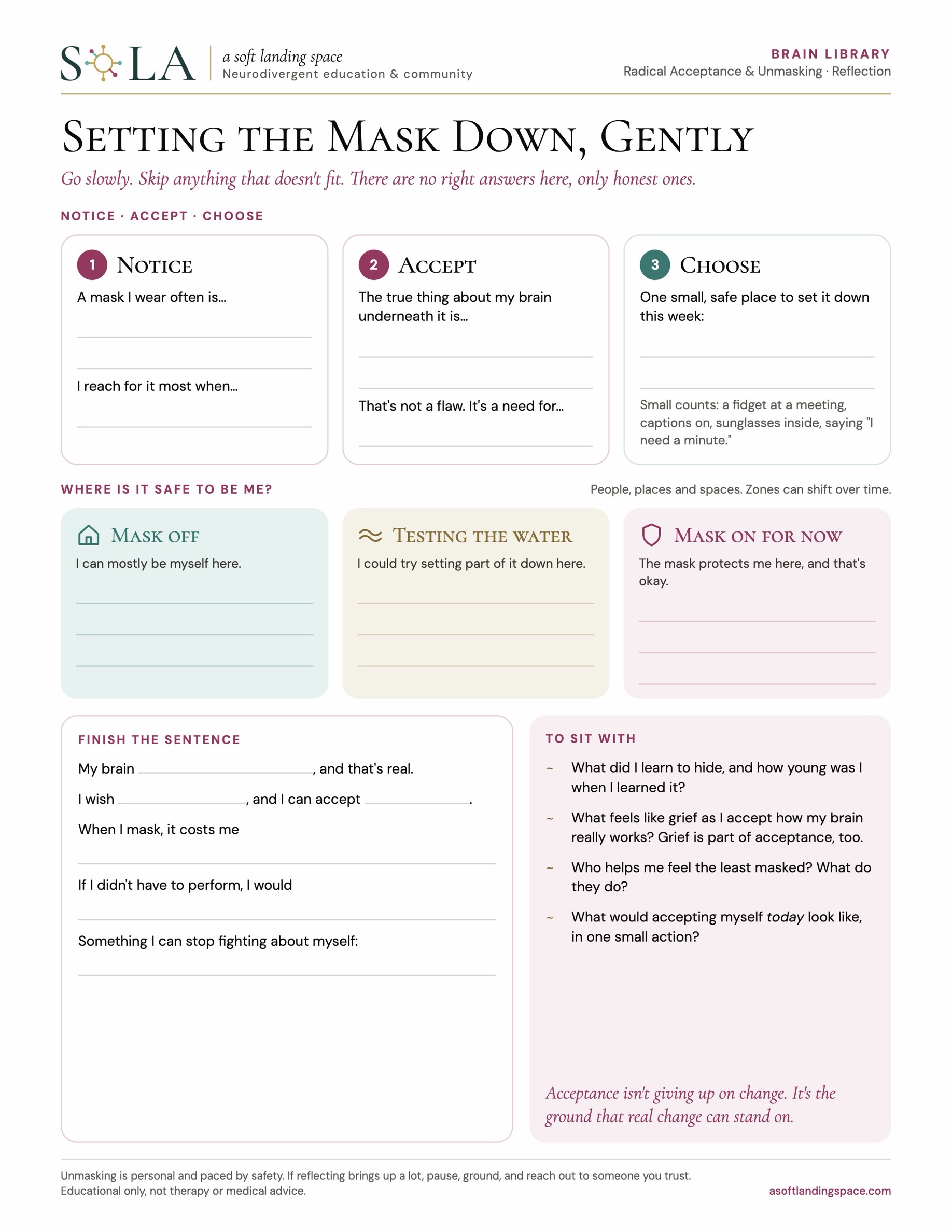
Setting the Mask Down, Gently
Go slowly. Skip anything that doesn't fit. There are no right answers here, only honest ones.
2 · Accept
3 · Choose
Where is it safe to be me?
People, places and spaces. Zones can shift over time.
Finish the sentence
To sit with
- What did I learn to hide, and how young was I when I learned it?
- What feels like grief as I accept how my brain really works? Grief is part of acceptance, too.
- Who helps me feel the least masked? What do they do?
- What would accepting myself *today* look like, in one small action?
Acceptance isn't giving up on change. It's the ground that real change can stand on.
Unmasking is personal and paced by safety. If reflecting brings up a lot, pause, ground, and reach out to someone you trust. Educational only, not therapy or medical advice.