Understand
Many Layers, One Nervous System
Intersectionality and the neurodivergent experience
The guide, as designed. The same content is written out below.
See page 2
What intersectionality means
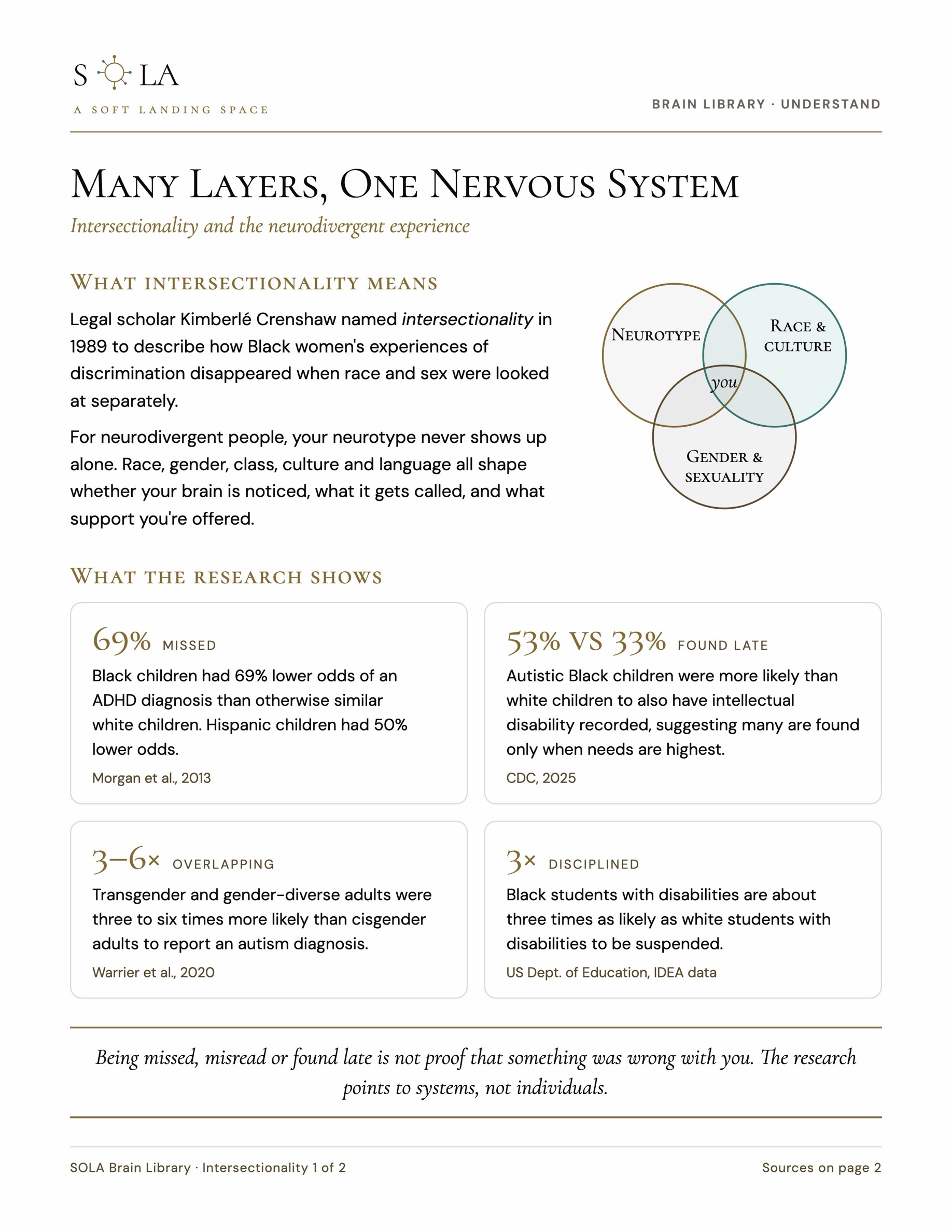
Legal scholar Kimberlé Crenshaw named intersectionality in 1989 to describe how Black women's experiences of discrimination disappeared when race and sex were looked at separately.
For neurodivergent people, your neurotype never shows up alone. Race, gender, class, culture and language all shape whether your brain is noticed, what it gets called, and what support you're offered.
Three overlapping circles: Neurotype, Race & culture, Gender & sexuality. Where all three meet: you.
What the research shows
Black children had 69% lower odds of an ADHD diagnosis than otherwise similar white children. Hispanic children had 50% lower odds. Morgan et al., 2013
Autistic Black children were more likely than white children to also have intellectual disability recorded, suggesting many are found only when needs are highest. CDC, 2025
Transgender and gender-diverse adults were three to six times more likely than cisgender adults to report an autism diagnosis. Warrier et al., 2020
Black students with disabilities are about three times as likely as white students with disabilities to be suspended. US Dept. of Education, IDEA data
Being missed, misread or found late is not proof that something was wrong with you. The research points to systems, not individuals.
Why the load adds up
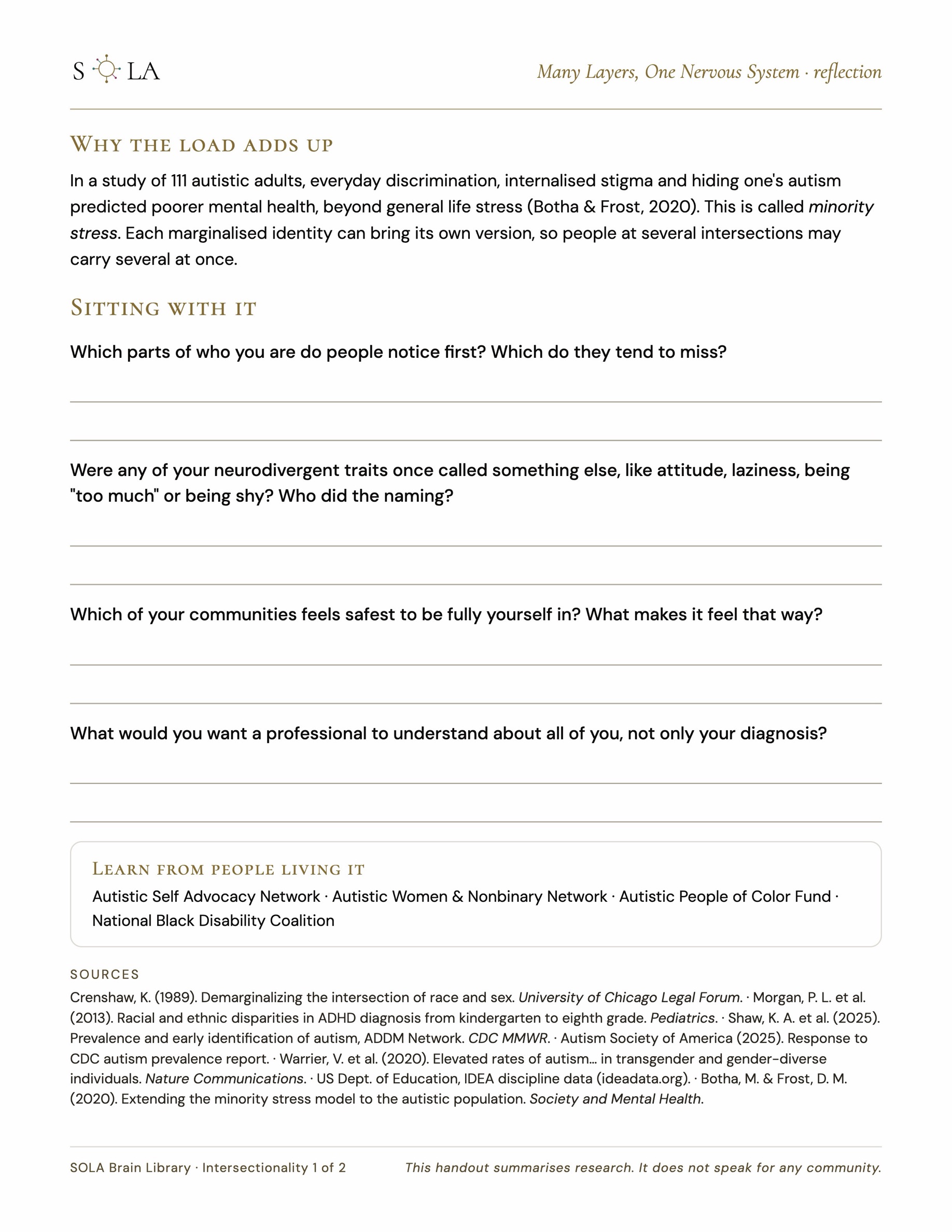
In a study of 111 autistic adults, everyday discrimination, internalised stigma and hiding one's autism predicted poorer mental health, beyond general life stress (Botha & Frost, 2020). This is called minority stress. Each marginalised identity can bring its own version, so people at several intersections may carry several at once.
Sitting with it
Learn from people living it
Autistic Self Advocacy Network · Autistic Women & Nonbinary Network · Autistic People of Color Fund · National Black Disability Coalition
Sources and credits. SOLA Brain Library · Intersectionality 1 of 2. This handout summarises research. It does not speak for any community. Sources: Crenshaw, K. (1989). Demarginalizing the intersection of race and sex. University of Chicago Legal Forum. · Morgan, P. L. et al. (2013). Racial and ethnic disparities in ADHD diagnosis from kindergarten to eighth grade. Pediatrics. · Shaw, K. A. et al. (2025). Prevalence and early identification of autism, ADDM Network. CDC MMWR. · Autism Society of America (2025). Response to CDC autism prevalence report. · Warrier, V. et al. (2020). Elevated rates of autism… in transgender and gender-diverse individuals. Nature Communications. · US Dept. of Education, IDEA discipline data (ideadata.org). · Botha, M. & Frost, D. M. (2020). Extending the minority stress model to the autistic population. Society and Mental Health.