Learn
Fight, Flight, Freeze & Fawn
in burnout: four ways your body tries to protect you when the tank is low
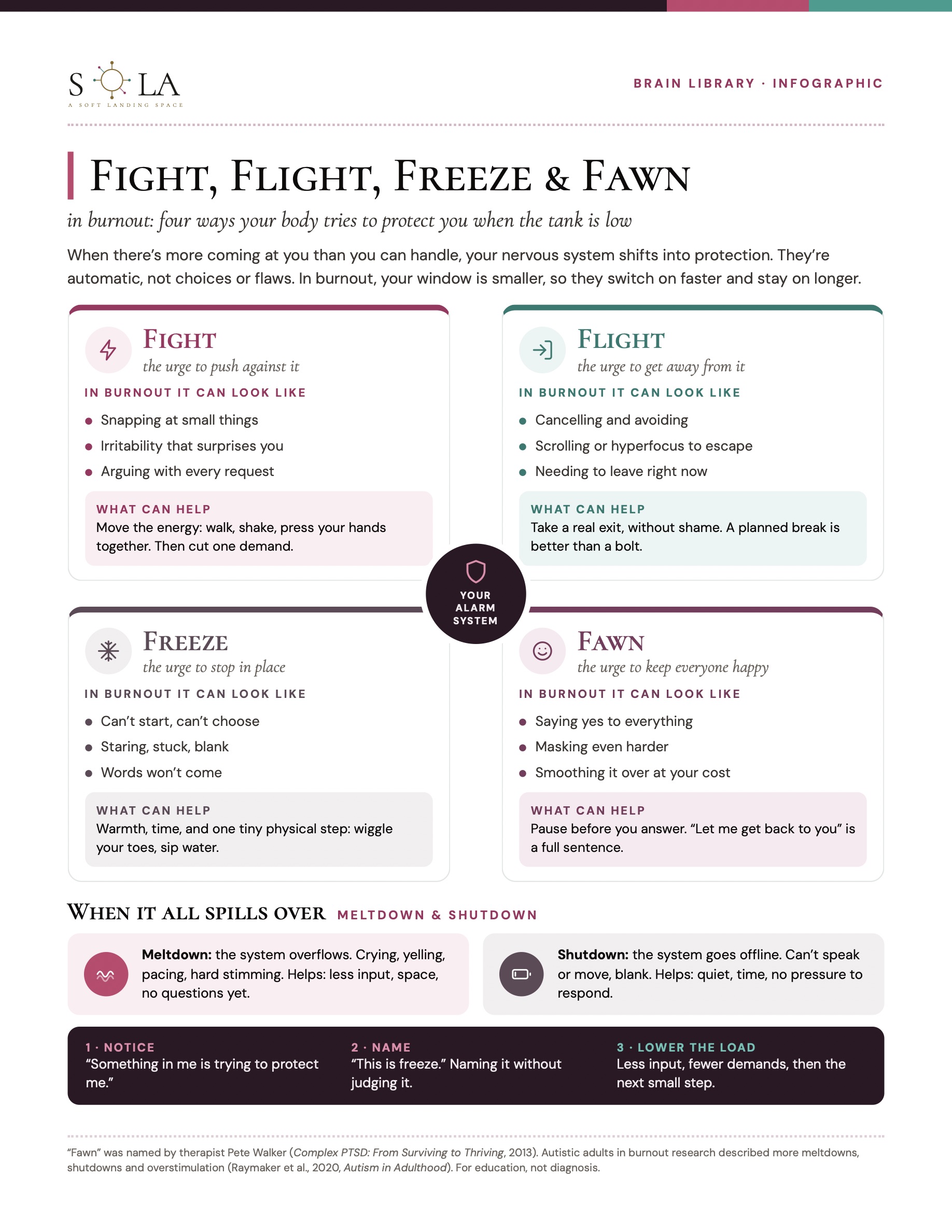
When there’s more coming at you than you can handle, your nervous system shifts into protection. They’re automatic, not choices or flaws. In burnout, your window is smaller, so they switch on faster and stay on longer.
The guide, as designed. The same content is written out below.
See page 2
the urge to push against it
In burnout it can look like
- Snapping at small things
- Irritability that surprises you
- Arguing with every request
What can help Move the energy: walk, shake, press your hands together. Then cut one demand.
the urge to get away from it
In burnout it can look like
- Cancelling and avoiding
- Scrolling or hyperfocus to escape
- Needing to leave right now
What can help Take a real exit, without shame. A planned break is better than a bolt.
the urge to stop in place
In burnout it can look like
- Can’t start, can’t choose
- Staring, stuck, blank
- Words won’t come
What can help Warmth, time, and one tiny physical step: wiggle your toes, sip water.
the urge to keep everyone happy
In burnout it can look like
- Saying yes to everything
- Masking even harder
- Smoothing it over at your cost
What can help Pause before you answer. “Let me get back to you” is a full sentence.
(At the centre of the four: your alarm system.)
When it all spills over
Meltdown & shutdown
the system overflows. Crying, yelling, pacing, hard stimming. Helps: less input, space, no questions yet.
the system goes offline. Can’t speak or move, blank. Helps: quiet, time, no pressure to respond.
“Something in me is trying to protect me.”
2 · Name “This is freeze.” Naming it without judging it.
3 · Lower the load Less input, fewer demands, then the next small step.
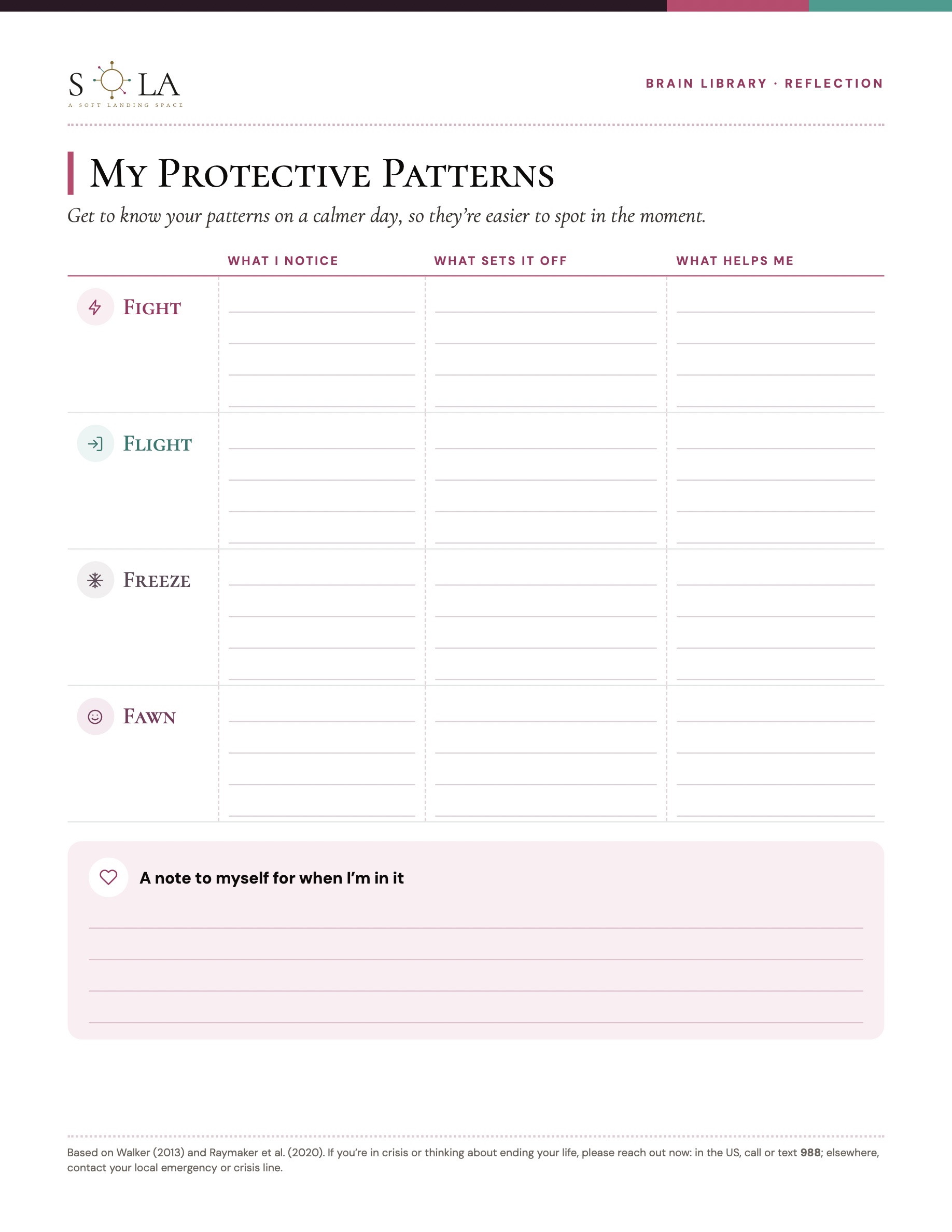
My Protective Patterns
Get to know your patterns on a calmer day, so they’re easier to spot in the moment.
| What I notice | What sets it off | What helps me | |
|---|---|---|---|
| Fight | |||
| Flight | |||
| Freeze | |||
| Fawn |
If you’re in crisis or thinking about ending your life, please reach out now: in the US, call or text 988; elsewhere, contact your local emergency or crisis line.
Sources and credits. “Fawn” was named by therapist Pete Walker (Complex PTSD: From Surviving to Thriving, 2013). Autistic adults in burnout research described more meltdowns, shutdowns and overstimulation (Raymaker et al., 2020, Autism in Adulthood). For education, not diagnosis. Based on Walker (2013) and Raymaker et al. (2020).