Learn
Hormones & the ND Brain
Women's Hormones & ND · Handout
Why focus, mood, sensory load and even medication can shift across the month and across a lifetime. What the research says so far, and what it doesn't yet.
The guide, as designed. The same content is written out below.
See page 2
The estrogen–dopamine link
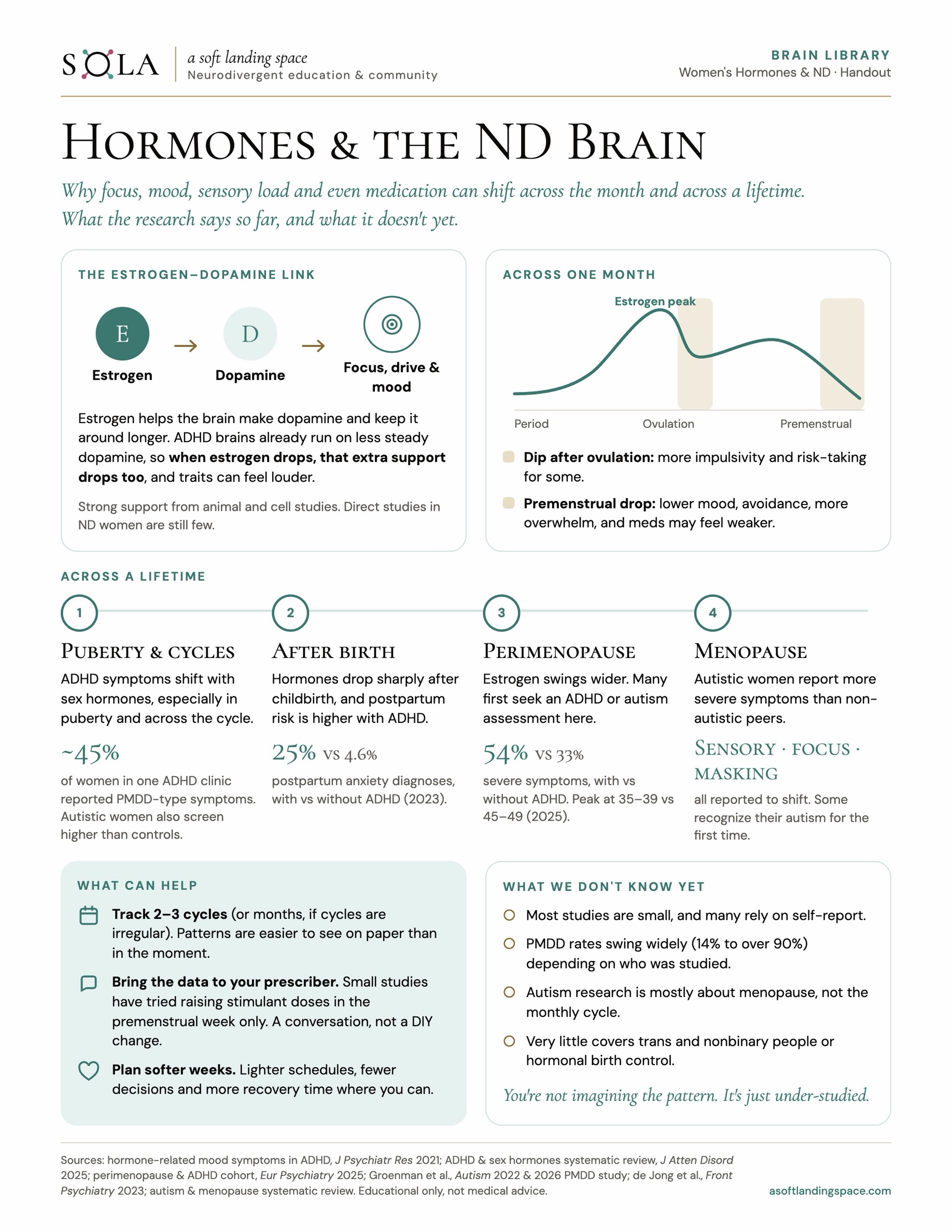
Estrogen → Dopamine → Focus, drive & mood
Estrogen helps the brain make dopamine and keep it around longer. ADHD brains already run on less steady dopamine, so when estrogen drops, that extra support drops too, and traits can feel louder.
Strong support from animal and cell studies. Direct studies in ND women are still few.
Across one month
(A curve across the month: low at Period, rising to the Estrogen peak around Ovulation, a dip after, a smaller rise, then falling into Premenstrual.)
- Dip after ovulation: more impulsivity and risk-taking for some.
- Premenstrual drop: lower mood, avoidance, more overwhelm, and meds may feel weaker.
Across a lifetime
ADHD symptoms shift with sex hormones, especially in puberty and across the cycle.
~45% of women in one ADHD clinic reported PMDD-type symptoms. Autistic women also screen higher than controls.
Hormones drop sharply after childbirth, and postpartum risk is higher with ADHD.
25% vs 4.6% postpartum anxiety diagnoses, with vs without ADHD (2023).
Estrogen swings wider. Many first seek an ADHD or autism assessment here.
54% vs 33% severe symptoms, with vs without ADHD. Peak at 35–39 vs 45–49 (2025).
Autistic women report more severe symptoms than non-autistic peers.
Sensory · focus · masking all reported to shift. Some recognize their autism for the first time.
What can help
- Track 2–3 cycles (or months, if cycles are irregular). Patterns are easier to see on paper than in the moment.
- Bring the data to your prescriber. Small studies have tried raising stimulant doses in the premenstrual week only. A conversation, not a DIY change.
- Plan softer weeks. Lighter schedules, fewer decisions and more recovery time where you can.
What we don't know yet
- Most studies are small, and many rely on self-report.
- PMDD rates swing widely (14% to over 90%) depending on who was studied.
- Autism research is mostly about menopause, not the monthly cycle.
- Very little covers trans and nonbinary people or hormonal birth control.
You're not imagining the pattern. It's just under-studied.
My Hormone & Brain Map
Curiosity, not judgment. You're collecting clues about your own brain, and there's no wrong answer.
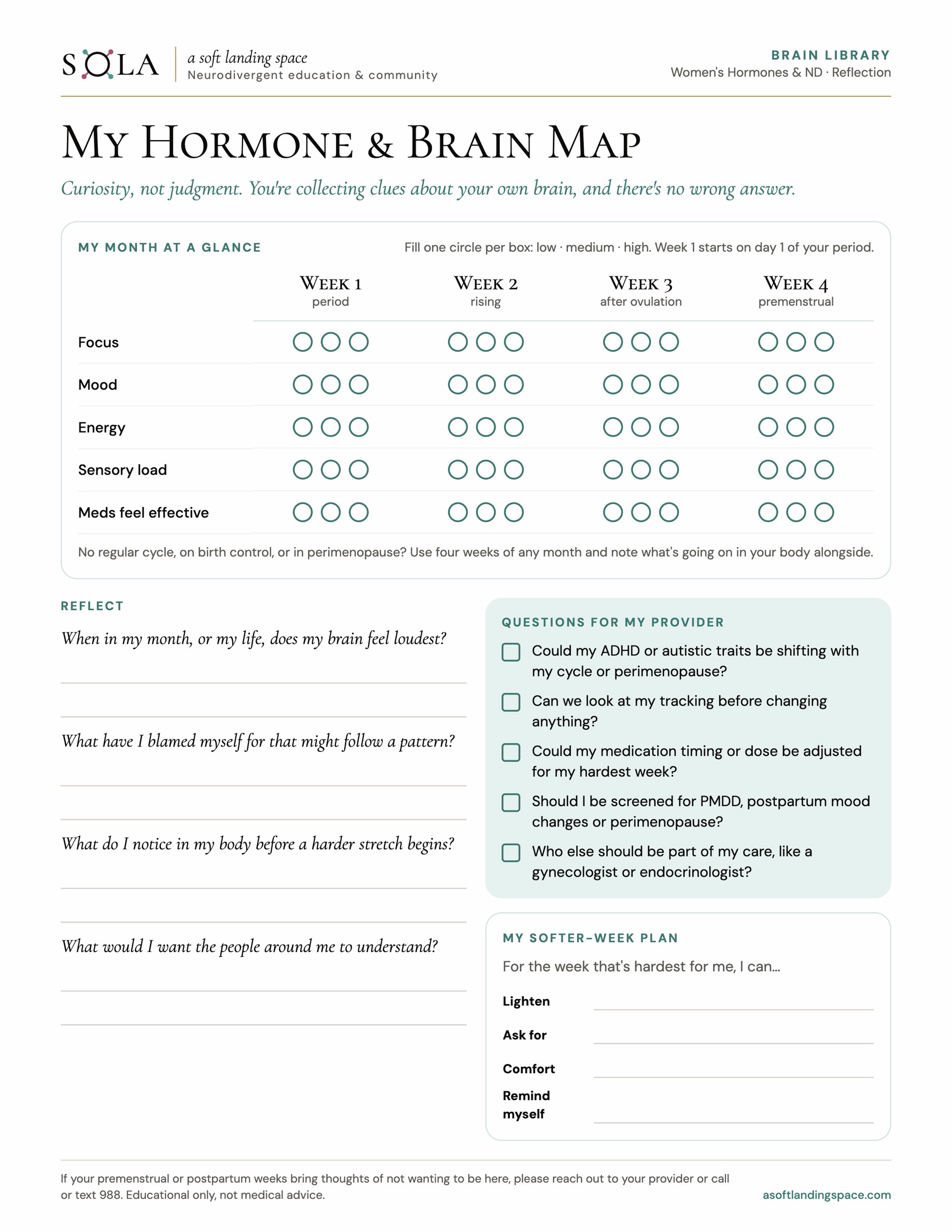
My month at a glance
Fill one circle per box: low · medium · high. Week 1 starts on day 1 of your period.| Week 1 (period) | Week 2 (rising) | Week 3 (after ovulation) | Week 4 (premenstrual) | |
|---|---|---|---|---|
| Focus | ||||
| Mood | ||||
| Energy | ||||
| Sensory load | ||||
| Meds feel effective |
No regular cycle, on birth control, or in perimenopause? Use four weeks of any month and note what's going on in your body alongside.
Reflect
Questions for my provider
Questions for my provider Tick all that apply
- Could my ADHD or autistic traits be shifting with my cycle or perimenopause?
- Can we look at my tracking before changing anything?
- Could my medication timing or dose be adjusted for my hardest week?
- Should I be screened for PMDD, postpartum mood changes or perimenopause?
- Who else should be part of my care, like a gynecologist or endocrinologist?
My softer-week plan
For the week that's hardest for me, I can…
If your premenstrual or postpartum weeks bring thoughts of not wanting to be here, please reach out to your provider or call or text 988. Educational only, not medical advice.
Sources and credits. Sources: hormone-related mood symptoms in ADHD, J Psychiatr Res 2021; ADHD & sex hormones systematic review, J Atten Disord 2025; perimenopause & ADHD cohort, Eur Psychiatry 2025; Groenman et al., Autism 2022 & 2026 PMDD study; de Jong et al., Front Psychiatry 2023; autism & menopause systematic review. Educational only, not medical advice.