Learn
Shame at Work, at Home & in Love
Neurodivergence & Shame · Handout 2
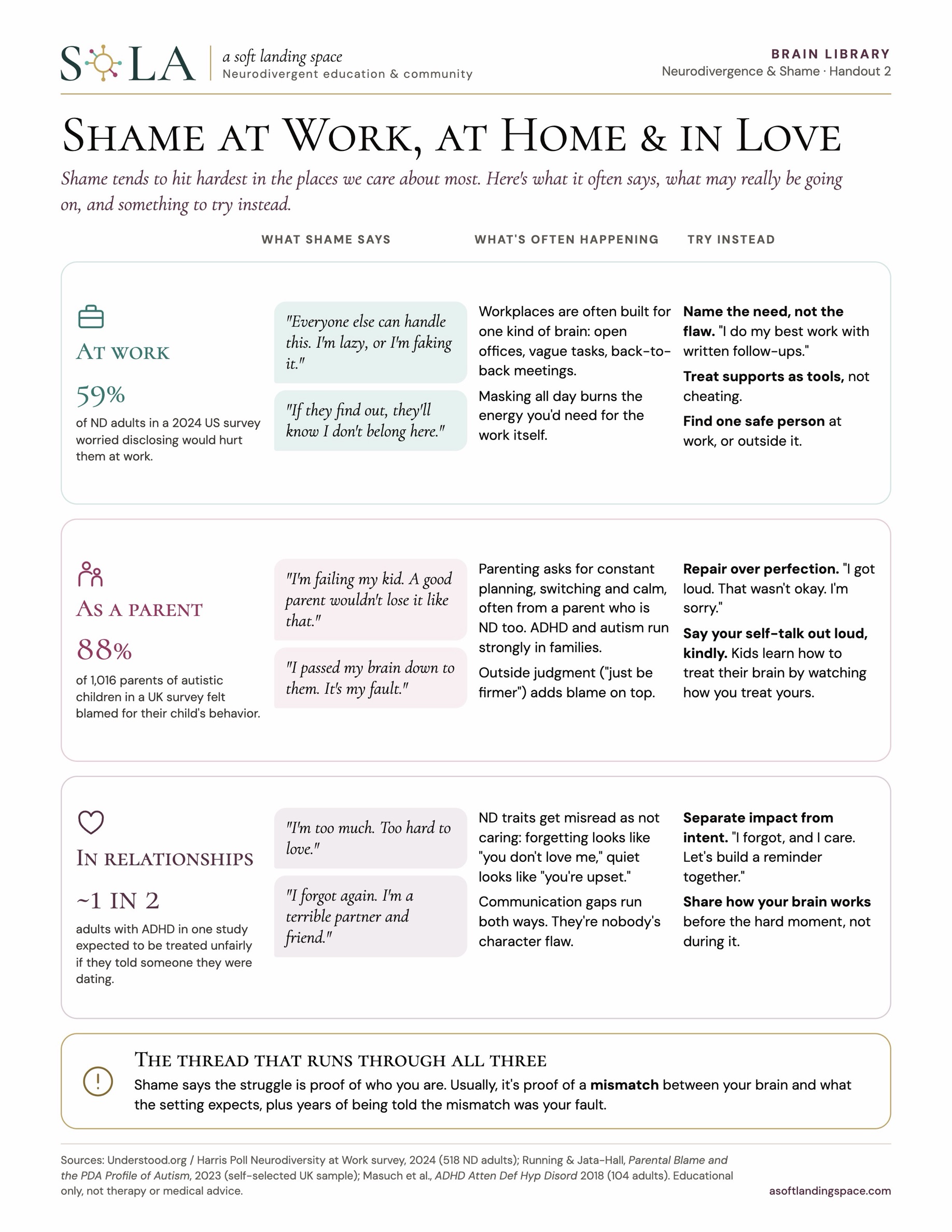
Shame tends to hit hardest in the places we care about most. Here's what it often says, what may really be going on, and something to try instead.
The guide, as designed. The same content is written out below.
See page 2
At work
of ND adults in a 2024 US survey worried disclosing would hurt them at work.
"Everyone else can handle this. I'm lazy, or I'm faking it."
"If they find out, they'll know I don't belong here."
Workplaces are often built for one kind of brain: open offices, vague tasks, back-to-back meetings.
Masking all day burns the energy you'd need for the work itself.
- Name the need, not the flaw. "I do my best work with written follow-ups."
- Treat supports as tools, not cheating.
- Find one safe person at work, or outside it.
As a parent
of 1,016 parents of autistic children in a UK survey felt blamed for their child's behavior.
"I'm failing my kid. A good parent wouldn't lose it like that."
"I passed my brain down to them. It's my fault."
Parenting asks for constant planning, switching and calm, often from a parent who is ND too. ADHD and autism run strongly in families.
Outside judgment ("just be firmer") adds blame on top.
- Repair over perfection. "I got loud. That wasn't okay. I'm sorry."
- Say your self-talk out loud, kindly. Kids learn how to treat their brain by watching how you treat yours.
In relationships
adults with ADHD in one study expected to be treated unfairly if they told someone they were dating.
"I'm too much. Too hard to love."
"I forgot again. I'm a terrible partner and friend."
ND traits get misread as not caring: forgetting looks like "you don't love me," quiet looks like "you're upset."
Communication gaps run both ways. They're nobody's character flaw.
- Separate impact from intent. "I forgot, and I care. Let's build a reminder together."
- Share how your brain works before the hard moment, not during it.
The thread that runs through all three
Shame says the struggle is proof of who you are. Usually, it's proof of a mismatch between your brain and what the setting expects, plus years of being told the mismatch was your fault.
From Shame to Repair
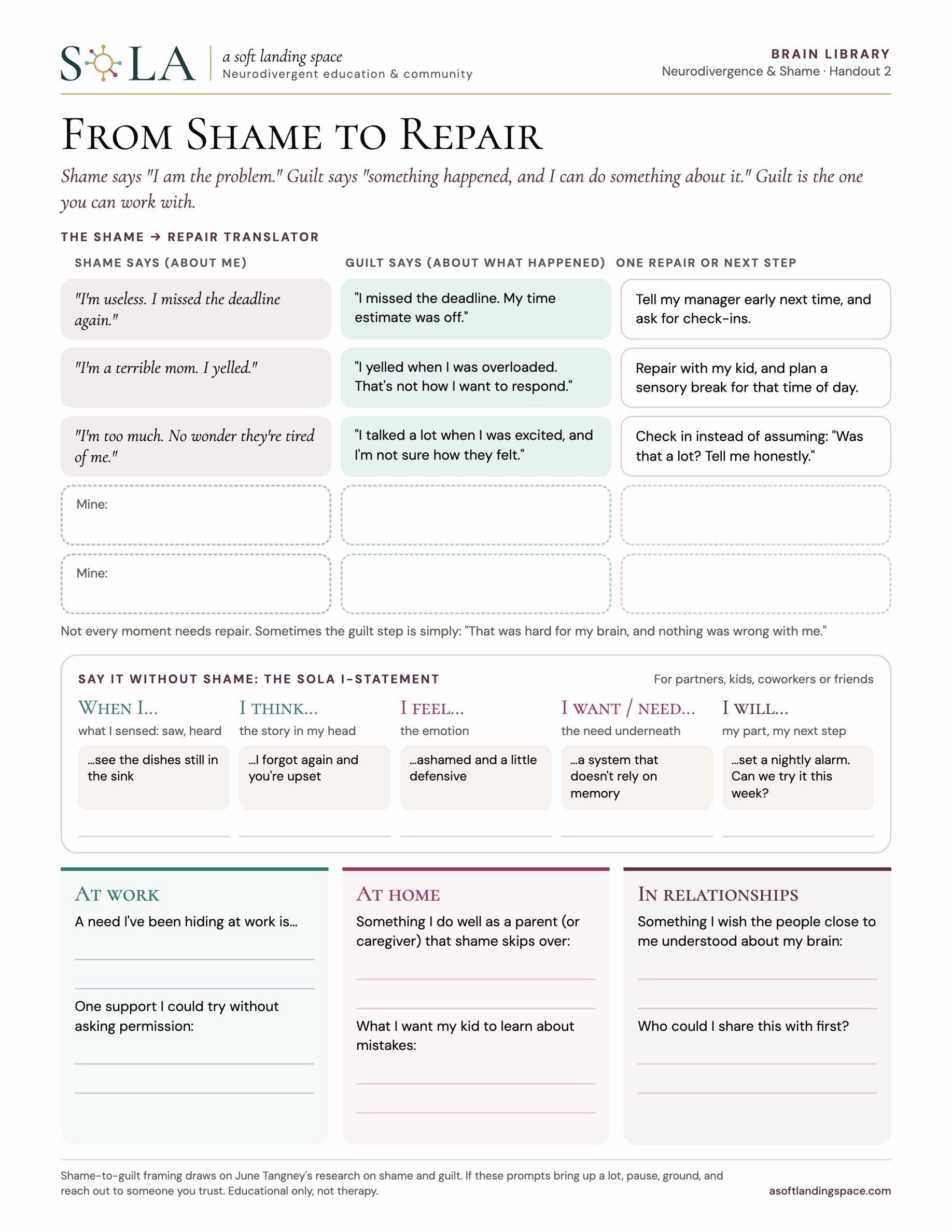
Shame says "I am the problem." Guilt says "something happened, and I can do something about it." Guilt is the one you can work with.
The shame → repair translator
"I'm useless. I missed the deadline again."
Guilt says (about what happened): "I missed the deadline. My time estimate was off."
One repair or next step: Tell my manager early next time, and ask for check-ins.
"I'm a terrible mom. I yelled."
Guilt says (about what happened): "I yelled when I was overloaded. That's not how I want to respond."
One repair or next step: Repair with my kid, and plan a sensory break for that time of day.
"I'm too much. No wonder they're tired of me."
Guilt says (about what happened): "I talked a lot when I was excited, and I'm not sure how they felt."
One repair or next step: Check in instead of assuming: "Was that a lot? Tell me honestly."
Mine:
| Shame says (about me) | Guilt says (about what happened) | One repair or next step |
|---|---|---|
Not every moment needs repair. Sometimes the guilt step is simply: "That was hard for my brain, and nothing was wrong with me."
Say it without shame: the SOLA I-statement
For partners, kids, coworkers or friends
When I… what I sensed: saw, heard. Example: …see the dishes still in the sink
I think… the story in my head. Example: …I forgot again and you're upset
I feel… the emotion. Example: …ashamed and a little defensive
I want / need… the need underneath. Example: …a system that doesn't rely on memory
I will… my part, my next step. Example: …set a nightly alarm. Can we try it this week?
At work
At home
In relationships
If these prompts bring up a lot, pause, ground, and reach out to someone you trust. Educational only, not therapy or medical advice.
Sources and credits. Sources: Understood.org / Harris Poll Neurodiversity at Work survey, 2024 (518 ND adults); Running & Jata-Hall, Parental Blame and the PDA Profile of Autism, 2023 (self-selected UK sample); Masuch et al., ADHD Atten Def Hyp Disord 2018 (104 adults). Shame-to-guilt framing draws on June Tangney's research on shame and guilt.