Closing the knowing-doing gap.
Knowing what to do is not the same as being able to do it. SOLA builds technology that carries what a member learned in the room into the moment they need it, and that asks as little of a tired brain as it can.
See it, in two minutes
SOLA’s guide, live today
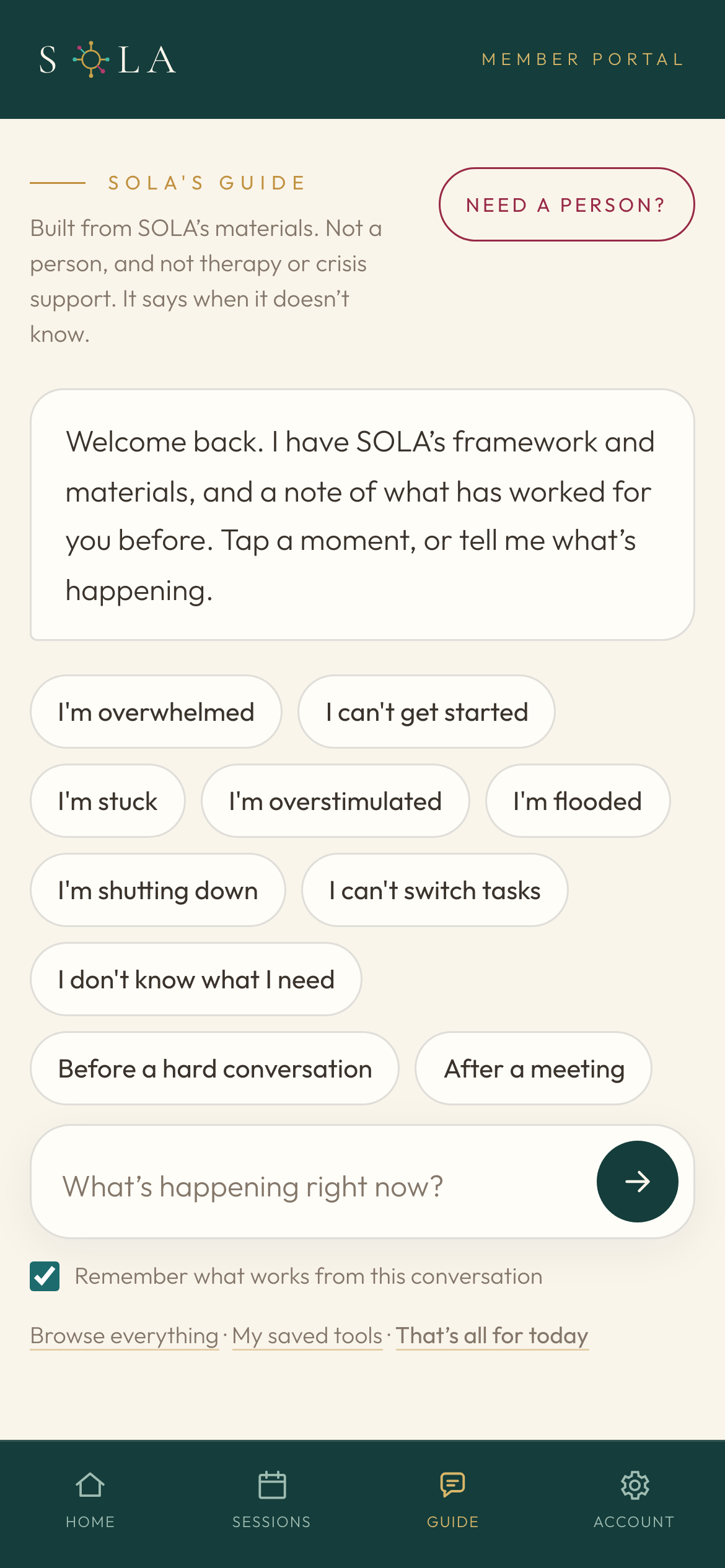
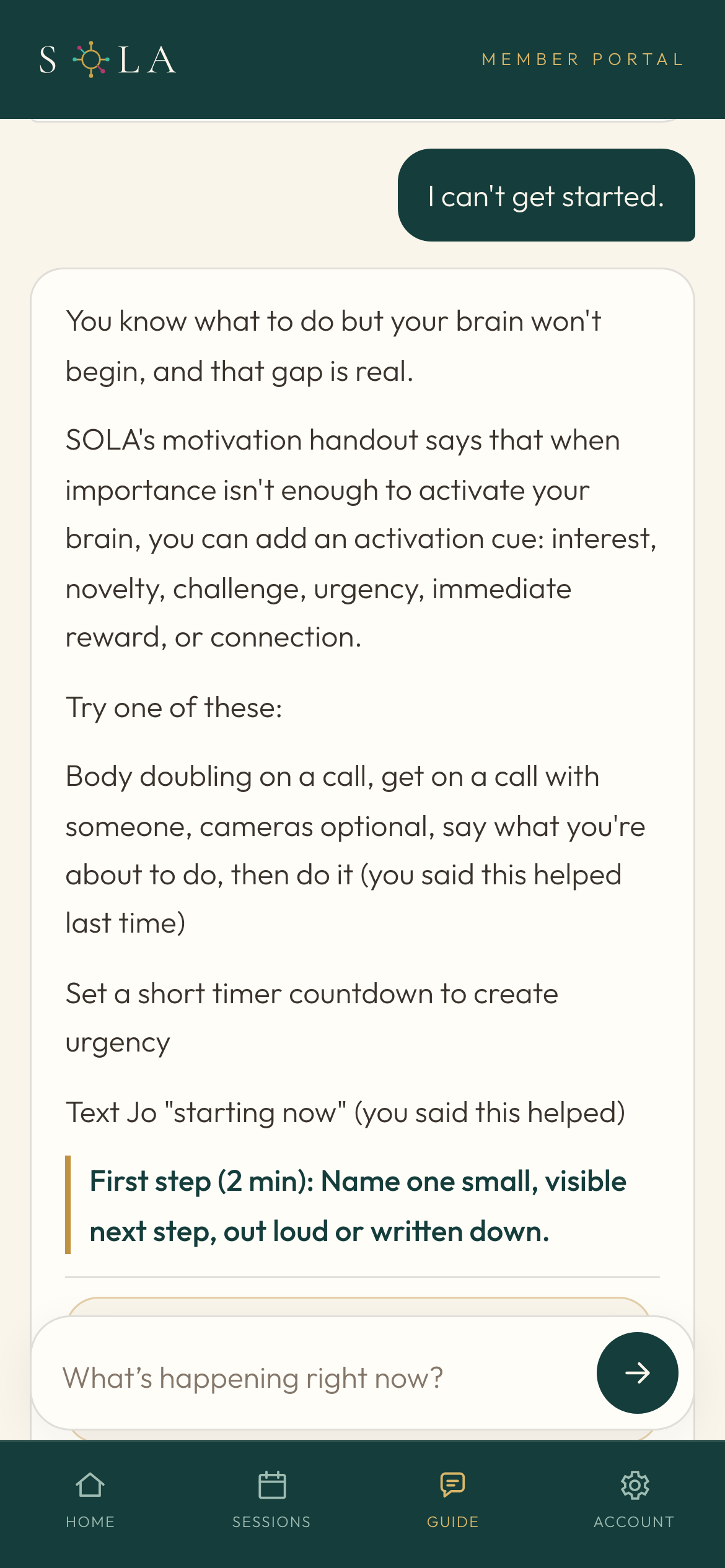
Brains are built differently. We can’t say we do individualized work and then hand everyone the same five strategies. The guide is a conversation built from SOLA’s own materials and what each member has saved. It is not a person, and not therapy or crisis support, and it says so on the first screen.
Name the moment
Tap a moment such as Can’t get started or Overstimulated, or say what’s happening in your own words.
Grounded answer
The guide answers only from the SOLA Framework, the Brain Library, and the member’s own saved tools. It says when it doesn’t know.
One next step
A two-minute first step and the handout behind it, not a list. One suggestion at a time.
Remember what worked
“I did it” shapes what comes back next time. Members can see, edit, pause, or delete everything the guide remembers.
Real screens from the member portal. The guide is built on the SOLA Framework members learn in live sessions every week, and on the crisis protocol published on our Safety page.
There was therapy. There were programs. There wasn’t much in the middle.
Therapy gives you the insight. SOLA integrates it into your life, and the technology is how one room reaches many more people without turning into a content library they use alone. The program runs on three layers. The first two are human. The third is what makes them reachable at 11 PM on a Tuesday.
Learning
Education that fits the brain.Practical, neurodivergent-affirming teaching that helps people understand their patterns and needs.
→ TwoCommunity
People who understand the experience.Guided practice, shared language, connection, and support.
→ ThreeTechnology
A scalable layer, live today.A member portal, a Brain Library members can fill in and keep, and a guide that brings the right piece of it back in the moment it’s needed.
→Live today
- Live virtual programmingThree sessions a week, every week since August 31, 2026
- Member portalHome, sessions, reminders by text, and account in one place. No password to remember: a link or a six-digit code by email
- Brain Library100+ worksheets, workbooks, and guides written by Leah, each a designed PDF and a live page members fill in and keep
- SOLA’s guideAnswers only from SOLA’s materials and what a member has saved; crisis language goes to a person
- Outcome surveysRunning in the pilot from the first week
Next
- Program evaluationConsent-gated, de-identified measures, ready for a study
- Research partnershipTo evaluate the practices, not just the response
- A second facilitatorSo the model scales without one person in every room
- Institutional pilotsAny practice with one facilitator and a phone could run it the same way
What the guide will not do
It does not discuss medication, diagnosis, or treatment, and it does not write care plans. Every message is screened before the AI reads it. If the screen finds danger, the guide stops and shows a fixed message with 988 and 911, and a “Need a person?” button is always on screen. Flagged exchanges reach a person so someone can follow up. That is the only time a person sees guide messages.
What it runs on
The whole thing is deliberately lean so that funding goes to people, not infrastructure. The site and portal are mobile-first HTML, CSS, and JavaScript. Supabase holds accounts, schedules, and member records with row-level security, so each member sees only their own data. The guide runs on Anthropic’s Claude models with SOLA’s library as its only source. By policy we store no health data.
The care stays human. AI is the infrastructure that carries it. Nothing a member saves is rewritten, ranked, or sold.
The pilot. SOLA launched on August 31, 2026. Eighteen adults are piloting the program, two months of weekly curriculum complete and the third underway, and no one has left. The platform was built by two people and runs on a lean, neuro-first stack, with weekly releases driven by what members and the facilitator ask for. SOLA is fiscally sponsored by the Fiscal Sponsorship Alliance, so grants and institutions can fund it today.
We’re looking for
Research collaborators
The pilot already runs outcome surveys, and the portal produces consent-gated, de-identified data. We want a partner to evaluate the practices.
Pilot partners
Clinics, practices, and programs that want to run SOLA with their own people, on the infrastructure that already exists.
Funding partners
Funding for access, not product development. Every dollar goes to giving the program free to the people who need it most.